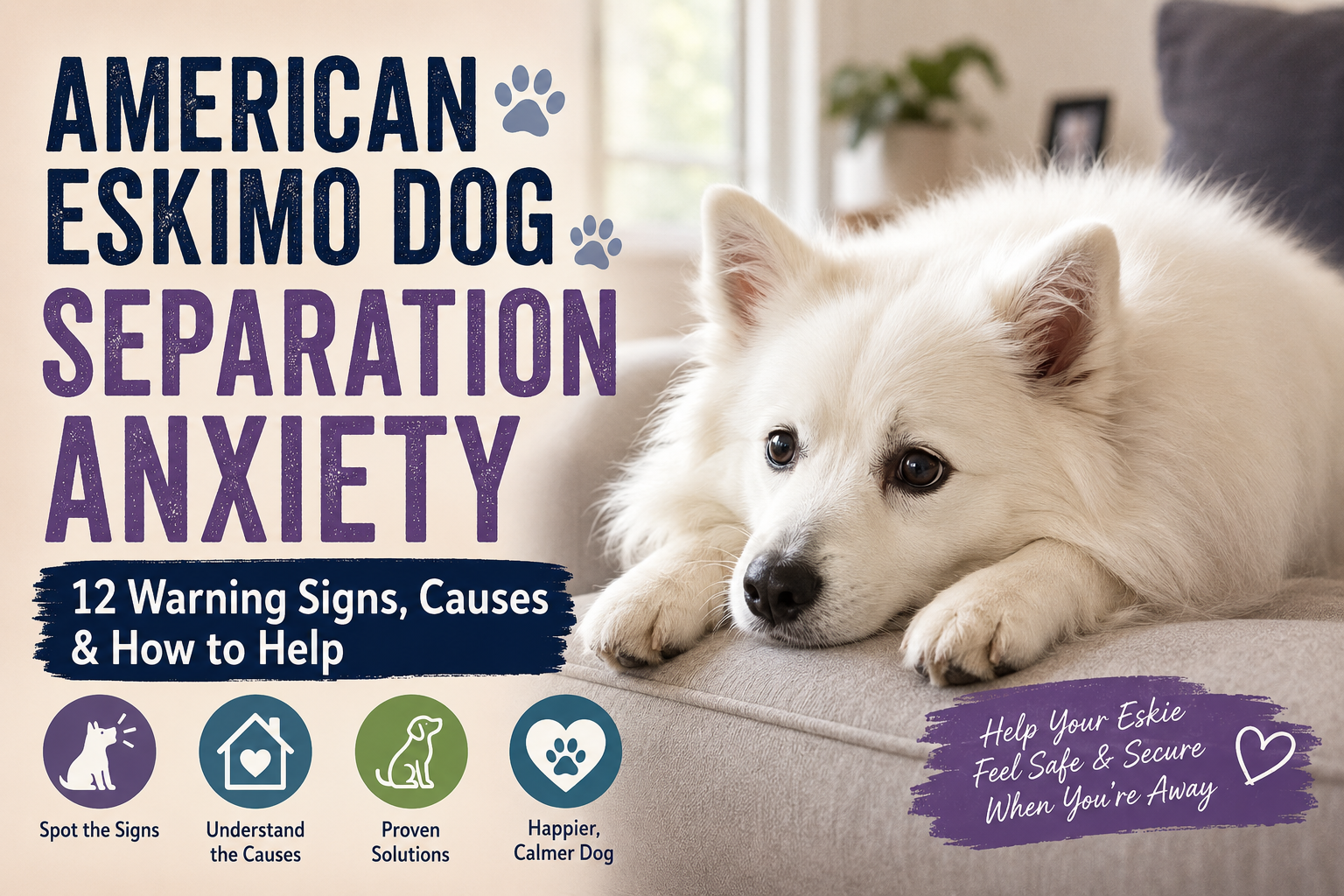
12 Warning Signs, Causes & How to Help
American Eskimo Dogs are affectionate, intelligent companions that thrive on human interaction.
Because they form such strong bonds with their families, they can be particularly prone to separation anxiety.
Common warning signs include destructive behaviour, excessive barking, pacing, house soiling, drooling, and attempts to escape when left alone.
With patience, consistent training, and the right routine, most dogs can learn to feel calmer and more confident when home alone.
| 🐶 Topic | ✔ Details |
|---|---|
| Breed | American Eskimo Dog |
| Common Issue | Separation Anxiety |
| Typical Symptoms | Barking, chewing, pacing, drooling, accidents indoors |
| Severity | Mild to Severe |
| Can it be treated? | ✅ Yes, in most cases |
| Best Treatment | Behaviour training, routine, enrichment, gradual desensitisation |
🐾 Does Your American Eskimo Dog Hate Being Left Alone?
American Eskimo Dogs are famous for their bright personalities, fluffy white coats, and unwavering devotion to their families.
They’re intelligent, affectionate, and love being involved in everyday life. While these qualities make them wonderful companions, they also mean many American Eskimo Dogs struggle when left home alone for long periods.
Unlike more independent breeds, Eskies often become deeply attached to their owners. They don’t simply enjoy your company—they genuinely thrive on it.
When that companionship suddenly disappears, some dogs experience genuine emotional distress rather than simple boredom.
This condition, known as separation anxiety, affects thousands of dogs every year and is one of the most common behavioural challenges faced by owners.
The good news is that separation anxiety isn’t a sign of stubbornness or bad behaviour. It’s an emotional response that can usually be improved with understanding, patience, and the right training approach.
In this guide, you’ll discover the warning signs to look out for, why American Eskimo Dogs are particularly susceptible, and the practical steps you can take to help your dog feel happier and more secure when you’re away.
❤️ Why American Eskimo Dogs Are More Prone to Separation Anxiety
Originally bred as companion and performing dogs, American Eskimo Dogs have spent generations working closely alongside people.
They crave interaction, mental stimulation, and affection, making them one of the most people-focused breeds around.
Because of this close bond, many Eskies find being left alone confusing or even frightening—especially if they haven’t gradually learned that their owners always return.
Several characteristics increase the likelihood of separation anxiety developing:
✔ Extremely loyal nature
✔ Highly intelligent and emotionally aware
✔ Strong attachment to family members
✔ Thrive on daily routines
✔ Sensitive to changes in the household
✔ Can become bored quickly without mental stimulation
A lack of exercise, inconsistent routines, or sudden lifestyle changes—such as returning to work after spending weeks at home—can all make anxiety significantly worse.
💡 Quick Tip: A tired American Eskimo Dog is usually a calmer American Eskimo Dog. Daily walks, puzzle toys, scent games, and short training sessions can dramatically reduce anxiety levels.
📘 Want to understand every aspect of owning this wonderful breed?
The American Eskimo Dog Blueprint is packed with expert advice on behaviour, training, grooming, health, nutrition, exercise, and much more—helping you raise a happy, confident companion from puppyhood through to their senior years.

🚨 12 Warning Signs Your American Eskimo Dog Has Separation Anxiety
Not every dog reacts to being left alone in the same way. Some become noisy, others become destructive, while some simply shut down emotionally. Learning to recognise these warning signs early can prevent the problem from becoming more severe.
1. 🦴 Destructive Chewing
One of the earliest and most obvious signs of separation anxiety is destructive chewing.
Your American Eskimo Dog isn’t being naughty—they’re trying to relieve stress.
Common targets include:
✔ Door frames
✔ Window sills
✔ Shoes
✔ Furniture
✔ Remote controls
✔ Cushions
✔ Children’s toys
Dogs experiencing anxiety often focus on areas where their owner usually exits the home, such as front doors or windows.
💡 Expert Tip: If the destruction only happens while you’re away, anxiety is a far more likely cause than simple boredom.
2. 🗣️ Excessive Barking or Howling
American Eskimo Dogs naturally enjoy using their voice, but separation anxiety takes vocalisation to another level.
Your neighbours may hear:
- Continuous barking
- Long periods of howling
- High-pitched whining
- Distressed yelping
This behaviour often begins within minutes of you leaving the house and can continue for hours.
Unfortunately, many owners never realise this is happening until a neighbour mentions it or they install a pet camera.
3. 🚪 Constant Pacing
An anxious Eskie rarely settles.
Instead, they may repeatedly walk:
➡ Front door
➡ Window
➡ Hallway
➡ Living room
…over and over again.
This repetitive pacing is a classic sign that your dog is struggling emotionally rather than simply waiting for you to return.
4. 🚽 Accidents Indoors
Has your house-trained American Eskimo Dog suddenly started having accidents while you’re away?
This can be another strong indicator of separation anxiety.
Many owners wrongly assume their dog is becoming disobedient.
In reality, extreme stress can cause dogs to lose bladder or bowel control.
If accidents only occur during your absence—and your dog is otherwise fully house-trained—it’s worth investigating anxiety as a possible cause.
⚠ Don’t punish your dog. Punishment only increases fear and can make separation anxiety much worse.
5. 🤤 Excessive Drooling
Some anxious dogs drool far more than usual.
You might notice:
✔ Wet bedding
✔ Damp floors
✔ Saliva around food bowls
✔ Wet fur around the mouth
Heavy drooling often accompanies elevated stress levels and may occur alongside panting or trembling.
6. 😮💨 Heavy Panting
Panting isn’t always caused by hot weather.
Dogs suffering from anxiety frequently pant despite being in a cool, comfortable room.
If your American Eskimo Dog pants excessively only when you’re preparing to leave or after you’ve gone, this is another clue that emotional distress may be the underlying cause.
❤️ Why This Happens
Separation anxiety activates your dog’s natural stress response.
When they believe they’ve been abandoned, their body releases stress hormones such as cortisol and adrenaline.
These chemicals prepare the body for “fight or flight,” leading to symptoms like:
✔ Panting
✔ Drooling
✔ Restlessness
✔ Pacing
✔ Vocalisation
✔ Increased heart rate
This isn’t a behavioural choice—it’s an emotional reaction.
📘 Enjoying this guide?
If you’re passionate about giving your Eskie the very best life, The American Eskimo Dog Blueprint goes far beyond this article, covering training, puppy development, nutrition, grooming, health, behaviour, enrichment, and much more in one easy-to-follow guide.
7. 🚪 Escape Attempts
Some dogs become so distressed that they’ll attempt to escape the house.
This can include:
- Scratching doors
- Digging under fences
- Jumping gates
- Clawing windows
- Damaging crates
Sadly, many dogs injure themselves during these attempts.
Broken nails, damaged teeth, bleeding paws and even fractures can occur in severe cases.
If your American Eskimo Dog repeatedly tries to escape while you’re away, it’s important to seek help before they hurt themselves.
8. 👤 Following You Everywhere
Does your dog follow you from room to room?
Bathroom?
Kitchen?
Bedroom?
Even if you’re only gone for a few seconds?
This “Velcro Dog” behaviour is adorable to many owners—but it can also be one of the earliest warning signs of developing separation anxiety.
A dog that never feels comfortable being apart from you indoors is much more likely to struggle when left alone outside the home.
❤️ Owner Tip: Encourage small periods of independence while you’re still at home by rewarding your dog for relaxing on their own bed rather than constantly following you.
9. 🍽️ Refusing Food When Alone
Many anxious dogs simply won’t eat.
You may notice untouched food bowls or favourite treats left behind after you’ve returned home.
Because anxiety suppresses appetite, your dog may only begin eating once they know you’re safely back.
10. 😔 Withdrawal After You Return
Not every anxious dog greets you with excitement.
Some appear:
- Quiet
- Exhausted
- Depressed
- Emotionally drained
This often surprises owners, but it can simply be the result of several hours spent in a heightened state of stress.
11. 💤 Constant Exhaustion
After hours of barking, pacing and worrying, many dogs sleep heavily once you’re home.
While this may look like calm behaviour, it’s often the result of emotional exhaustion rather than relaxation.
12. 📉 Gradually Worsening Behaviour
Perhaps the biggest warning sign is progression.
Without support, separation anxiety rarely disappears on its own.
Instead, owners often notice behaviour becoming increasingly severe over weeks or months.
What begins as occasional barking may develop into:
✔ Furniture destruction
✔ Escape attempts
✔ Constant howling
✔ Self-injury
✔ House soiling
✔ Severe emotional distress
The earlier you recognise these signs, the easier it usually is to help your dog regain confidence.
📌 Key Takeaways
Before moving on, ask yourself these questions:
✅ Does my American Eskimo Dog only become destructive when left alone?
✅ Do they bark or howl for long periods?
✅ Do they pace or wait by doors and windows?
✅ Have they started having accidents despite being house-trained?
✅ Do they panic when I prepare to leave?
If you answered yes to several of these questions, your dog may be showing signs of separation anxiety rather than simple boredom. The encouraging news is that, with the right approach, most dogs can make significant progress.
🧩 What Causes Separation Anxiety in American Eskimo Dogs?
Although separation anxiety often appears suddenly, it usually develops over time. In many cases, it’s the result of several factors combining rather than one single event.
American Eskimo Dogs are intelligent, affectionate, and extremely people-oriented. They love routine and companionship, so even small changes can leave them feeling insecure.
Understanding the underlying causes is the first step towards helping your dog feel safe and confident when home alone.
🏡 1. Changes to Your Daily Routine
Dogs thrive on consistency.
If your daily routine suddenly changes, your American Eskimo Dog may struggle to adapt.
Common examples include:
✔ Returning to work after working from home
✔ Children going back to school
✔ A new work schedule
✔ Retirement
✔ Shift work
✔ A family member moving out
Imagine spending every day with your favourite person for months, only for them to disappear for eight hours a day without warning. That’s how many dogs experience sudden routine changes.
💡 Quick Tip: Introduce changes gradually whenever possible. Start with short absences and slowly increase the time your dog spends alone.
📦 2. Moving House
Moving is exciting for people—but confusing for dogs.
Everything changes at once:
- New smells
- New sounds
- Different neighbours
- Different walking routes
- Different sleeping areas
Even confident dogs may become unsettled during the first few weeks.
American Eskimo Dogs often rely on familiar surroundings to feel secure, so moving home can temporarily increase anxiety levels.
👶 3. Major Family Changes
Dogs notice far more than many owners realise.
Events that may trigger anxiety include:
❤️ A new baby
❤️ Marriage
❤️ Divorce
❤️ A family bereavement
❤️ An elderly relative moving in
❤️ A child leaving for university
Your dog doesn’t understand why their family dynamic has changed—they simply know that life feels different.
🚑 4. Previous Negative Experiences
Some dogs develop separation anxiety after a frightening event.
Possible triggers include:
✔ Long stays in boarding kennels
✔ Time spent in rescue centres
✔ Being abandoned
✔ Medical treatment requiring hospitalisation
✔ Spending prolonged periods alone
Even one distressing experience can make some dogs worry that every departure means you’ll never return.
🧠 5. Lack of Mental Stimulation
American Eskimo Dogs are among the smartest companion breeds.
Without enough mental exercise, they quickly become frustrated.
A bored, intelligent dog has plenty of energy—but nowhere to direct it.
Mental stimulation should include:
🧩 Puzzle feeders
👃 Scent games
🎾 Interactive toys
🎓 Short training sessions
🔍 Hide-and-seek games
Many owners accidentally focus only on physical exercise, forgetting that a clever breed like the Eskie also needs to work its brain.
🚶 6. Insufficient Exercise
Exercise alone won’t cure separation anxiety.
However…
A dog that’s full of unused energy often finds it much harder to relax.
Daily walks should be combined with:
✔ Training
✔ Play
✔ Mental enrichment
✔ Calm relaxation afterwards
The goal isn’t simply to tire your dog out—it’s to help them feel mentally satisfied.
🤔 Is It Separation Anxiety… or Just Boredom?
This is one of the biggest questions owners ask.
Fortunately, there are several important differences.
| 🐾 Boredom | ❤️ Separation Anxiety |
|---|---|
| Chews occasionally | Destroys doors or furniture regularly |
| Stops when given toys | Continues despite enrichment |
| Settles after a while | Remains distressed for long periods |
| Eats treats normally | Often refuses food |
| Sleeps during the day | Paces, pants and vocalises |
| Usually relaxed | Highly emotional and panicked |
If your American Eskimo Dog becomes distressed every time you leave—regardless of how many toys you provide—separation anxiety is much more likely than simple boredom.
⚠ Common Mistake
Many owners assume their dog is “being naughty.”
In reality…
Your dog isn’t trying to get revenge.
They’re experiencing genuine panic.
Punishing anxious behaviour is a little like punishing someone for having a panic attack—it doesn’t solve the problem and usually makes it worse.
🎥 Use a Pet Camera to Discover the Truth
One of the easiest ways to understand your dog’s behaviour is to install a simple pet camera.
Many affordable models allow you to see exactly what happens after you leave.
You might discover that your dog:
✔ Settles down after five minutes (great news!)
✔ Barks continuously
✔ Paces the house
✔ Watches the door
✔ Howls
✔ Sleeps peacefully
Knowing what actually happens while you’re away makes it much easier to choose the right training approach.
📘 Looking for complete training guidance?
The American Eskimo Dog Blueprint includes practical behaviour plans, confidence-building exercises, puppy training advice, enrichment ideas, grooming routines, nutrition guidance and much more—giving you everything you need to raise a happy, well-balanced companion.
❤️ Can Separation Anxiety Be Cured?
The encouraging answer is…
In many cases, yes—or at least significantly improved.
Most American Eskimo Dogs respond very well when owners:
✅ Stay patient
✅ Build independence gradually
✅ Follow a consistent routine
✅ Avoid punishment
✅ Reward calm behaviour
✅ Meet their physical and mental needs
Progress rarely happens overnight, but many owners begin noticing positive changes within a few weeks of consistent training.
📌 Key Takeaways
Remember these important points:
✔ Separation anxiety has many possible causes.
✔ Routine changes are one of the biggest triggers.
✔ American Eskimo Dogs naturally crave companionship.
✔ Mental stimulation is just as important as physical exercise.
✔ Anxiety is an emotional response—not bad behaviour.
✔ Early intervention usually leads to the best outcome.
🩺 How to Diagnose Separation Anxiety in Your American Eskimo Dog
Because separation anxiety shares symptoms with boredom, medical conditions, and other behavioural issues, it’s important not to jump to conclusions.
A proper diagnosis will help ensure your dog receives the most appropriate support.
👀 Step 1: Observe Your Dog’s Behaviour
Start by paying close attention to what happens before, during, and after you leave the house.
Ask yourself:
✔ Does my dog become anxious when I pick up my keys?
✔ Do they follow me from room to room?
✔ Do they begin whining before I leave?
✔ Are they calm once I return?
✔ Does destructive behaviour only happen when I’m away?
Patterns are often more revealing than isolated incidents.
📹 Step 2: Record What Happens While You’re Away
A pet camera can provide valuable insights.
Many owners are surprised to discover their dog behaves very differently once the front door closes.
Watch for signs such as:
🐾 Continuous pacing
🐾 Barking or howling
🐾 Panting
🐾 Scratching at doors
🐾 Ignoring toys
🐾 Inability to settle
Even a 30-minute recording can reveal whether your dog is anxious or simply waiting quietly.
🩺 Step 3: Visit Your Veterinarian
Some physical illnesses can mimic the symptoms of separation anxiety.
Your vet may wish to rule out conditions such as:
- Urinary tract infections
- Digestive disorders
- Hormonal imbalances
- Pain-related conditions
- Cognitive decline in older dogs
Only once medical issues have been excluded should behavioural treatment begin.
❤️ Owner Tip: Always mention exactly when the behaviours occur. Telling your vet that the problem only happens when you’re away is extremely useful information.
🏠 Proven Ways to Help Your American Eskimo Dog
The good news?
Most dogs improve dramatically when owners combine patience with consistent training.
🎓 1. Teach Independence Gradually
One of the biggest mistakes owners make is expecting their dog to suddenly cope with being left alone for several hours.
Instead…
Build confidence in small steps.
For example:
✅ Leave the room for 30 seconds.
✅ Return before your dog becomes anxious.
✅ Reward calm behaviour.
✅ Repeat several times.
Slowly increase the time over days and weeks.
Your goal is to teach your dog:
“My owner always comes back.”
🚶 2. Exercise Before You Leave
A relaxed dog is far more likely to settle.
Before leaving home, try to include:
🐾 A brisk walk
🎾 A game of fetch
🧩 A puzzle toy
👃 A scent game
🎓 Five minutes of training
Mental enrichment is often just as tiring as physical exercise for an intelligent breed like the American Eskimo Dog.
🧸 3. Leave Interesting Activities
Instead of focusing on your departure…
Give your dog something exciting to do.
Excellent enrichment ideas include:
✔ Stuffed KONG toys
✔ Lick mats
✔ Puzzle feeders
✔ Safe chew toys
✔ Frozen treats
These activities encourage calm, independent behaviour and create positive associations with your absence.
🎵 4. Create a Calm Environment
Some simple environmental changes can make a surprising difference.
Many owners find success with:
🎶 Soft classical music
📺 Television left on quietly
🌿 Dog-safe calming pheromone diffusers
🛏 A favourite blanket
🧸 Familiar toys
Keeping the environment predictable helps many anxious dogs relax.
💡 Pro Tip: Avoid making a big fuss when leaving or returning home. Calm departures and relaxed greetings help teach your dog that your comings and goings are completely normal.
❌ Common Mistakes That Make Separation Anxiety Worse
Even the most loving owners sometimes accidentally reinforce anxious behaviour.
Try to avoid:
❌ Punishing destruction
❌ Shouting after accidents
❌ Leaving suddenly for long periods
❌ Making emotional goodbyes
❌ Overly excited greetings
❌ Inconsistent daily routines
Remember…
Your dog isn’t choosing to feel anxious.
They’re experiencing genuine emotional distress.
📘 Need more step-by-step training advice?
The American Eskimo Dog Blueprint includes easy-to-follow training plans, puppy guidance, behaviour troubleshooting, enrichment ideas, grooming advice, health information, and much more to help you raise a calm, confident companion.
💊 Can Medication Help?
Sometimes…
Yes.
For moderate or severe cases, your veterinarian may recommend medication alongside behavioural training.
Medication isn’t a shortcut.
Instead, it can reduce anxiety enough for your dog to learn new coping skills.
Your vet may also suggest natural calming supplements where appropriate.
Never give medication or supplements without professional advice.
👨🏫 When Should You Call a Behaviourist?
Professional help is recommended if your dog:
🚩 Injures themselves trying to escape
🚩 Destroys doors or windows
🚩 Barks for hours
🚩 Refuses food regularly
🚩 Shows no improvement after several weeks
A qualified dog behaviourist can develop a personalised treatment plan based on your dog’s specific triggers.
📌 Key Takeaways
Helping your American Eskimo Dog isn’t about finding one magical solution.
Success usually comes from combining several small improvements:
✔ Consistent routines
✔ Daily exercise
✔ Mental stimulation
✔ Gradual independence training
✔ Veterinary support when needed
With patience and consistency, most dogs become far more relaxed and confident over time.
🐶 How to Prevent Separation Anxiety in American Eskimo Puppies
While separation anxiety can develop at any age, prevention is always easier than treatment. Helping your American Eskimo puppy build confidence from the very beginning gives them the best chance of becoming a relaxed, independent adult dog.
🐾 Start Independence Training Early
One of the kindest things you can teach your puppy is that being alone for short periods is perfectly safe.
Rather than spending every minute together, gradually introduce brief periods of independence from an early age.
Start with:
✔ Leaving the room for a minute or two
✔ Encouraging your puppy to settle on their own bed
✔ Allowing them to enjoy toys without constant interaction
✔ Rewarding calm, relaxed behaviour
These small exercises help your puppy understand that your absence is temporary and nothing to worry about.
🌍 Socialise Your Puppy Properly
A well-socialised American Eskimo Dog is generally more confident and adaptable.
Expose your puppy to:
- New people
- Friendly dogs
- Different environments
- Everyday household noises
- Car journeys
- Grooming routines
- Veterinary visits
Positive experiences build resilience and reduce the likelihood of fear-related behaviours developing later in life.
🧩 Keep Their Mind Busy
American Eskimo Dogs are exceptionally intelligent.
Without enough mental stimulation, they can quickly become frustrated and anxious.
Daily enrichment ideas include:
🧩 Puzzle feeders
👃 Scent work
🎾 Interactive toys
🎓 Short obedience sessions
🏡 Hide-and-seek games around the house
Five or ten minutes of brain work can often tire an Eskie as much as a long walk.
❤️ Build Positive Associations with Alone Time
Instead of making your departure something to fear, teach your dog that good things happen when you’re away.
For example:
✔ Offer a stuffed food toy only when you leave.
✔ Leave a favourite chew waiting.
✔ Play calming background music.
✔ Keep departures calm and predictable.
Eventually, your dog may begin looking forward to these quiet moments rather than dreading them.
💡 Pro Tip: Save your dog’s favourite enrichment toy exclusively for alone time. This makes it far more valuable and helps create a positive emotional association with your departure.

⚠️ Common Mistakes Owners Should Avoid
Even with the best intentions, some habits can unintentionally reinforce separation anxiety.
Try not to:
❌ Make dramatic goodbyes.
❌ Rush back inside every time your dog whines.
❌ Punish anxious behaviour.
❌ Leave your dog without sufficient exercise.
❌ Ignore changes in behaviour.
❌ Expect overnight improvement.
Remember, confidence is built gradually.
❤️ Living Happily with an American Eskimo Dog
American Eskimo Dogs are among the most affectionate and loyal companions you could wish for.
Their love of people is one of their greatest strengths—but it can also make them more vulnerable to separation anxiety if they’re never taught that being alone is safe.
With patience, consistency, and understanding, most dogs make excellent progress.
The key is to focus on building confidence rather than correcting behaviour.
Celebrate the small wins.
Every calm minute spent alone is another step towards a happier, more relaxed dog.
❓ Frequently Asked Questions
Can American Eskimo Dogs be left alone?
Yes, but most American Eskimo Dogs prefer company and shouldn’t be left alone for long periods on a regular basis. Gradual independence training from puppyhood helps them cope much better with time apart.
Are American Eskimo Dogs prone to separation anxiety?
Yes. Their affectionate, people-oriented personality means they are more susceptible to separation anxiety than many more independent breeds.
How long can an American Eskimo Dog safely stay home alone?
Healthy adult dogs can often manage several hours with proper exercise, enrichment, and training. Puppies, senior dogs, and dogs with anxiety usually need more frequent companionship and breaks.
Will getting another dog solve separation anxiety?
Not necessarily.
While another dog may provide companionship, separation anxiety is usually linked to the bond with the owner rather than loneliness alone. The underlying anxiety still needs to be addressed through training and routine.
Should I crate my American Eskimo Dog if they have separation anxiety?
Some dogs feel secure in a crate, while others become even more distressed.
If your dog already panics in a crate, forcing them to stay inside can make the problem worse. Introduce crate training gradually and always use positive reinforcement.
Can separation anxiety be cured?
Many dogs improve significantly with consistent behaviour training, mental enrichment, and patience.
Severe cases may require support from a veterinarian or qualified behaviourist, but long-term improvement is achievable for most dogs.
📌 Final Thoughts
Separation anxiety can be upsetting for both you and your American Eskimo Dog, but it’s important to remember that your dog isn’t being stubborn or disobedient.
They’re reacting to genuine emotional distress.
By recognising the warning signs early, maintaining a consistent routine, providing plenty of physical and mental stimulation, and using positive training methods, you can help your dog develop the confidence they need to feel safe when home alone.
Progress may be gradual, but every small improvement is a step towards a happier, healthier companion.
📘 Want to Become the Best American Eskimo Dog Owner You Can Be?
If you found this guide helpful, you’ll love The American Eskimo Dog Blueprint.
Inside, you’ll discover:
✅ Step-by-step training advice
✅ Puppy care essentials
✅ Grooming and coat maintenance
✅ Health and nutrition guidance
✅ Exercise and enrichment ideas
✅ Behaviour troubleshooting
✅ Senior dog care tips
…and much more.
Whether you’re welcoming your first American Eskimo Dog or have shared your life with the breed for years, The American Eskimo Dog Blueprint is packed with practical, easy-to-follow advice to help your companion thrive.
🐾 Discover The American Eskimo Dog Blueprint today and give your loyal friend the happiest, healthiest life possible.