
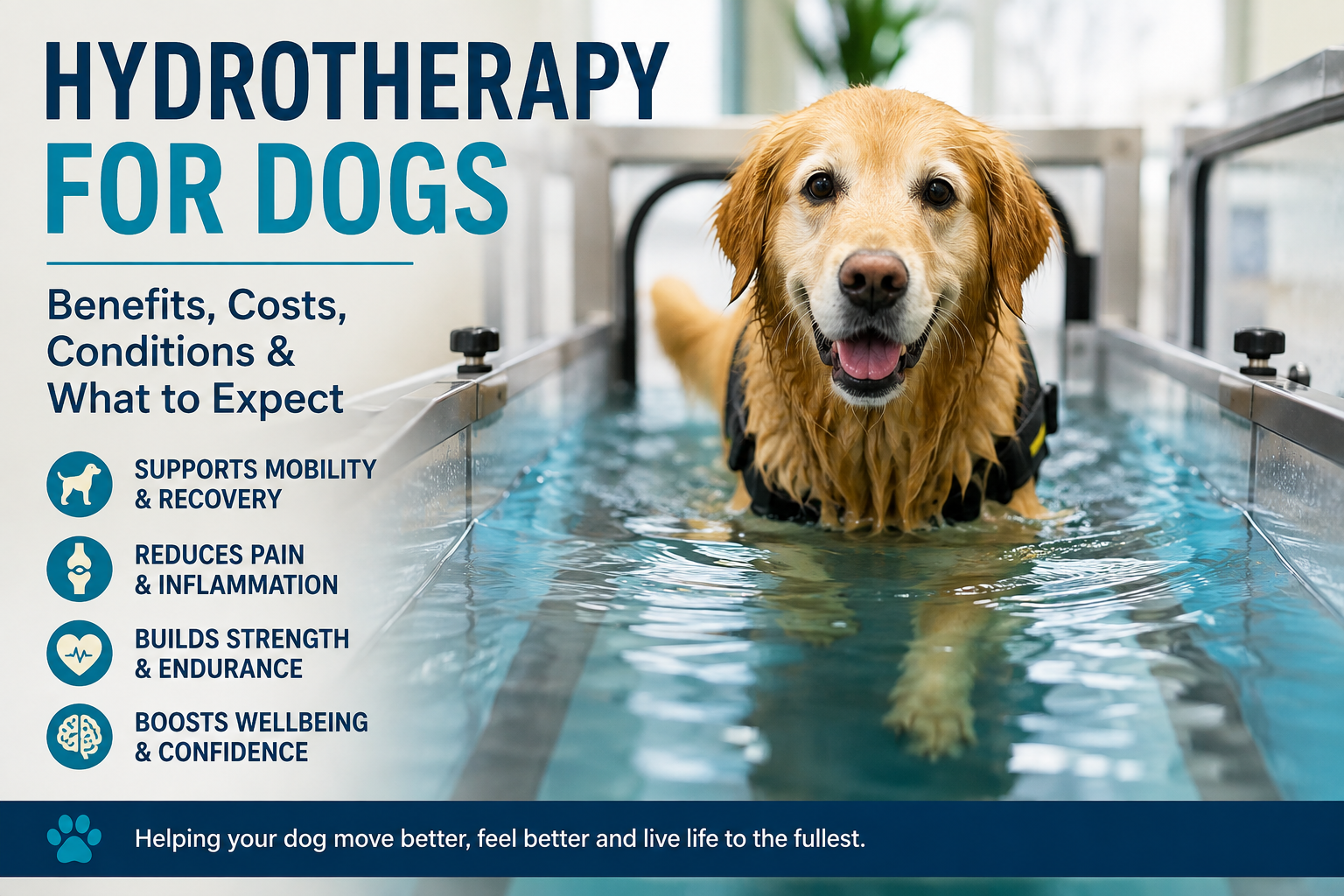
Hydrotherapy for Dogs
Benefits, Costs, Conditions & What to Expect
Watching a dog struggle to get up, climb stairs or enjoy their usual walks can be difficult.
Whether the problem follows surgery, an injury, arthritis or simply the effects of getting older, maintaining comfortable movement can become an important part of their care.
That’s where hydrotherapy for dogs can sometimes help.
Canine hydrotherapy uses controlled exercise in water to support rehabilitation, mobility and physical conditioning.
Depending on the dog and the reason for treatment, sessions may involve swimming in a specialist pool or walking on an underwater treadmill.
The big advantage is simple: water supports the dog’s body while still providing resistance to movement.
That can allow some dogs to exercise muscles and joints without placing the same load on their body that they would experience exercising on land.
Hydrotherapy isn’t suitable for every dog or every condition, though, and it shouldn’t simply mean taking an injured dog swimming.
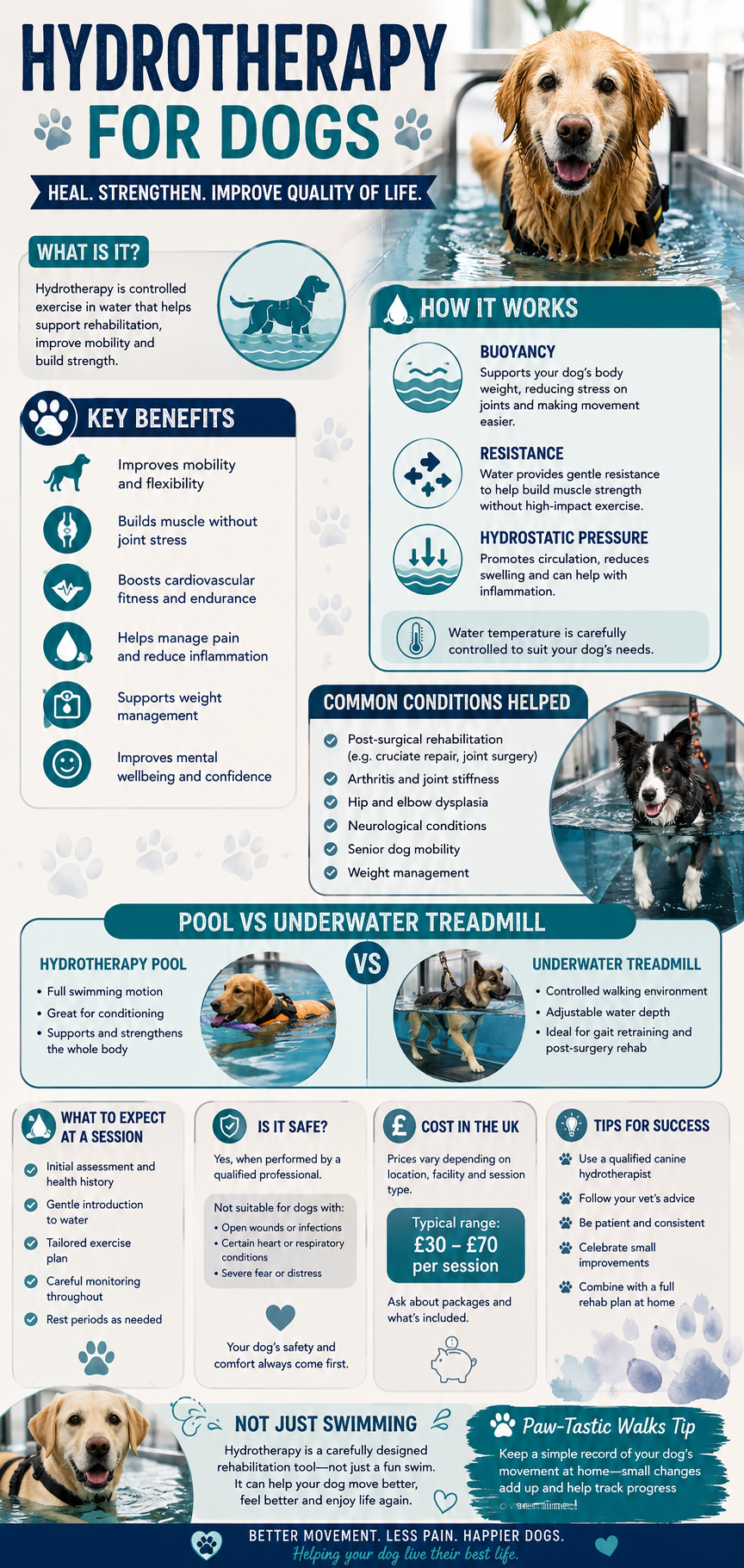
In this guide, we’ll look at how dog hydrotherapy works, the conditions it may be used for, swimming versus underwater treadmills, what happens during a session, possible risks, UK costs and how to find a suitably qualified canine hydrotherapist.
What Is Hydrotherapy for Dogs?
Hydrotherapy for dogs is controlled therapeutic exercise performed in water.
It is commonly incorporated into rehabilitation programmes for dogs recovering from certain injuries or operations and may also be used to support dogs with chronic mobility problems.
Two of the most familiar forms are:
- hydrotherapy pools
- underwater treadmills
Although both use water, they don’t necessarily achieve exactly the same thing.
A dog swimming in a pool moves very differently from a dog walking on an underwater treadmill, so the most appropriate approach depends on the individual dog and the goals of treatment.
How Does Canine Hydrotherapy Work?
The usefulness of hydrotherapy comes largely from the physical properties of water.
Buoyancy
When your dog enters water, buoyancy supports part of their body weight.
That reduces the amount of weight passing through their limbs and joints.
For a dog that finds normal walking uncomfortable or difficult, exercising in water can therefore provide an opportunity to move while experiencing less weight-bearing load.
The amount of support can also be altered in an underwater treadmill by changing the depth of the water.
Resistance
Water creates considerably more resistance than air.
Every time your dog moves a leg through the water, their muscles have to work against that resistance.
This makes it possible to challenge muscles while avoiding some of the impact associated with activities such as running or jumping.
Hydrostatic Pressure
Water also exerts pressure against the submerged parts of the body.
This is one of several characteristics of water that rehabilitation professionals can use when designing controlled exercise programmes.
Water Temperature
Specialist canine hydrotherapy doesn’t usually involve throwing a dog into a cold swimming pool.
Water temperature is controlled to help provide an appropriate environment for therapeutic exercise.
This is one reason professional hydrotherapy is very different from recreational swimming.
What Are the Benefits of Hydrotherapy for Dogs?
The exact benefits depend on why the dog is receiving hydrotherapy in the first place.
A young dog undergoing rehabilitation following orthopaedic surgery has very different requirements from a 13-year-old dog experiencing age-related mobility problems.
Potential benefits can include:
- supporting joint mobility
- rebuilding muscle following periods of reduced activity
- providing controlled low-impact exercise
- improving strength
- supporting coordination and movement
- improving cardiovascular fitness
- helping maintain physical conditioning
- providing exercise for dogs that struggle with some forms of land-based activity
Hydrotherapy should therefore be thought of as one possible component of a wider treatment or rehabilitation plan, rather than a miracle treatment by itself.
What Conditions Can Dog Hydrotherapy Help With?
Hydrotherapy may be incorporated into rehabilitation or management programmes for several different conditions.
Whether it is appropriate depends on the dog’s diagnosis, physical condition and veterinary advice.
Arthritis and Joint Stiffness
Arthritis can make normal exercise increasingly difficult.
The frustrating part is that maintaining appropriate movement can still be important for supporting muscles and mobility.
Hydrotherapy offers a way of exercising with reduced weight-bearing load.
For some arthritic dogs, this makes controlled movement easier than comparable exercise on land.
It doesn’t cure arthritis, but it may form part of a broader management programme alongside veterinary treatment, appropriate exercise, weight management and other rehabilitation techniques.
Hip and Elbow Dysplasia
Dogs affected by hip or elbow dysplasia may experience discomfort, altered movement and reduced activity.
Because water supports part of the dog’s body weight, hydrotherapy may sometimes be incorporated into a programme designed to maintain or improve muscle strength while managing stress on affected joints.
However, dysplasia varies enormously between individual dogs.
A hydrotherapy programme should therefore be based on professional assessment rather than assuming swimming is automatically beneficial.
Recovery After Surgery
One of the best-known uses of canine hydrotherapy is rehabilitation following orthopaedic surgery.
Depending on the operation and stage of recovery, controlled water-based exercise may eventually be introduced to help rebuild strength and improve movement.
Examples can include rehabilitation following certain:
- cruciate ligament procedures
- joint operations
- fracture repairs
- spinal procedures
- other orthopaedic surgery
Timing matters enormously.
A dog shouldn’t begin hydrotherapy simply because they’ve had an operation. Their veterinary surgeon or rehabilitation professional needs to decide when — and whether — water-based exercise is appropriate.
Cruciate Ligament Rehabilitation
Cruciate ligament injuries are a common cause of hind-limb lameness in dogs.
Following surgery, rehabilitation usually progresses gradually.
An underwater treadmill can be particularly useful in some rehabilitation programmes because water depth, walking speed and duration can all be controlled.
The objective isn’t to exhaust the dog.
It’s to encourage appropriate movement and gradually rebuild function according to their recovery plan.
Neurological Conditions
Hydrotherapy may sometimes form part of rehabilitation for dogs affected by neurological problems.
Water provides a supported environment in which carefully controlled movements can be encouraged.
These cases require particularly careful professional supervision because neurological conditions vary greatly in severity and cause.
Senior Dogs
You don’t necessarily need a dramatic injury before hydrotherapy becomes relevant.
Older dogs may lose:
- muscle mass
- strength
- stamina
- flexibility
- confidence in movement
Appropriately prescribed hydrotherapy may help some senior dogs maintain activity without demanding the same level of weight-bearing exercise as longer walks.
For an older dog, the objective may simply be maintaining comfortable function and quality of life rather than intensive rehabilitation.
Weight Management
Hydrotherapy can provide physical activity for some overweight dogs, particularly where mobility problems make conventional exercise more difficult.
However, there’s an important caveat:
Hydrotherapy cannot compensate for excessive calorie intake.
If a dog needs to lose weight, nutrition and calorie control remain fundamental.
Hydrotherapy may complement a veterinary weight-management programme, but it isn’t a substitute for one.
Underwater Treadmill vs Swimming: Which Is Better?
This is one of the most useful distinctions for owners to understand.
They’re both hydrotherapy, but they’re not interchangeable.
Underwater Treadmill
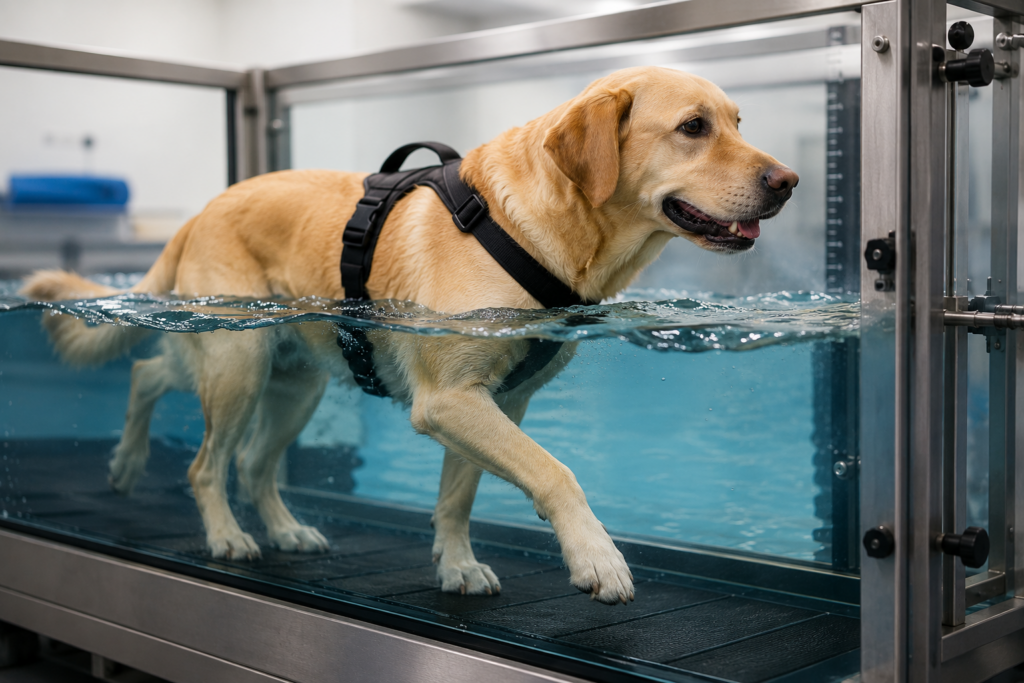
An underwater treadmill allows a dog to walk while partially submerged.
The therapist can control variables such as:
- water depth
- treadmill speed
- exercise duration
- rest periods
Because the dog is walking rather than swimming, therapists can observe gait and encourage controlled limb movement.
For some rehabilitation cases, that level of control can be extremely useful.
Hydrotherapy Pool
A hydrotherapy pool allows the dog to swim without bearing normal body weight through the limbs.
Swimming can provide a substantial muscular and cardiovascular workout.
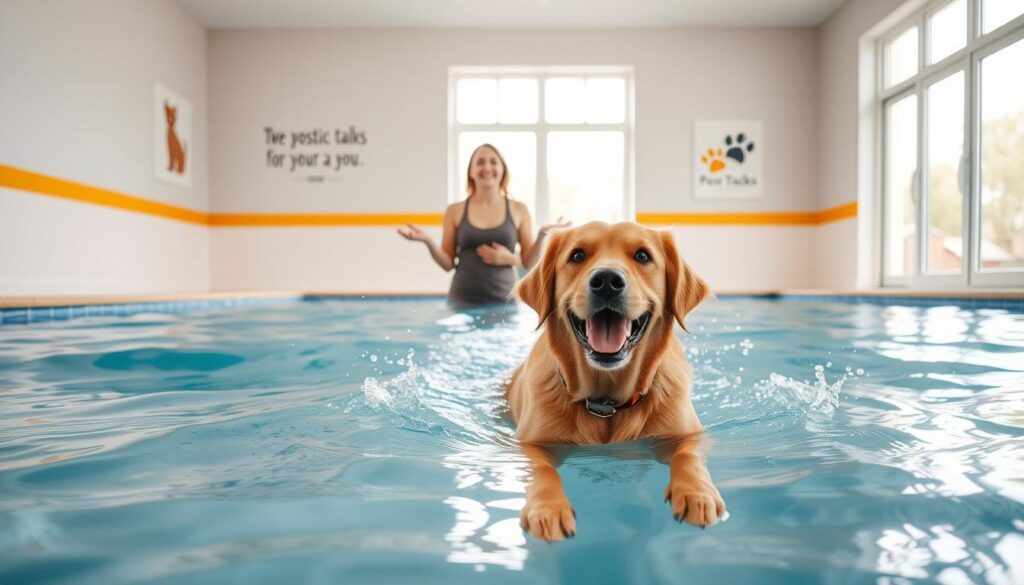
Dogs may wear a buoyancy aid or specialist harness, and the hydrotherapist can support or guide them during the session.
So Which One Does My Dog Need?
That depends entirely on the objective.
A dog relearning an appropriate walking pattern may have different requirements from a dog receiving conditioning exercise.
The decision should therefore be made according to your dog’s condition and rehabilitation goals rather than simply choosing whichever looks more enjoyable.
Is Hydrotherapy the Same as Taking Your Dog Swimming?
No — and this distinction is important.
Swimming recreationally can be excellent exercise for a healthy dog that enjoys water.
Professional canine hydrotherapy is different.
A hydrotherapy session involves controlled exercise selected according to the dog’s condition, with the dog monitored throughout.
The environment and equipment are also designed specifically for canine rehabilitation.
A lake, river, sea or garden swimming pool doesn’t provide the same level of control.
What Happens at a Dog Hydrotherapy Session?
If you’ve never taken a dog for hydrotherapy, the whole process can sound more intimidating than it actually is.
The first appointment will generally involve gathering information about your dog and determining what they need from treatment.
The hydrotherapist may consider factors such as:
- medical history
- reason for referral
- mobility
- muscle condition
- previous surgery or injury
- current medication or treatment
- temperament
- confidence around water
Your dog can then be introduced to the hydrotherapy environment carefully.
The aim isn’t to throw them in and make them swim.
During the Session
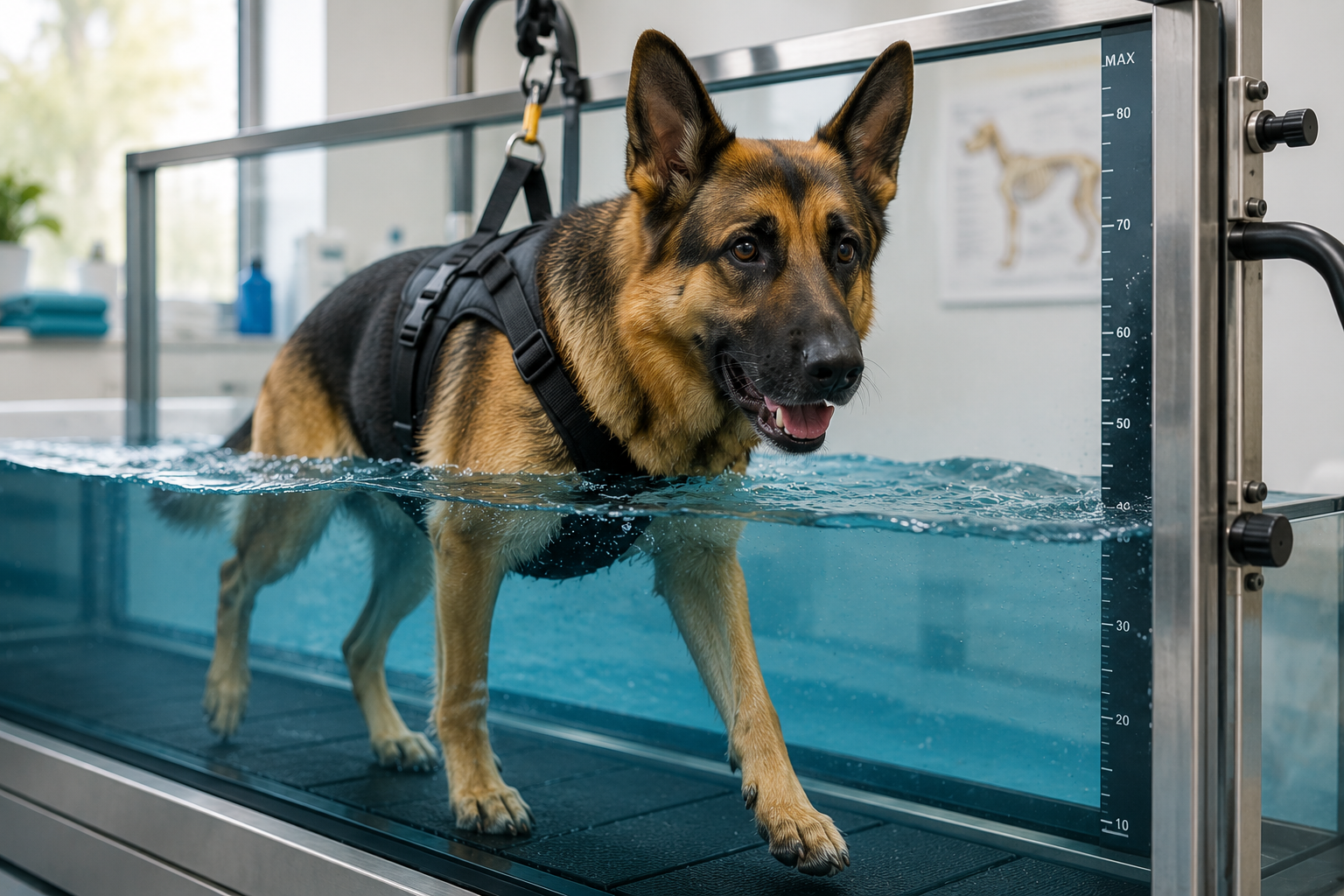
What happens next depends on whether your dog is using a pool or underwater treadmill.
A session might involve short periods of activity separated by rest.
Your dog’s movement, behaviour and response to exercise should be monitored throughout.
Dogs don’t need to swim until they’re exhausted for hydrotherapy to be useful.
In rehabilitation, controlled movement is more important than simply doing lots of exercise.
Does My Dog Need to Like Swimming?
Not necessarily.
Some dogs take one look at a hydrotherapy pool and apparently decide their ancestors evolved out of the ocean for a perfectly good reason.
That’s okay.
A good hydrotherapist should introduce the dog gradually rather than forcing a frightened animal into the water.
Some dogs that dislike swimming may tolerate an underwater treadmill much better because they remain standing and the water can be introduced gradually.
Your dog’s emotional comfort matters as well as their physical rehabilitation.
Can Brachycephalic Dogs Have Hydrotherapy?
Flat-faced or brachycephalic breeds such as Bulldogs, French Bulldogs and Pugs require additional consideration around water because their anatomy can affect breathing and swimming ability.
That doesn’t automatically mean hydrotherapy is impossible.
It does mean the therapist needs to assess the individual dog carefully and use appropriate precautions.
A specialist underwater treadmill may sometimes offer a more controlled environment than swimming, depending on the dog and reason for treatment.
Is Hydrotherapy Safe for Dogs?
When appropriately prescribed and professionally supervised, hydrotherapy is designed to provide controlled exercise.
However, it isn’t risk-free and it isn’t suitable for every dog.
There may be circumstances where hydrotherapy needs to be postponed, modified or avoided altogether.
Examples can include certain:
- open or infected wounds
- skin infections
- respiratory problems
- cardiovascular conditions
- infectious illnesses
- uncontrolled medical conditions
- severe fear or distress around water
Individual circumstances vary, so your dog’s suitability should be assessed rather than assumed.
Can I Do Dog Hydrotherapy at Home?
This is where I’d be cautious.
There’s a big difference between allowing a healthy dog to enjoy recreational swimming and attempting to reproduce a rehabilitation programme yourself.
If your dog is recovering from surgery, has arthritis, dysplasia, a neurological condition or another significant mobility problem, inappropriate exercise could potentially interfere with their recovery.
Natural water also introduces additional hazards such as:
- currents
- cold water
- steep banks
- poor water quality
- underwater obstacles
- difficulty getting out
- exhaustion
Even dogs that are normally strong swimmers can get into trouble.
If your dog has been prescribed hydrotherapy, follow the exercise guidance provided by their veterinary and rehabilitation team rather than inventing a home programme.
How Much Does Dog Hydrotherapy Cost in the UK?
Prices vary considerably according to location, facility, appointment length and whether the dog requires an assessment before treatment.
Rather than relying on a single national price — which quickly becomes outdated — check several qualified hydrotherapy centres in your area and compare what is included.
You may encounter separate charges for:
- initial assessment
- individual hydrotherapy sessions
- underwater treadmill sessions
- rehabilitation assessments
- treatment packages
Don’t choose a hydrotherapy centre purely because it is the cheapest.
The qualifications of the person treating your dog, quality of the facility and suitability of the treatment matter considerably more than saving a few pounds per session.
Does Pet Insurance Cover Dog Hydrotherapy?
Potentially.
Some UK pet insurance policies may contribute towards complementary treatments or rehabilitation, including hydrotherapy, when particular conditions are met.
Others may exclude it or impose separate limits.
Check:
- whether hydrotherapy is included
- the annual treatment limit
- whether veterinary referral is required
- whether the hydrotherapist needs particular qualifications or membership
- whether your dog’s underlying condition is covered
It’s worth checking before treatment begins rather than discovering afterwards that your policy doesn’t cover it.
How to Find a Good Canine Hydrotherapist
Don’t simply search for the nearest swimming pool that allows dogs.
You’re looking for somebody appropriately trained to work with dogs undergoing therapeutic exercise.
Ask about:
- hydrotherapy qualifications
- professional registration or membership
- experience with your dog’s particular condition
- veterinary referral requirements
- emergency procedures
- water hygiene
- water temperature monitoring
- how progress is recorded
- how they communicate with your vet or rehabilitation professional
A reputable therapist should be perfectly comfortable answering these questions.
Questions to Ask Before Your Dog’s First Session
Before booking, consider asking:
What qualifications do you hold?
Find out exactly who will be treating your dog.
Do you require veterinary consent or referral?
This can be particularly important where hydrotherapy forms part of medical rehabilitation.
Have you treated dogs with this condition before?
Experience with your dog’s particular problem can be valuable.
Will my dog use a pool or underwater treadmill?
Ask why that method has been recommended.
How will progress be measured?
Hydrotherapy should have an objective rather than simply becoming an indefinite weekly swim.
What happens if my dog is frightened of water?
The answer should involve gradual introduction and consideration of the dog’s welfare — not simply forcing them to participate.
How Often Do Dogs Need Hydrotherapy?
There isn’t one correct schedule.
Frequency depends on:
- the condition being treated
- stage of recovery
- age
- fitness
- other rehabilitation
- veterinary recommendations
- how the dog responds to treatment
Some rehabilitation programmes may initially involve regular sessions and then reduce frequency as the dog progresses.
Others may use hydrotherapy periodically as part of longer-term mobility management.
More isn’t automatically better.
The appropriate amount is the amount that supports your dog’s individual treatment plan.
How Quickly Will I See Results?
Again, this varies enormously.
Some owners may notice changes in confidence or movement relatively quickly, while meaningful strength and conditioning improvements can take longer.
Recovery also depends on far more than hydrotherapy.
Factors such as the dog’s:
- underlying condition
- age
- weight
- surgery
- medication
- rehabilitation programme
- home exercise
- general health
can all influence progress.
Be wary of anyone promising dramatic results within a guaranteed number of sessions.
Hydrotherapy for Dogs: Frequently Asked Questions
What is hydrotherapy for dogs?
Hydrotherapy is controlled exercise performed in water, usually using a specialist canine pool or underwater treadmill. It may be incorporated into rehabilitation, mobility management or conditioning programmes.
Is hydrotherapy good for dogs with arthritis?
Hydrotherapy may help some dogs with arthritis exercise with reduced weight-bearing load on their joints. It doesn’t cure arthritis and should form part of an appropriate management plan recommended for the individual dog.
Is an underwater treadmill good for dogs?
Underwater treadmills can be useful because water depth, walking speed and duration can be controlled. They are commonly used in canine rehabilitation, but whether one is appropriate depends on the dog’s condition.
Can hydrotherapy help after cruciate surgery?
Hydrotherapy may be incorporated into rehabilitation following certain cruciate procedures. The timing and type of exercise should be determined by the dog’s veterinary or rehabilitation team.
Do dogs need to know how to swim for hydrotherapy?
No. Underwater treadmill therapy doesn’t require swimming, and dogs using hydrotherapy pools are carefully supervised and may use buoyancy aids or supportive equipment.
Can old dogs have hydrotherapy?
Some senior dogs may benefit from appropriately prescribed hydrotherapy, particularly when conventional exercise has become difficult. Their overall health and any underlying conditions need to be considered first.
Can overweight dogs use hydrotherapy?
Potentially. Water-based exercise may be useful for some overweight dogs with limited mobility, but successful weight loss still depends heavily on appropriate calorie intake and veterinary weight management.
Can I take my dog swimming instead of paying for hydrotherapy?
Recreational swimming isn’t the same as professional hydrotherapy. If your dog requires rehabilitation following surgery or because of a medical condition, follow professional advice rather than substituting unsupervised swimming.
How much does hydrotherapy for dogs cost?
UK prices vary according to location, treatment type, appointment length and facility. Check current prices with qualified hydrotherapy centres near you and ask exactly what the quoted price includes.
Will pet insurance pay for canine hydrotherapy?
Some policies may cover hydrotherapy or rehabilitation subject to limits and conditions. Check your individual policy and insurer before beginning treatment.
Is Hydrotherapy Worth It for Your Dog?
For the right dog, hydrotherapy can be a valuable part of rehabilitation or long-term mobility management.
Its biggest advantage is the environment water creates.
Buoyancy can reduce weight-bearing load while resistance gives muscles something to work against. Specialist pools and underwater treadmills allow that exercise to take place in a controlled setting.
But the word controlled is important.
Hydrotherapy isn’t simply swimming, and more exercise isn’t necessarily better. The treatment needs to match the dog, their condition and their stage of recovery.
If your dog is struggling with mobility, recovering from surgery or living with a long-term joint problem, speak to your vet about whether canine hydrotherapy could be appropriate.
For some dogs, getting into the water can provide something that has become increasingly difficult on dry land:
the chance to get moving comfortably again.
Paw-Tastic Walks Tip
Keep a simple record of your dog’s mobility while they’re undergoing rehabilitation. Note things such as how easily they rise from bed, how they manage stairs, their walking tolerance and whether they appear stiff afterwards.
Small improvements can be surprisingly difficult to notice when you see your dog every day.
This article is intended for general educational purposes and isn’t a substitute for veterinary diagnosis or treatment. If your dog has mobility problems, is recovering from surgery or has an existing medical condition, seek veterinary advice before beginning hydrotherapy or changing their exercise programme.