
Causes and Calm Greeting Training
Most Boxers jump on people because they’re excited, social, energetic, and have learned that jumping gets attention. It’s usually not a dominance problem, but a greeting habit linked to poor impulse control.
That enthusiasm can still cause trouble. A powerful Boxer may scratch skin, knock over children, leave muddy pawprints on clean clothes, or make visitors feel uncomfortable before they’ve even taken off their shoes.
The good news is that Boxer jumping on people can improve with consistent, reward-based training.
Start by preventing your Boxer from rehearsing the behavior. Then reward four paws on the floor and teach a calm greeting, such as sitting or going to a mat. The goal is to help your dog show calm energy during greetings without suppressing its friendly personality.
You can find more practical training support in Check out our great guides on Payhip and Check out our ebook guides on Etsy. For a quick visual example, see this calm greeting training video, then let’s look at why this lively breed jumps in the first place.
This post may contain affiliate links. If you make a purchase through these links, I may earn a small commission at no extra cost to you.
Key Takeaways
- Boxer jumping on people usually comes from excitement, attention-seeking, and weak impulse control, not dominance. Build impulse control skills by practicing pauses, check-ins, and choosing four paws on the floor before greeting.
- Prevent rehearsals with a leash, baby gate, or separate room, then reward four paws on the floor.
- Teach a calm alternative, such as sitting, touching your hand, or settling on a mat.
- Practice first with familiar helpers, then increase distractions gradually. See our guide to Boxer impulse control and greeting training.
- Avoid pushing or yelling. For clear reward-based guidance, follow AKC jumping training advice.
Why Boxer jumping on people happens
Boxers are high-energy dogs that often greet with their whole bodies. Their social style can make them rush toward people, place paws on clothing, or deliver a face full of kisses.
Understanding the cause helps you respond without blaming your Boxer. For useful breed background, see this Boxer dog breed background.
Excitement, attention, and the greeting habit
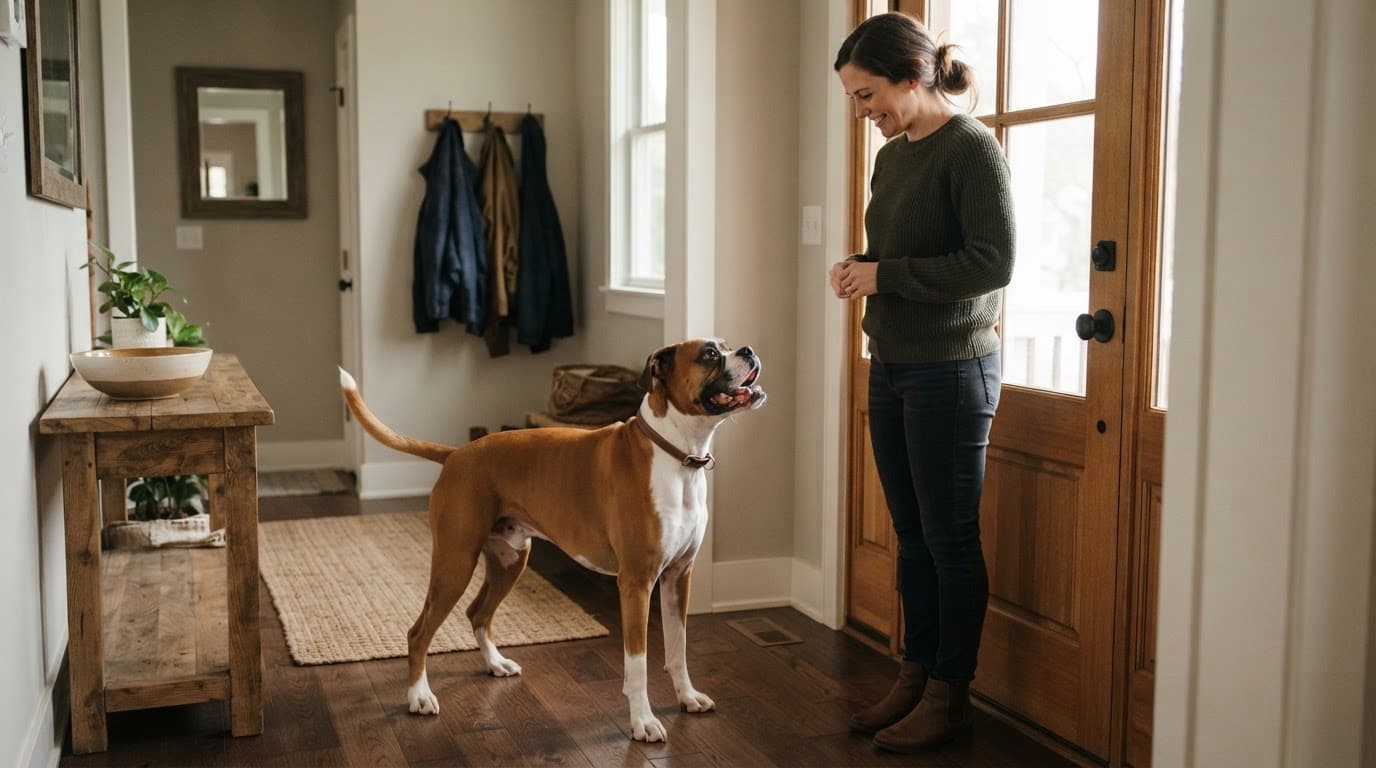
Your Boxer may jump because it works. When a visitor speaks, pets, pushes, laughs, or makes eye contact, the dog receives attention. Even a firm “off” can feel rewarding if your Boxer simply wants interaction.
Some Boxers are face-seekers, aiming for a visitor’s face during an excited greeting. Individual history and breed temperament can influence how strongly this behavior appears.
Picture a visitor coming through the door. Your Boxer rushes over and jumps. The visitor talks, moves their hands, and tries to turn away.
From your dog’s point of view, something exciting is happening, and jumping has started the conversation.
Repeated practice makes the habit stronger. Doorbells, people returning home, children running, and face-to-face greetings can all raise excitement. Inconsistent rules add to the confusion. If jumping earns attention from one person but gets ignored by another, your Boxer may keep trying.
Rewarding four paws on the floor gives your dog a clearer answer. Ask visitors to wait briefly, turn sideways, and offer attention only when your Boxer stays grounded. A sit, hand touch, or mat behavior can replace jumping because your dog can’t perform both behaviors at once.
When jumping may signal fear or discomfort
Not every jumping Boxer is simply happy to see someone. Fear, discomfort, or overstimulation can sometimes look like frantic greeting behavior, especially around unfamiliar people.
Watch the whole body, not just the paws. Concerning signs can include:
- A stiff body, tucked tail, or sudden avoidance.
- Lip licking, yawning, barking, or growling.
- Frantic movement, repeated lunging, or an inability to settle.
- Jumping that appears mainly around certain people, places, or handling.
A worried dog should never be forced to greet. Create more distance, allow your Boxer to move away, and reward calm glances or relaxed body language. Calming strategies for anxious dogs can help you support a nervous pet without adding pressure.
Pushing a worried dog toward a stranger can make the person feel more threatening, not less.
If the behavior is intense, sudden, or unusual for your Boxer, speak with your veterinarian. A qualified reward-based behavior professional can also help you identify the trigger and build a safe training plan.
How to stop a Boxer from jumping on people
Stopping jumping takes more than saying “off” after it happens. Your dog needs a clear replacement, such as standing calmly, sitting, touching your hand, or going to a mat.
Choose an incompatible behavior, meaning a sit, hand touch, or mat stay that makes jumping physically unavailable while giving your dog a way to earn attention.
Practice when your Boxer is calm, keep sessions short, and prevent visitors from rewarding the old habit.
Think of each greeting as a small training exercise, not a test your dog must pass perfectly.
Teach four paws on the floor
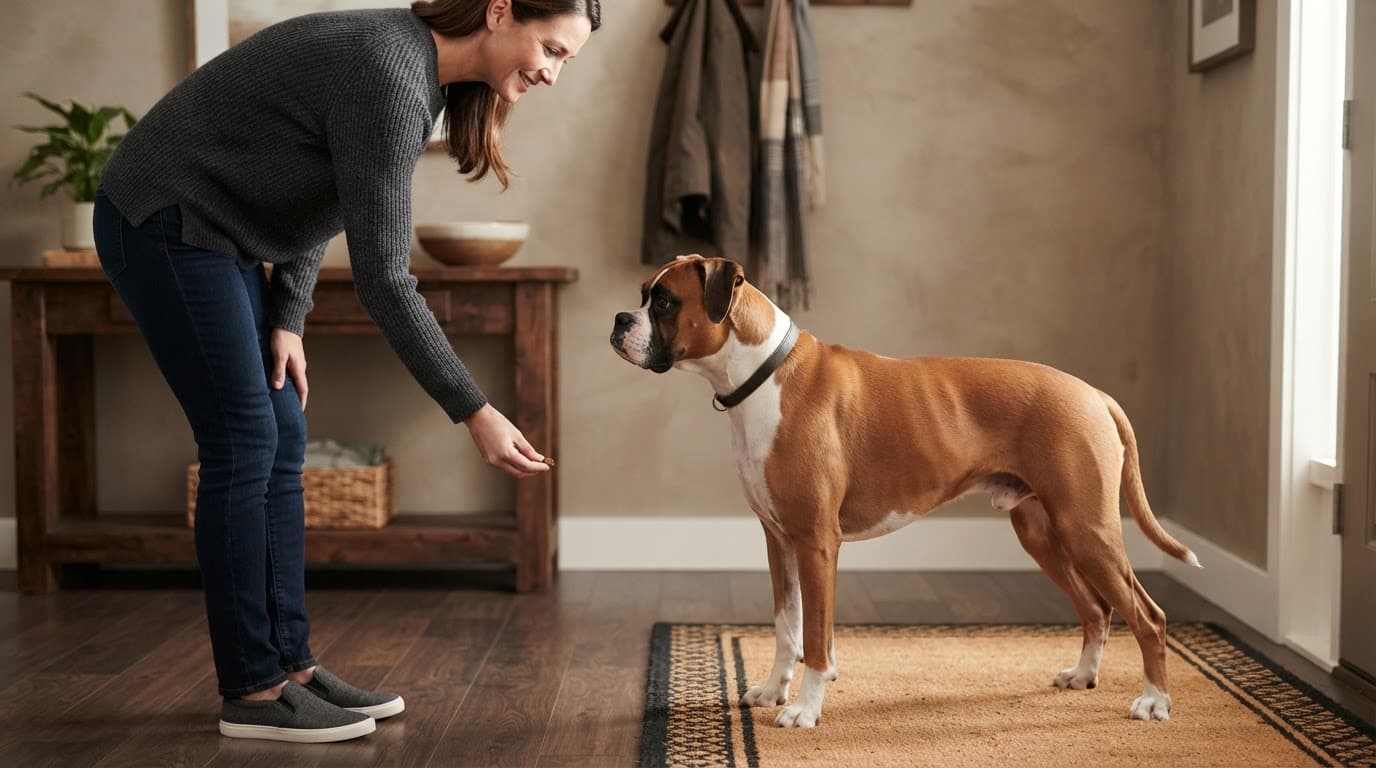
Begin in a quiet room with your Boxer standing near you. The instant all four paws touch the floor, say “yes” and give a small treat close to the ground. Delivering the reward quickly matters.
If you lift the treat toward your chest, your Boxer may spring upward to reach it.
You don’t need the most exciting food for easy practice. Small pieces of your dog’s regular kibble or a low-value treat are often enough. Save something more tempting, such as chicken, for visitor practice when the doorbell and a new person make calm behavior harder.
Watch for the moment your Boxer chooses to stay grounded. You might see relaxed standing, a brief pause, or a glance toward you instead of a leap. Mark that exact moment, then reward low.
With repetition, your dog starts to understand that four paws on the floor make good things happen.
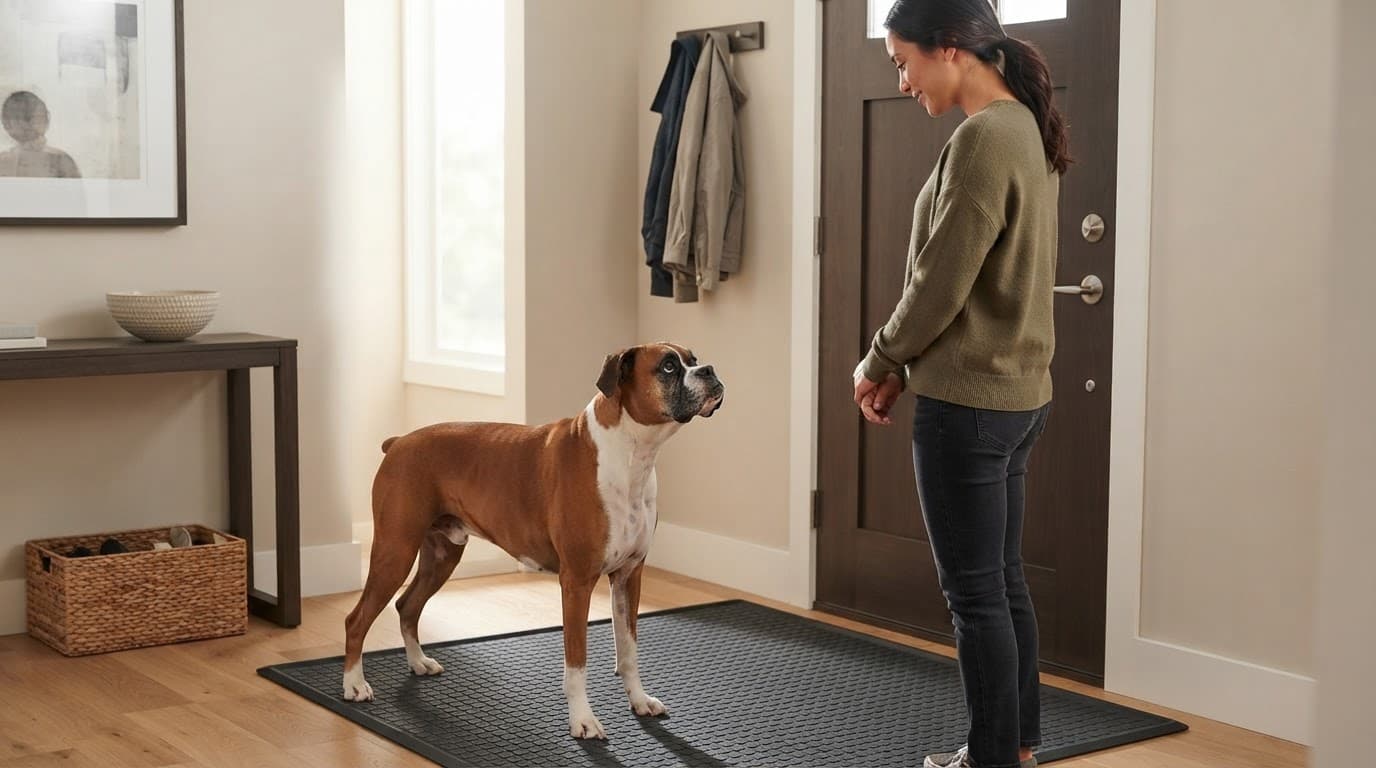
When your Boxer jumps, the person being greeted should turn away, fold their arms, and avoid talking. Wait for the paws to return to the floor, then mark and reward.
Don’t push your dog down, wave your hands, or repeat “off” several times. Those reactions can add excitement and may still feel like attention.
Teach sit or go to your mat as the new greeting
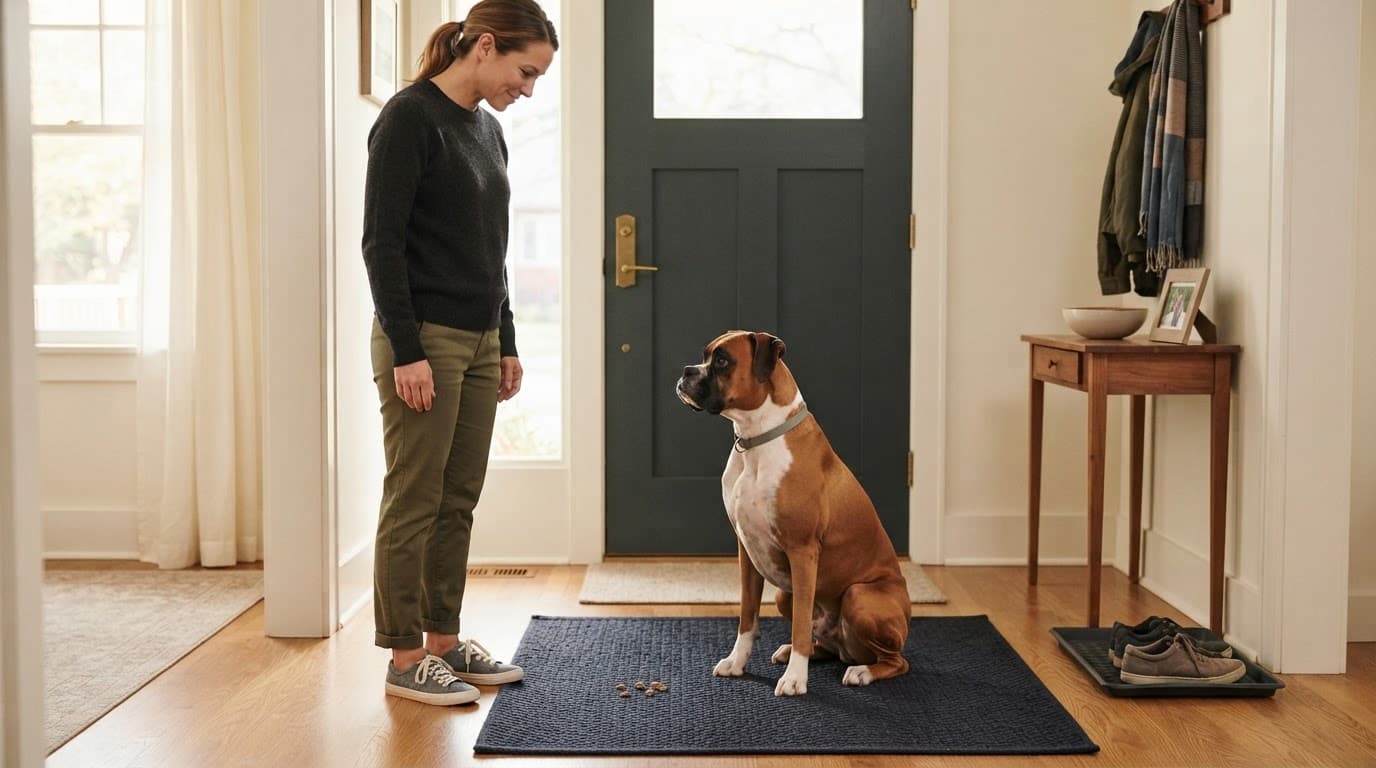
Choose one replacement behavior first. Sit is often convenient, while a mat gives your Boxer a clear place to settle when visitors arrive.
You can also teach a hand touch if your dog enjoys moving toward you without jumping.
Practice in a quiet room before adding real greetings. Reward your Boxer for sitting, stepping onto the mat, or touching your hand. Keep each session around 3 to 5 minutes, and practice several times a day. Short sessions help your dog learn without becoming overexcited.
Once the behavior is reliable, add one piece of difficulty at a time. Use baby steps by increasing only one challenge at each stage:
- Ask for the behavior in another room.
- Practice when a familiar person walks past.
- Add a gentle knock or doorbell sound.
- Invite one calm helper to enter and wait.
- Practice with several familiar people.
- Repeat in different rooms and during realistic arrivals.
The replacement behavior needs enough practice to become automatic. If your Boxer only hears “go to your mat” when a visitor is already inside, the cue may not work when excitement is high.
For more ideas about teaching calm behavior, see these mat training tips for an overstimulated dog.
Use distance when your Boxer gets too excited
Training becomes difficult when your Boxer is lunging, bouncing, barking, or unable to take a treat. Pause or move farther away when your dog’s excitement level is too high for responding to a cue.
Move farther away from the visitor, doorway, or other trigger. Reward your Boxer for looking calmly, standing with four paws down, or checking back with you.
Decrease the distance only when your dog can stay relaxed and respond to the cue.
A bouncy body and loose, social movement often suggest excitement, but jumping can also happen alongside fear. Tension, avoidance, tucked posture, barking, or repeated attempts to escape deserve extra care.
Don’t force a greeting. Give your Boxer space and seek help from your veterinarian or a qualified reward-based behavior professional if needed. AKC’s expert jumping guidance also supports rewarding calm greetings instead of giving attention for jumping.
Manage visitors so Boxer jumping does not get rehearsed
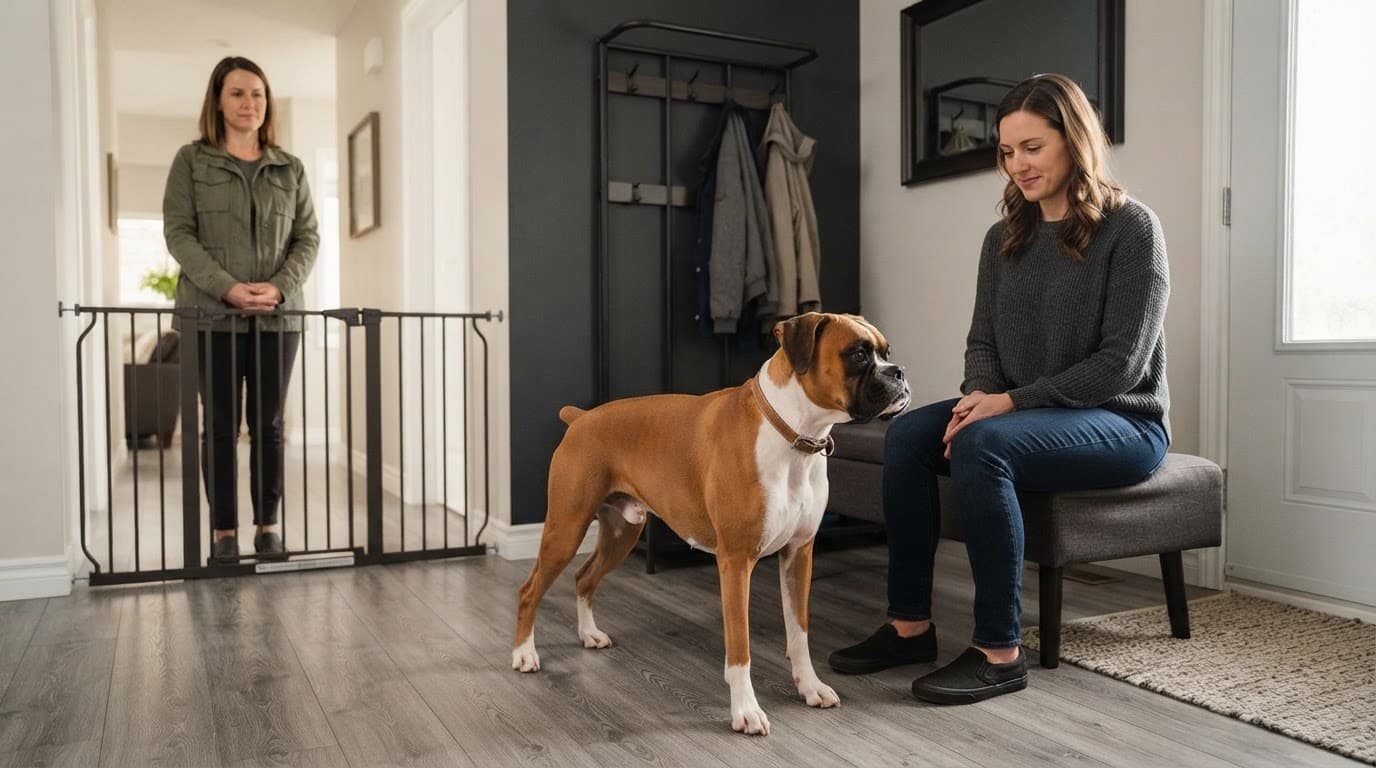
Every jump your Boxer practices can strengthen the habit. Management isn’t a failure or shortcut. Using gates, leashes, pens, and separate rooms is environment management. It prevents rehearsal while you teach a calmer response.
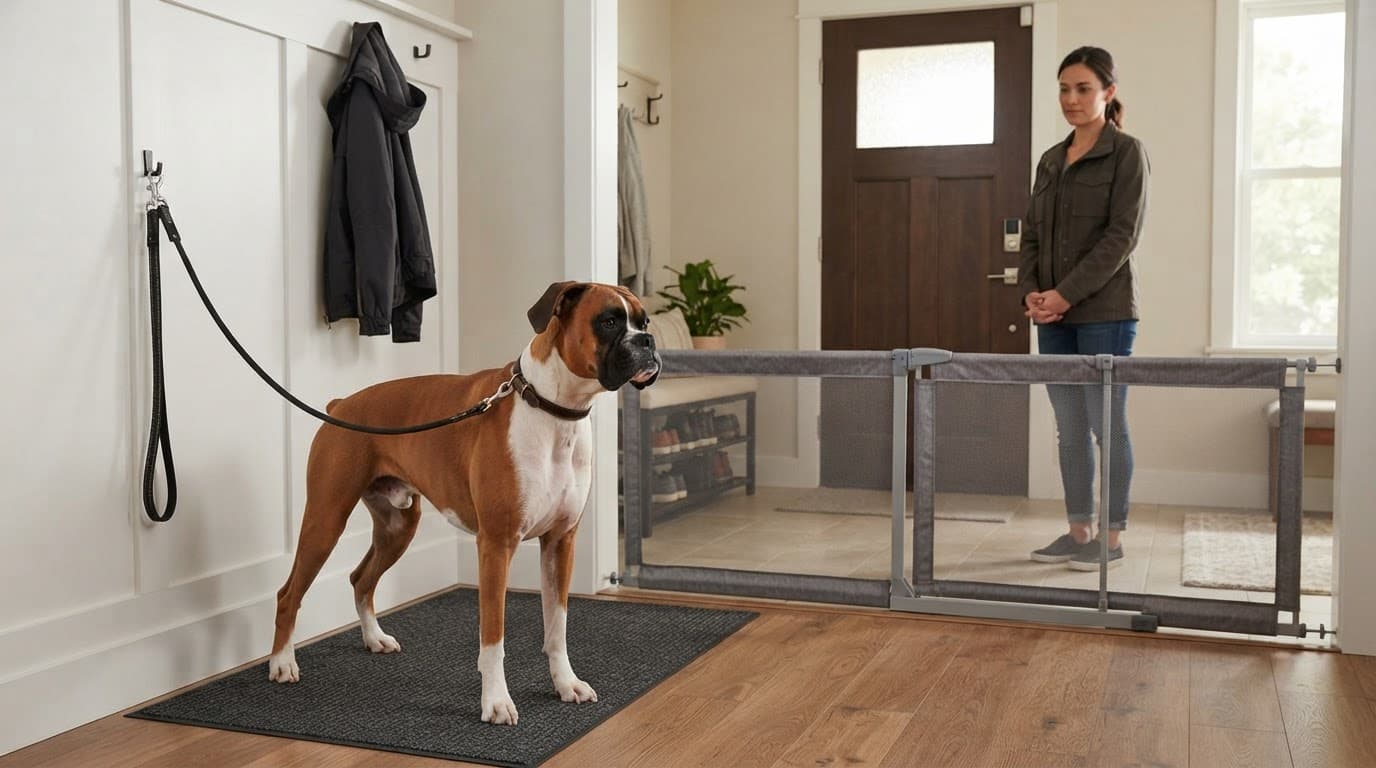
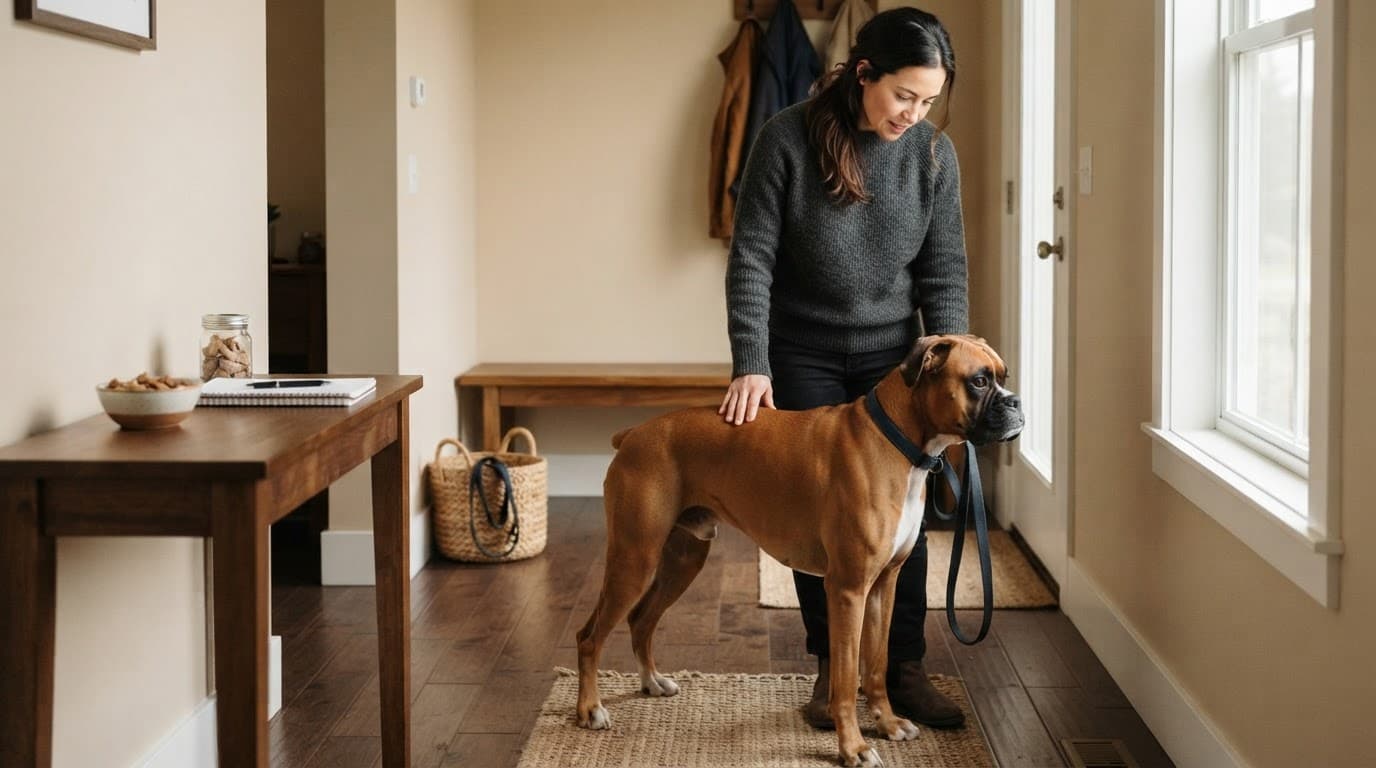
Before opening the door, use a leash, baby gate, exercise pen, closed door, or safe separate room. Choose the option that gives you reliable control without making your Boxer feel trapped.
Create a calm front-door routine
Keep treats near the entrance so you’re ready before the doorbell rings. Secure your Boxer first, then cue the mat or ask for a sit.
Open the door only when your dog has four paws on the floor and can respond to you.
Reward frequently while the guest enters. Give treats low to the ground, or scatter a few on the mat, so your Boxer keeps their nose down. Ask the visitor to ignore jumping by turning away and avoiding eye contact or touch.
If your Boxer jumps, pause the greeting. Use the leash or barrier to create distance, then wait for calm and reward again.
Contact comes only after your dog settles. A guest may need to wait several minutes, and that’s perfectly fine.
Practice the routine before inviting real visitors. Play a doorbell recording at a very low volume, then reward your Boxer for staying calm on the mat. Repeat from different rooms and slowly increase the volume over several sessions.
If barking or jumping starts, lower the intensity again.
You can also practice with gentle knocks and a familiar helper. For another calm-greeting example, watch this step-by-step dog greeting lesson.
Keep children and vulnerable guests safe
A child, older adult, or fearful visitor may not be able to move safely if an excited Boxer rushes forward. Use a barrier or keep your dog on a short, secure leash when these guests arrive.
Never ask a child to manage a strong Boxer alone.
Greetings should stay brief and supervised until your dog has a dependable calm response. A nervous guest can remain behind the barrier while you reward your Boxer for looking calmly, sitting, or resting on the mat. Nobody needs to pet the dog before they feel comfortable.
Delivery workers and repair professionals also need a separate plan. Keep your Boxer behind a closed door or gate while the person enters and leaves.
House guests and family members must follow these rules too. One person allowing jumping can keep the habit alive for everyone else.
What to do when your Boxer jumps during walks
For now, prevent greetings with strangers on walks. Politely ask people to wait, turn away, or avoid touching your Boxer while jumping.
If someone won’t follow your request, create distance and keep walking.
Reward calm walking and attention before allowing a controlled greeting. Use leash training to teach your Boxer to look at the person, check back with you, and stay grounded before greeting.
Your Boxer might first need to stand with four paws down.
In a secure, fenced area, you can use a long line for controlled practice. Never use one near roads or uncontrolled strangers.
Use a secure large-dog harness if you need extra handling control.
Only allow contact when your Boxer is calm and you say it is time. Keep the greeting short, then move away while things are still going well.
Consistency outside the home matters because a Boxer may behave perfectly in the hallway, then turn into a spring-loaded greeting machine on the sidewalk.

Mistakes that can make Boxer jumping worse
Some reactions feel natural when a strong Boxer launches toward you, but they can add fear, frustration, or more excitement.
Removing attention from unwanted behavior is only half the plan. Your dog also needs to learn which calm response earns attention.
Avoid physical corrections and shouting
Pushing your Boxer down, grabbing their paws, kneeing the chest, or jerking the leash can make greetings unpleasant. Physical corrections for dog jumping can increase arousal or create negative associations with greetings.
Your dog may become worried about approaching people, or respond with more bouncing, barking, and frustration. These methods also increase your risk of scratches, bites, and accidental falls.
Yelling “off” often adds attention and energy to the moment. The same applies to waving your arms, chasing your dog away, or wrestling them back. Rough play during greetings can be especially confusing because your Boxer may think jumping has started a fun game.
Avoid shock collars, prong collars, and leash corrections for this problem. The American Veterinary Society of Animal Behavior’s reward-based guidance explains why aversive methods can create negative associations and increase stress.
Instead, turn away, keep your hands still, and wait for four paws on the floor. Then mark the calm behavior and reward it promptly.
Ignoring alone is not enough, because your Boxer also needs to learn what to do next.
Keep the rules clear for everyone
Inconsistent rules can keep Boxer jumping on people going for months. If jumping earns a fuss from one guest but gets ignored by another, your dog has a reason to keep trying.
Ask every family member and visitor to follow the same routine.
Don’t wait until your Boxer is already bouncing, barking, and unable to take a treat before asking for a sit. Create distance first, use a gate or leash, and reward small moments of calm.
Guests should never encourage jumping, even if they find it cute. Calm greetings may feel slower at first, but they give your Boxer a behavior that works every time.
When to call a veterinarian or certified dog trainer
Most Boxer jumping improves with steady practice and better visitor management. However, some behavior changes need professional support, especially when the behavior is sudden, intense, or linked to fear.
Speak with your veterinarian first
Book a veterinary check if your Boxer suddenly starts jumping, becomes unusually sensitive, or acts out of character. A dog that jumps because of pain, discomfort, anxiety, or fear needs more than a training cue.
Tell your veterinarian when the behavior began and what happens before each episode. Mention signs such as stiffness, limping, reluctance to move, touch sensitivity, tucked posture, lip licking, growling, or attempts to escape.
Medical problems can sometimes appear first as behavior changes, so don’t assume your Boxer is simply being difficult.
Your veterinarian can look for health concerns and recommend the right next step. That may include a referral to a certified dog training professional, veterinary behavior specialist, or another qualified expert.
Sudden jumping is not always a training problem. A physical check can help you avoid missing pain or illness.
Hire a qualified behavior professional
Contact a certified, reward-based trainer when your Boxer is strong enough to knock people down, visitors can’t enter safely, or your dog cannot settle despite consistent practice.
Growling, snapping, lunging, and biting require professional help rather than stronger corrections.
Look for clear credentials, experience with large breeds, and humane methods. Useful qualifications may include CPDT-KA, IAABC, KPA, or CTC. For serious fear or aggression, ask your veterinarian about a board-certified veterinary behaviorist with experience in humane behavioral training.
The American College of Veterinary Behaviorists’ behavior guidance also recommends checking credentials and choosing professionals who use rewards and management.
A good trainer should explain the plan clearly. It should focus on preventing jumps, rewarding calm choices, and changing the environment when needed. Seeking help early is responsible dog ownership, not a sign that you’ve failed.
A realistic plan for calmer greetings
Calm greetings take practice, but your Boxer doesn’t need to be perfect on day one. Use gradual jump training, reward grounded behavior, and keep each session easy enough to succeed.
Follow a gradual training plan
Use this simple plan over several weeks. Move forward only when your Boxer can stay relaxed and take treats. Work in baby steps instead of advancing after one successful greeting.
- Week 1: Practice at home without visitors. Reward four paws on the floor, sitting, checking in with you, and settling on a mat.
- Week 2: Add one familiar helper at a distance. Reward your Boxer for noticing the person without rushing over. Decrease the distance slowly.
- Week 3: Practice the front-door routine with short visits. Use a leash or gate, ask for the mat behavior, and allow contact only when your dog stays grounded.
- Weeks 4 and 5: Add different adults and slightly longer visits. Children should only take part with careful adult control and plenty of space.
- Later practice: Try calm greetings in new locations, such as a quiet friend’s home or a peaceful outdoor area. In a secure, enclosed area, a long line can support safe, controlled practice.
This gradual approach matches professional guidance from VCA’s greeting behavior advice. If your Boxer becomes frantic, increase distance and return to an easier step.
Track progress, not perfection
Keep a simple log after each session. Record the trigger, distance, trigger intensity, treats used, and recovery time.
Note any movement-based rewards, such as walking away, visiting a sniffing area, or taking a brief decompression break after calm behavior.
You may notice progress through fewer jumps, faster recovery, and more reliable alternative behaviors. These changes show that your Boxer’s greeting manners are improving.
Don’t measure success by a completely still dog. A Boxer who jumps twice instead of ten times, then settles quickly, is learning.
For more practical ideas, see this guide to training calm greetings, then Check out our great guides on Payhip or Check out our ebook guides on Etsy for further dog-care and training support.
Frequently Asked Questions
Boxer jumping on people can improve with a consistent routine, but progress doesn’t mean your dog becomes completely emotionless. These answers address common questions after calm greeting training begins.
Will my Boxer ever stop jumping completely?
Many Boxers improve greatly with consistent training and careful visitor management. Your dog may still get bouncy when a favorite person comes home.
The goal is a reliable, safe response, not the loss of your Boxer’s friendly personality. Reward four paws on the floor, a sit, or a mat behavior as excitement rises.
Should I ignore my Boxer when they jump?
Turning away, keeping your hands still, and removing attention can help. Pair this response with rewards for four paws on the floor or a trained sit.
If you only ignore the behavior, your Boxer may feel confused. Show your dog what works, then offer attention when they make the right choice.
Why does my Boxer jump on me but not other people?
Your Boxer may be more excited by family members or may have practiced jumping more often with you. Talking, laughing, pushing, or petting can reward the behavior.
Use the same calm greeting rules at home. Wait for grounded paws or a sit before giving affection, even after you’ve just walked through the door.
Is jumping a sign that my Boxer is aggressive?
Friendly jumping with a loose, wiggly body usually signals excitement rather than aggression. Still, body language matters more than jumping alone.
Be cautious around stiffness, hard staring, growling, snapping, tucked posture, or avoidance. Give your Boxer space and seek professional help. Veterinary guidance on jumping behavior can help you choose safer greeting options.
How long does it take to train a Boxer not to jump?
You may notice small improvements within days or weeks. Reliable behavior around visitors usually takes longer because doorbells and busy greetings increase excitement.
Progress depends on your Boxer’s history, arousal level, practice frequency, and household consistency. Calm visitor training for dogs offers similar ideas for building polite responses around guests.
At what age do Boxers usually stop jumping?
Puppy energy and adolescent excitement often ease as impulse control develops. Many Boxers show noticeable maturity around 18 to 24 months.
Some remain exuberant until roughly 2 to 3 years, and there is no guaranteed stop age. Training, management, sleep, genetics, and past reinforcement matter more than waiting for maturity alone.
Can more exercise fix a Boxer that jumps on guests?
Appropriate exercise can reduce excess energy, but it won’t teach greeting manners by itself. Your Boxer also needs impulse-control practice, enrichment, safe management, and calm visitor training.
Combine walks and play with short sessions for sit, wait, hand touch, and settling on a mat. A tired Boxer may find calm choices easier, but training teaches your dog what to do when guests arrive.
Conclusion
Boxers often jump during greetings because excitement and attention have reinforced the habit.
They’re usually not trying to dominate anyone. Their friendly energy simply gets ahead of their manners, especially when visitors arrive.
The most helpful plan is clear and consistent. Prevent practice, reward four paws on the floor, and teach a calm alternative such as sitting or settling on a mat. Use a leash, gate, or separate room, then practice gradually with familiar helpers.
With patience, your Boxer can learn that calm greetings work better than rushing into someone’s personal space.
Contact your veterinarian or a certified reward-based behavior professional if jumping involves fear, aggression, sudden changes, or serious safety concerns.
Check out our Boxer Blueprint Page to learn more about this fascinating breed.