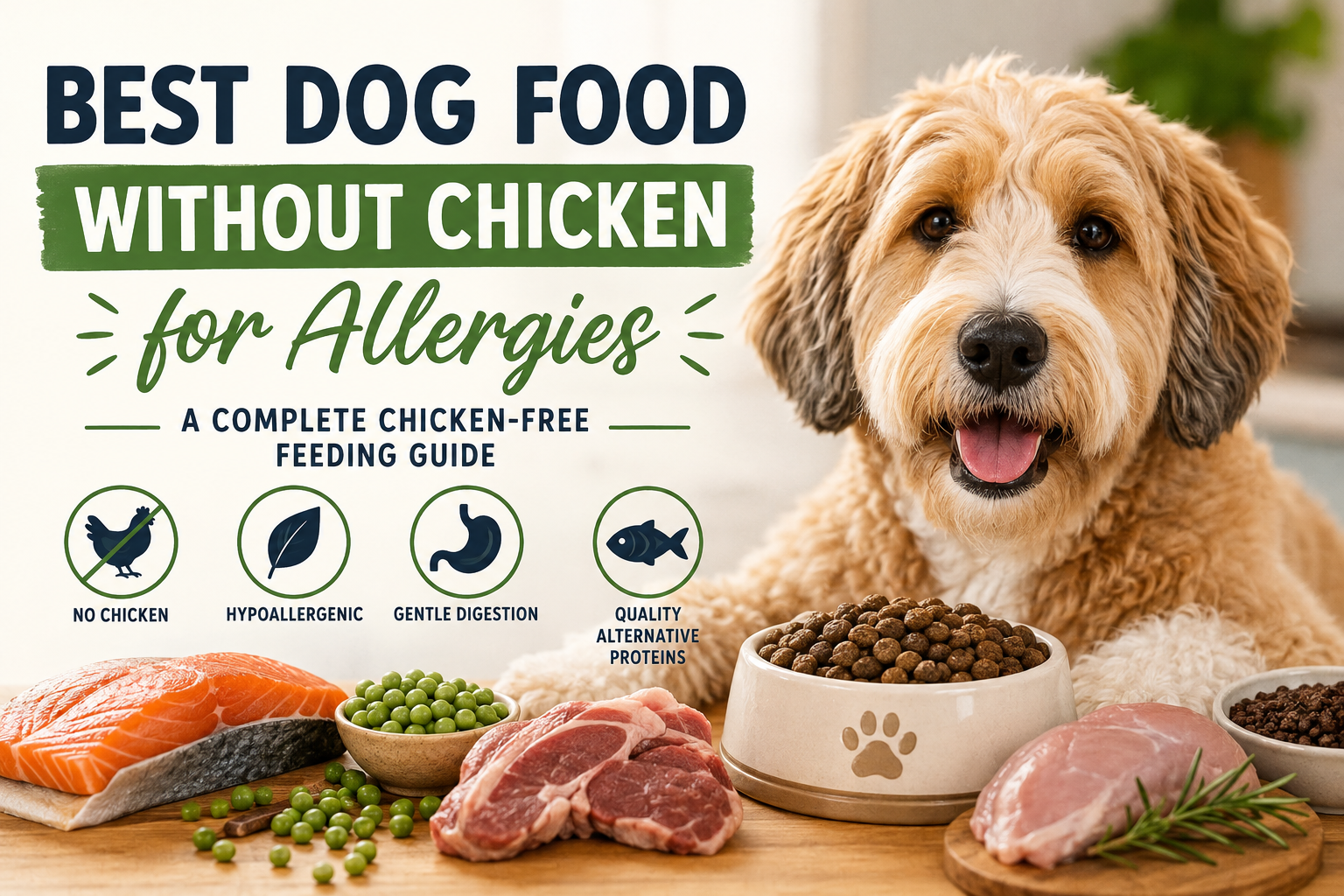
Best Dog Food Without Chicken for Allergies:
A Complete Chicken-Free Feeding Guide
If your dog is constantly scratching, suffering from recurring ear problems or experiencing digestive upsets, you may have started wondering whether something in their food is responsible.
And chicken often ends up near the top of the suspect list.
Chicken is extremely common in commercial dog food. You’ll find it in obvious places such as chicken recipes, but it can also appear as chicken meal, poultry ingredients, broth, stock or other less obvious ingredients.
That can make finding genuinely chicken-free dog food surprisingly frustrating.
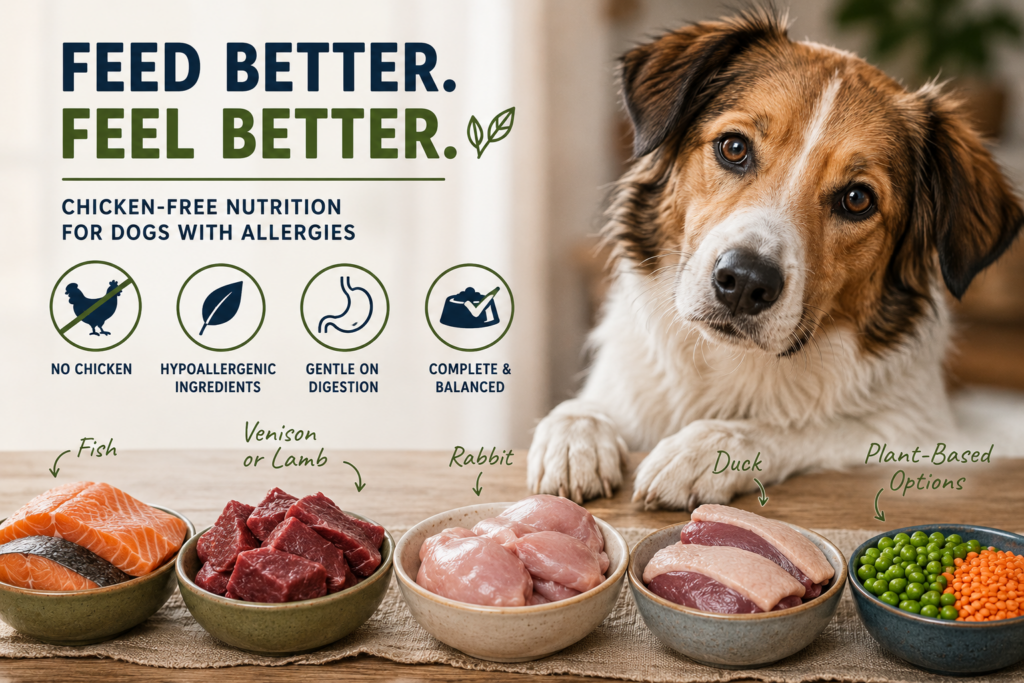
The good news is that there are plenty of alternative protein sources available, including fish, lamb, venison, duck, rabbit and even insect protein.
But there’s an important point to understand first:
Removing chicken isn’t automatically the same as treating a food allergy.
If you suspect your dog has a genuine food allergy, it’s worth discussing it with your vet rather than repeatedly changing foods and trying to identify the culprit yourself.
In this guide, we’ll look at how to choose dog food without chicken for allergies, what ingredients to watch for, alternative proteins to consider and how to make the switch safely.
Can Dogs Really Be Allergic to Chicken?
Yes. Dogs can develop adverse reactions to ingredients in their diet, including proteins.
However, an itchy dog isn’t automatically a dog with a food allergy.
Skin problems can have numerous causes, including environmental allergies, parasites and infections. Digestive symptoms can similarly have many possible explanations.
This is why diagnosing a food allergy from symptoms alone can be difficult.
If chicken genuinely is causing your dog’s problems, simply switching from one chicken-based food to another isn’t likely to solve the issue.
Instead, your vet may recommend a carefully controlled dietary trial to investigate whether food is involved.
Signs That Your Dog May Be Reacting to Their Food
Possible signs associated with adverse food reactions can include:
- persistent itching
- licking or chewing the paws
- recurring ear problems
- irritated or inflamed skin
- digestive upset
- loose stools
- vomiting
- excessive wind
- recurrent skin problems
These symptoms aren’t specific to chicken allergies, though.
That’s important.
For example, a dog repeatedly scratching its ears may have an ear infection rather than a chicken allergy. Similarly, diarrhoea doesn’t automatically mean that a particular protein is responsible.
Don’t remove major parts of your dog’s diet solely on the basis of one symptom.
If problems are persistent or recurring, speak to your vet.
Chicken Allergy vs Chicken Intolerance
The terms allergy and intolerance are often used interchangeably, but they aren’t quite the same thing.
Food allergy
A genuine food allergy involves an immune response to something the dog has eaten.
Food intolerance
An intolerance doesn’t involve the same immune mechanism. Instead, the dog may simply have difficulty tolerating or digesting a particular ingredient.
From an owner’s perspective, both can make choosing food difficult.
But determining what’s actually happening is useful because it affects how you approach your dog’s diet.
Why Is Chicken in So Many Dog Foods?
One reason owners have difficulty avoiding chicken is simply that it’s incredibly common.
Chicken is a widely used source of animal protein and can appear in dry food, wet food, treats and complementary products.
You might pick up a bag prominently labelled:
“Salmon”
or
“Lamb”
and reasonably assume you’ve found an alternative.
But the recipe may still contain chicken-derived ingredients.
That’s why the front of the bag isn’t enough.
Turn it over and read the complete ingredient list.
Hidden Sources of Chicken in Dog Food
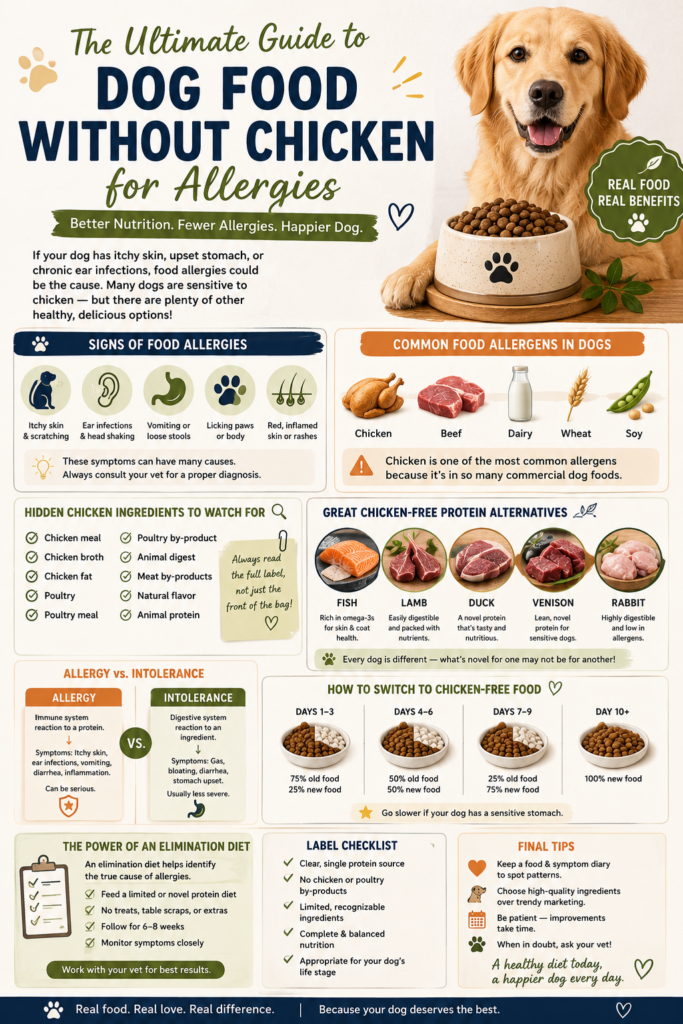
If you’re deliberately avoiding chicken, don’t just look for the word chicken at the beginning of the ingredient list.
Depending on the product, chicken or poultry-derived ingredients may appear under various descriptions.
Potential ingredients to investigate include:
- chicken
- chicken meal
- chicken protein
- chicken liver
- chicken broth
- chicken stock
- chicken gravy
- poultry
- poultry meal
- poultry protein
- animal protein
- animal derivatives
- meat derivatives
- animal digest
This doesn’t mean every vaguely described animal ingredient definitely contains chicken.
It means that if you’re trying to conduct a strict chicken-free dietary trial, ambiguity matters.
When the source isn’t clear, contact the manufacturer before assuming the food is suitable.
What About Chicken Fat?
This is where things become slightly more complicated.
Food allergies generally involve reactions to proteins.
Highly purified fats may contain very little protein, but that doesn’t mean owners investigating a suspected allergy should automatically decide that every chicken-derived fat is acceptable.
If your vet has recommended a strict elimination diet, follow their instructions regarding which ingredients must be excluded.
The same principle applies to treats, chews, supplements and flavoured medications.
A dietary trial isn’t particularly useful if the main meal is chicken-free but chicken-containing treats are being handed out every afternoon!
Best Alternatives to Chicken in Dog Food
Once chicken is removed, you still need a nutritionally appropriate source of protein.
Fortunately, there are plenty of possibilities.
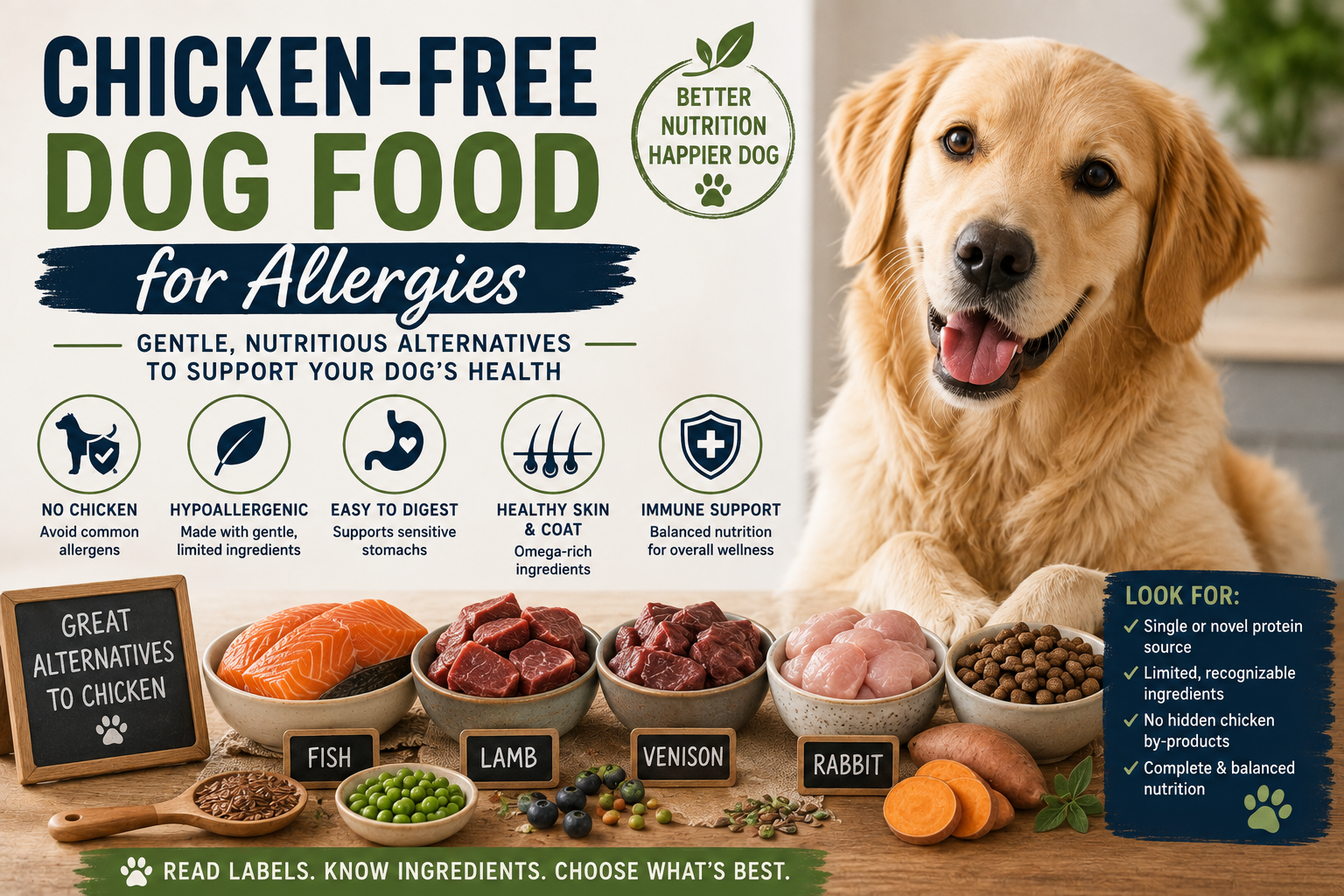
Fish
Fish-based dog foods are extremely popular alternatives.
Common options include:
- salmon
- white fish
- trout
- herring
- cod
Fish can also provide useful omega-3 fatty acids.
But remember our earlier rule:
A bag displaying a huge salmon on the front isn’t necessarily chicken-free.
Always check the complete formulation.
Lamb
Lamb is another widely available alternative.
It can be useful when you’re simply looking for a chicken-free food, although whether lamb qualifies as a genuinely novel protein depends on what your dog has eaten previously.
A dog that’s eaten lamb-flavoured foods and treats for years has obviously been exposed to lamb before.
Duck
Duck is often suggested for dogs requiring an alternative animal protein.
However, don’t assume that “duck recipe” automatically means “no chicken.”
Some commercial foods contain multiple animal proteins.
Check the label carefully.
Venison
Venison is less commonly encountered in many dogs’ everyday diets and may therefore be useful in certain specialised diets.
It tends to be less widely available and potentially more expensive than proteins such as chicken, beef or fish.
Rabbit
Rabbit is another protein sometimes found in limited-ingredient and specialist diets.
As with venison, availability and cost can be drawbacks.
Insect Protein
Insect-based dog food has become an interesting alternative, particularly for owners looking beyond traditional meat proteins.
It can provide another dietary option for some dogs and is increasingly appearing in specialist pet foods.
Whether it’s appropriate for your individual dog should depend on the complete formulation rather than the novelty of the protein alone.
What Does “Novel Protein” Actually Mean?
You’ll frequently see the phrase novel protein when researching dog food for allergies.
It sounds complicated, but the basic idea is straightforward.
A novel protein is generally a protein your dog hasn’t previously eaten.
That’s why there isn’t one universal novel protein.
Rabbit might be completely new to one dog.
Another dog may have eaten rabbit treats every week for three years.
For that second dog, rabbit isn’t novel at all.
This is another reason keeping track of your dog’s previous foods, treats and chews can be useful when discussing dietary problems with your vet.
What Is a Limited Ingredient Dog Food?
A limited ingredient diet aims to keep the recipe relatively simple.
Instead of combining numerous animal proteins and other ingredients, the formulation may concentrate on a smaller number of carefully selected ingredients.
This can make identifying and avoiding particular ingredients easier.
However:
“Limited ingredient” doesn’t automatically mean “hypoallergenic.”
You still need to examine what’s actually in the food.
Look for:
- clearly identified animal proteins
- a complete ingredient list
- nutritional suitability for your dog’s life stage
- ingredients your dog needs to avoid
- clear feeding instructions
For a dog undergoing a veterinary-supervised elimination trial, your vet may recommend something more specific than an ordinary over-the-counter limited-ingredient food.
Hydrolysed Dog Food: Another Option for Allergies
You may also hear your vet mention a hydrolysed diet.
Hydrolysed diets are different from simply buying a chicken-free food.
The proteins in these diets are processed into much smaller components, with the aim of making them less likely to trigger an immune response.
Veterinary hydrolysed diets can therefore play an important role in investigating and managing suspected food allergies.
If your dog has persistent symptoms or appears to react to several different foods, this is something worth discussing with your vet.
Is Grain-Free Dog Food Better for Chicken Allergies?
Not necessarily.
This is an important misconception.
Chicken-free and grain-free describe two completely different things.
If chicken protein is the problem, removing rice, oats, barley or other grains doesn’t automatically help.
Likewise, a grain-free food may still contain chicken.
Rather than choosing a product simply because the packaging says grain-free, concentrate on the specific ingredient you’re trying to avoid and whether the overall diet is nutritionally appropriate.
How to Read a Dog Food Label When Avoiding Chicken
Get into the habit of ignoring the glamorous front of the packet for a moment.
Flip it over.
1. Find the ingredient list
Look through the entire list rather than just the first ingredient.
2. Identify every animal protein
Don’t stop when you see salmon, lamb or duck.
Check whether chicken or poultry appears further down.
3. Look for vague descriptions
If you’re conducting a strict elimination diet, ingredients with unclear animal origins may warrant further investigation.
4. Check treats too
This catches plenty of owners out.
Your dog’s main food might be completely chicken-free while their:
- training treats
- dental chews
- biscuits
- table scraps
- supplements
still contain chicken.
5. Check recipes regularly
Don’t assume that because you’ve bought the same food for two years, the formulation will remain identical forever.
Manufacturers can reformulate products.
Check the packaging periodically, particularly when avoiding an ingredient for medical reasons.
Don’t Forget Cross-Contamination
Dogs requiring strict avoidance present another challenge.
A product may not intentionally contain chicken but could potentially be manufactured in facilities handling other animal proteins.
For many dogs, this may never become relevant.
For a dog undergoing a strict veterinary elimination trial, however, even small unintended exposures can complicate interpretation of the results.
If this is a concern, contact the manufacturer and ask about its production and allergen-control procedures.
How to Choose a Good Chicken-Free Dog Food
Don’t judge food solely by what has been removed.
Your dog still needs a nutritionally balanced diet.
A good chicken-free food should be appropriate for your dog’s:
- age
- size
- life stage
- activity level
- body condition
- individual health requirements
For most healthy dogs eating commercial food, look for a product described as complete rather than complementary.
A complementary food is designed to be fed alongside other foods and may not provide everything required as the sole diet.
Puppies have different nutritional requirements from adults, while certain health conditions can require specialised veterinary diets.
When in doubt, ask your vet.
How to Switch Your Dog to Chicken-Free Food
If you’re simply changing foods and your vet hasn’t instructed you otherwise, a gradual transition can help reduce digestive upset.
A typical change might look something like:
| Days | Existing Food | New Chicken-Free Food |
|---|---|---|
| 1–3 | 75% | 25% |
| 4–6 | 50% | 50% |
| 7–9 | 25% | 75% |
| Day 10 onward | 0% | 100% |
Some dogs need a slower transition.
However, if your vet has prescribed a specific elimination diet, follow their transition instructions rather than a generic schedule.
Keep a Food and Symptom Diary
Here’s one of the simplest things you can do when investigating a suspected dietary problem.
Keep notes.
Record:
- what food your dog eats
- treats and chews
- table scraps
- supplements
- digestive problems
- itching
- paw licking
- ear problems
- changes in stool
- skin flare-ups
You don’t need anything fancy.
A notebook or note on your phone will do.
Patterns that are almost impossible to remember over several weeks can become much easier to spot when they’re written down.
It can also give your vet much more useful information.
The Problem With Constantly Changing Dog Foods
When a dog is itchy, it’s tempting to keep experimenting.
Chicken doesn’t work?
Try salmon.
Still scratching?
Try lamb.
Then duck.
Then grain-free.
Then raw.
Then something else.
Before long, your dog has eaten practically every protein available and you still don’t know what caused the original problem.
Constant switching can make dietary investigation harder.
If symptoms are persistent, a structured approach with your vet is far more useful than repeatedly trying random foods.
What Is an Elimination Diet?
An elimination diet trial is a controlled way of investigating whether food is contributing to your dog’s symptoms.
Your vet may recommend a carefully selected diet containing ingredients your dog hasn’t previously eaten or a veterinary hydrolysed diet.
The important word is controlled.
During the trial, other foods can interfere with the results.
That can include seemingly harmless extras such as:
- treats
- leftovers
- flavoured chews
- other pet food
- certain supplements
The process takes patience, but it’s much more informative than simply buying something labelled “hypoallergenic” and hoping for the best.
When Should You See a Vet?
Speak to your vet if your dog has persistent or recurring:
- itching
- skin inflammation
- ear infections
- vomiting
- diarrhoea
- hair loss
- sores or skin lesions
- unexplained weight loss
- poor appetite
You should also seek veterinary advice before attempting a highly restrictive homemade diet.
Removing chicken is relatively straightforward.
Creating a nutritionally complete long-term diet from scratch is much more complicated.
Chicken-Free Dog Food Checklist
Before buying a new food, ask yourself:
- Does the complete ingredient list contain chicken?
- Does it contain poultry or vaguely described animal ingredients?
- What is the primary protein source?
- Has my dog eaten that protein before?
- Is this a complete food appropriate for my dog’s life stage?
- Do my dog’s treats and chews also need changing?
- Has my vet recommended a formal elimination or hydrolysed diet?
- Do I know what I’m actually trying to eliminate?
That final question might be the most important of all.
Frequently Asked Questions
What is the best dog food without chicken for allergies?
There isn’t one chicken-free food that’s best for every dog. Suitable choices depend on your dog’s age, health, previous diet and the ingredient they’re actually reacting to. Fish, lamb, duck, rabbit, venison and other proteins may all be possibilities. Dogs with suspected genuine food allergies may benefit from a veterinary-supervised elimination or hydrolysed diet.
How do I know if my dog is allergic to chicken?
Possible signs can include itching, recurrent skin or ear problems and digestive symptoms.
However, these symptoms have many possible causes, so they don’t prove a chicken allergy. Speak to your vet about appropriate investigation rather than diagnosing the allergy from symptoms alone.
Can a dog with a chicken allergy eat turkey?
Don’t automatically assume so. If you’re carrying out an elimination diet or your dog has a confirmed allergy, ask your vet which animal proteins should be avoided.
Is salmon dog food normally chicken-free?
Not always. A salmon-based food can still contain chicken or other poultry ingredients. Read the complete ingredient list rather than relying on the flavour shown on the front of the packaging.
Is chicken-free dog food the same as hypoallergenic dog food?
No. Chicken-free simply means chicken isn’t included in the formulation as an intentional ingredient. A dog can be allergic or sensitive to something completely different.
Is grain-free food good for dogs allergic to chicken?
Grain-free food isn’t automatically beneficial for a chicken allergy. A grain-free recipe may still contain chicken, while a food containing grains may be completely chicken-free.
What protein can I give my dog instead of chicken?
Depending on your dog’s individual needs and previous diet, alternatives can include fish, lamb, duck, rabbit, venison and other protein sources. Your vet may recommend a specific novel or hydrolysed protein when investigating an allergy.
Can dog treats contain chicken too?
Absolutely. Chicken and poultry ingredients are common in treats, chews and other products. If your dog needs strict chicken avoidance, check everything they eat rather than concentrating only on their main meals.
How quickly will my dog’s allergy improve after stopping chicken?
Don’t expect an overnight answer. Dietary investigations can take time, particularly when skin symptoms are involved. If you’re conducting an elimination trial, follow the duration and instructions provided by your vet rather than deciding after a few days whether the new diet has worked.
Should I make homemade chicken-free dog food?
Removing chicken from a homemade recipe is easy; ensuring the resulting diet provides all the nutrients your dog requires is considerably harder. Long-term homemade diets should ideally be formulated with appropriate veterinary nutritional guidance.
Final Thoughts: Finding the Right Dog Food Without Chicken
Finding dog food without chicken for allergies doesn’t have to mean endlessly wandering through the pet-food aisle reading every packet in sight.
Start with the ingredient list.
Look beyond the flavour printed on the front of the bag and identify every animal protein in the recipe. Check treats and chews as well as your dog’s main food, and don’t assume terms such as grain-free, natural or limited ingredient automatically make a product appropriate for an allergic dog.
Most importantly, remember that removing chicken only helps if chicken is actually part of the problem.
If your dog has persistent itching, recurring ear or skin problems or ongoing digestive symptoms, involve your vet. A structured dietary investigation can give you far more useful information than continually switching between foods.
Once you know what your dog needs to avoid, choosing the right food becomes considerably easier — and you’ll have a much better chance of finding a diet that keeps both their stomach and their skin happy.