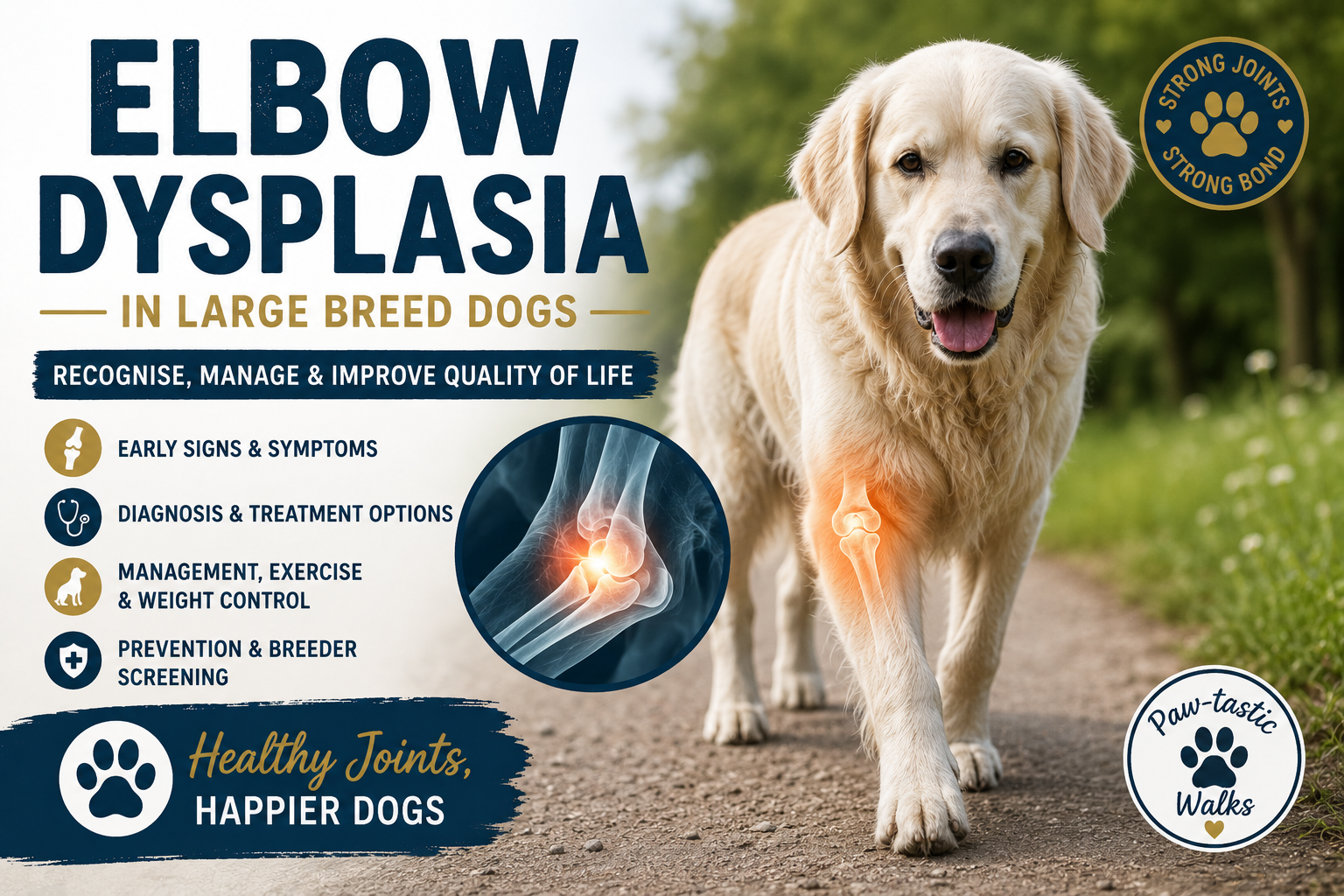
If your big dog has started showing an abnormal gait on walks, you’re not alone. Elbow dysplasia in large breed dogs is a common cause of front leg pain, and it often shows up in everyday moments, like slowing on hills, hesitating at kerbs, or limping after a fun run.
In simple terms, elbow dysplasia means the elbow joint didn’t form perfectly as your dog grew. It can lead to rubbing inside the joint, soreness, and early arthritis.
On daily dog walks, it often looks like stiffness after rest, forelimb lameness such as a short stride, or a limp that comes and goes. The first thing to do is book a vet check, especially if it keeps happening.
Around East Cornwall, muddy lanes, coast paths, and steep bits near Looe and Polperro can bring these signs out sooner.
The good news is many dogs do well with early care, sensible exercise, and support from local dog walking services, including a reliable dog walker who follows a plan.
What elbow dysplasia is, and why large breed dogs get it more often
Think of the elbow like a three-piece hinge that has to move smoothly, thousands of times a day.
In dogs, the elbow is made of three bones meeting together: the humerus (upper arm), plus the radius and ulna (lower arm). If those parts don’t fit perfectly, pressure doesn’t spread evenly.
Over time, the joint gets sore and inflamed.
Elbow dysplasia is a “development” problem, meaning it often starts while a puppy is growing. Many large breed puppies show their first signs between about 5 and 18 months.
Some pups limp early, then seem to “grow out of it.” Others look fine until adulthood, when wear and tear adds up and arthritis appears.
Large breed dogs are more at risk because they grow fast and carry more weight through the front end.
Add a growth spurt, a little extra puppy fat, and lots of high-impact exercise, and the elbows can struggle. Genetic predisposition plays a big part. If close relatives had elbow issues, the odds go up.
If you want a quick background on the joint itself, the Wikipedia page on the elbow gives a simple overview of how this hinge works.
Elbow dysplasia isn’t caused by anything you did “wrong.” But it can be made worse by things we can control, like diet, growth rate, and body condition.
That’s why early support matters, even if your dog still wants to charge about like a tank.
For more detailed veterinary guidance, the American College of Veterinary Surgeons overview of canine elbow dysplasia explains how the condition affects the joint and why arthritis can follow.
Common elbow dysplasia types vets look for (FCP, UAP, OCD)
Vets often use “canine elbow dysplasia” as an umbrella term. Under that umbrella are a few common problems:
- Fragmented coronoid process: a small piece of bone in the ulna doesn’t stay smooth and stable.
- Ununited anconeal process: a part of the ulna that should fuse during growth doesn’t fully join.
- Osteochondrosis dissecans: cartilage growth defects in the joint surface don’t form normally, which can create a painful flap.
These issues can lead to early arthritis. More than one can happen in the same elbow, and both elbows can be affected.
Breeds at higher risk, plus the role of genetics and rapid growth
Some breeds show up again and again in elbow dysplasia discussions. That includes Labrador Retriever, Golden Retriever, German Shepherd Dog, Rottweiler, Bernese Mountain Dog, and Newfoundland. Many other large and giant breeds can be affected too.
Genetics matters because joint shape, cartilage strength, and growth patterns run in families. In the UK, elbow scoring schemes exist to help breeders reduce risk over time.
The British Veterinary Association guide to elbow dysplasia is a helpful place to understand the inherited side.
Growth and weight matter because extra load increases joint stress. Overfeeding a large breed pup can push fast weight gain, even if the puppy looks “healthy.”
You can’t change genetics, but you can control steady growth, a lean body condition, and smart exercise.
Signs on walks: how to spot elbow pain early (before it becomes arthritis)
Most owners don’t notice elbow dysplasia during quiet time at home. It tends to show up when you’re out walking, when your dog has to shift weight, pull slightly, or deal with uneven ground.
It’s also something a professional dog walker may spot first, because they see lots of dogs moving on lead.
If you’re searching for pet walking near me or comparing dog walking services, it’s worth asking if the walker is happy to follow a vet plan. Early elbow pain can flare with rough play, hard stops, and long off-lead sprints, and ignoring it risks progressive arthritis from long-term joint wear.
Group dog walks can be brilliant for social dogs, but they’re not always the best match during a flare-up.
Here are practical, real-world red flags to watch for on daily dog walks:
- Forelimb lameness that’s worse after rest, then improves after a few minutes
- Slowing down on hills, or “bunny hopping” down steep steps
- Turning a paw out, or taking short choppy steps in front
- Hesitating to jump into the car, or avoiding kerbs
- Stopping to sit or lie down sooner than normal
If you see these more than once, pause the bigger adventures. Swap to calm, controlled lead walks, and book a vet check.
If you use puppy walking services, tell your walker straight away, because puppy joints can be sensitive during fast growth.
For a clear owner-friendly overview of symptoms and treatment options, this PetMD article on elbow dysplasia in dogs is a useful read.
Movement clues: stiffness, limping, short steps, and the ‘warming up’ pattern
A classic pattern is, “He looks stiff when he gets up, then he’s fine.” That warming-up effect can fool people into waiting. It still needs a vet check, because it often means the joint is sore at the start of movement.
Other clues include elbows held slightly away from the body, or a front end that looks tight and restricted. Some dogs shift weight onto the back legs when stopping, like they’re trying to unload the elbows.
You may also notice your dog avoids sharp turns, or swings wide on corners.
A simple home tip: keep a quick note on your phone for one week. Track:
Which leg, what time, what surface, and what happened just before (sleep, play, hills, ball chasing). That little log helps your vet and helps your dog walker plan safer routes.
If you need a steady exercise routine during this time, choose dog exercise services that can do one-to-one, on-lead walks, rather than high-energy play.
When it is urgent: Elbow joint swelling, yelping, sudden non weight bearing lameness
If your dog suddenly won’t put weight on a front leg, or yelps when the elbow is touched, treat it as urgent.
That could be a sprain, a torn nail, a paw injury, or another joint problem. Call your vet the same day for advice.
Don’t give human pain relief. Many common human meds are dangerous for dogs. Keep your dog quiet, prevent jumping, and use a lead for toilet breaks until you get guidance.
Diagnosis and treatment: what your vet may recommend, and what owners can do at home
A vet visit usually starts with questions about when the limp happens, which leg seems worse, and what exercise your dog does.
Then comes an orthopedic examination. The vet may watch your dog walk and trot, feel the joint, and gently flex and extend the elbow to check for pain or reduced range of motion.
Imaging is often needed. X-ray imaging can show signs of joint change and arthritis, but small fragments don’t always show clearly. Some cases need a CT scan, because CT can pick up fine detail inside the elbow.
If you want a specialist-level explanation of why fit and forces matter in the elbow, Fitzpatrick Referrals has a helpful page on canine elbow dysplasia.
Surgical treatment depends on age, severity, and how much arthritis is present:
Conservative care may be enough for mild cases or older dogs with stable signs. That includes weight management, controlled exercise, pain relief, and physical therapy.
Surgery may be advised for younger dogs or certain joint changes like medial compartment disease, often using arthroscopy (a small camera).
Surgery can improve comfort and function, but degenerative joint disease risk may remain, so long-term management still matters.
If you’re planning rehab walks, it can help to budget for extra support, because dog walking rates can vary for short structured visits compared with long adventures. The goal is steady progress, not big mileage.
Conservative care that really helps: weight management, calm exercise, physical therapy, pain relief
If there’s one home change that helps almost every sore elbow, it’s keeping your dog lean. Less weight means less force through each step.
Ask your vet for a target weight and body condition score, then measure meals.
Exercise should be calm and repeatable. Avoid long fetch sessions, jumping off walls, and sprinting on slippery ground.
Think “slow miles,” not “fast chaos.” Swimming and hydrotherapy for dogs can be great if your vet agrees, because they build muscle with less joint impact.
Pain relief is often needed. Many dogs do well on vet-prescribed anti-inflammatory medications. Never adjust doses without guidance.
Joint supplements like omega-3s, glucosamine and chondroitin, or other joint products may help comfort for some dogs, but they’re not a cure. Treat them as support, not the main plan.
A simple weekly routine that suits many dogs:
2 to 3 short walks daily, steady pace, mostly flat routes, and rest days if your vet suggests them.
For at-home calm time, gentle sniff games and short training sessions help. If your dog needs a safe outlet, a few minutes with tug toys can be easier on elbows than repeated ball throwing (keep it controlled and stop if your dog gets wild).
Surgery options and recovery: what to expect in simple terms
Arthroscopic surgery is a common surgical approach. A surgeon uses a tiny camera and tools to look inside the joint and treat problem areas. The exact procedure depends on what’s found.
Recovery usually has phases:
Early stage (first weeks): strict rest, controlled lead toilet breaks, and pain control.
Middle stage: short lead walks build slowly, often with physio exercises.
Later stage: gradual return to longer walks, avoiding high-impact play at first.
This is where a reliable dog walker can be a real help, once your vet clears it. Rehab walks need calm handling and steady pacing, not excited group play.
Ask your walker to stick to your vet’s instructions, and to avoid off-lead situations until you’re told it’s safe.
Safer walking and prevention for big dogs in East Cornwall: routines, gear, and smart exercise
Cornwall is beautiful, but it asks a lot of joints. Coastal paths can be uneven, lanes get muddy, and winter rain makes stones slick. Prevention is about small choices, repeated daily.
For pups and teens, aim for steady growth, not speed. Feed a large-breed puppy diet if your vet recommends it. Use measured meals, and avoid pushing long hikes too soon.
For adult dogs, keep them lean, warm up with a few minutes of slow walking, and choose kinder routes when your dog is stiff.
Wet footing matters too. If you’re unsure about safe outings in bad weather, this guide on walking your dog in the rain has practical tips for comfort and grip.
If your dog is on rest or controlled exercise, you can still use local dog walking support. Many dog walking services can do short, steady lead walks, which is often better than one long trek.
For peace of mind on quieter routes, a tracker can help if your dog is a flight risk. Here’s a helpful look at the Tractive GPS dog tracker for owners who want that extra layer of safety.
Puppy and teenage dog rules: building strong joints without overdoing it
Large breed puppies can keep growing until around 18 months, sometimes longer. Their growth plates and joints need time to harden and settle.
Helpful rules that keep exercise joint-friendly:
Short, frequent walks beat one long march, especially to protect growth plates.
Add sniff breaks, because sniffing tires the brain too.
Use gentle hills, but avoid repeated steep climbs.
Skip long runs with bikes, especially on hard ground.
Avoid repeated fetch on tarmac, because sharp stops jar elbows.
Ask your vet for a growth and exercise plan if your pup is at risk. If you use puppy walking services, choose someone who won’t “over-achieve” the mileage.
Walking set ups that reduce strain: lead handling, pacing, and supportive harness fit
Pulling loads the front end, and sudden stops hit the elbows hard. A good set up encourages a loose lead, steady pace, and fewer jolts.
A well-fitting harness can help spread pressure and improve control. This guide to choosing a well-fitting harness for large dogs is a solid starting point if your dog is strong or sensitive around the neck.
Also think about:
Keep nails trimmed for grip on wet stone.
Avoid sharp turns on slippery paths.
Slow down before steps or kerbs.
Use calm lead skills, not constant corrections.
If you’re worried about off-lead dogs rushing up during a rehab walk, this advice on dealing with loose aggressive dogs on walks can help you plan safer routes and responses.
And if elbow pain has made you anxious about getting out at all, you’ll find balanced guidance in is dog walking dangerous. The risks are real, but they’re manageable with good habits that may help avoid the need for surgical treatment later in life.
Conclusion
Elbow dysplasia in large breed dogs is common, and it often shows up first on walks. Stiffness after rest, a stop-start limp, or slowing on hills are all worth taking seriously.
Early vet support, plus smart exercise, can protect joints and keep your dog happy on daily dog walks.
A simple next-step checklist helps: book the vet, manage weight, switch to controlled lead walks, and plan rehab with clear rules.
If you use dog walking services in East Cornwall, choose a professional dog walker who understands canine elbow dysplasia, keeps things calm, follows vet guidance, and avoids rough play.
Need help setting up a safe walking routine? You can reach out here: https://paw-tastic-walks.com/contact-us/