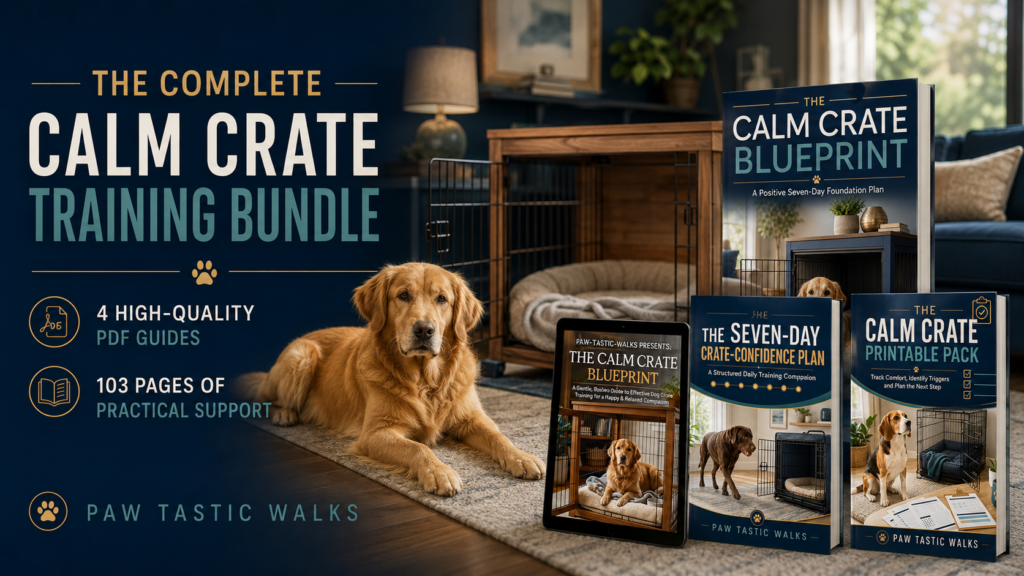
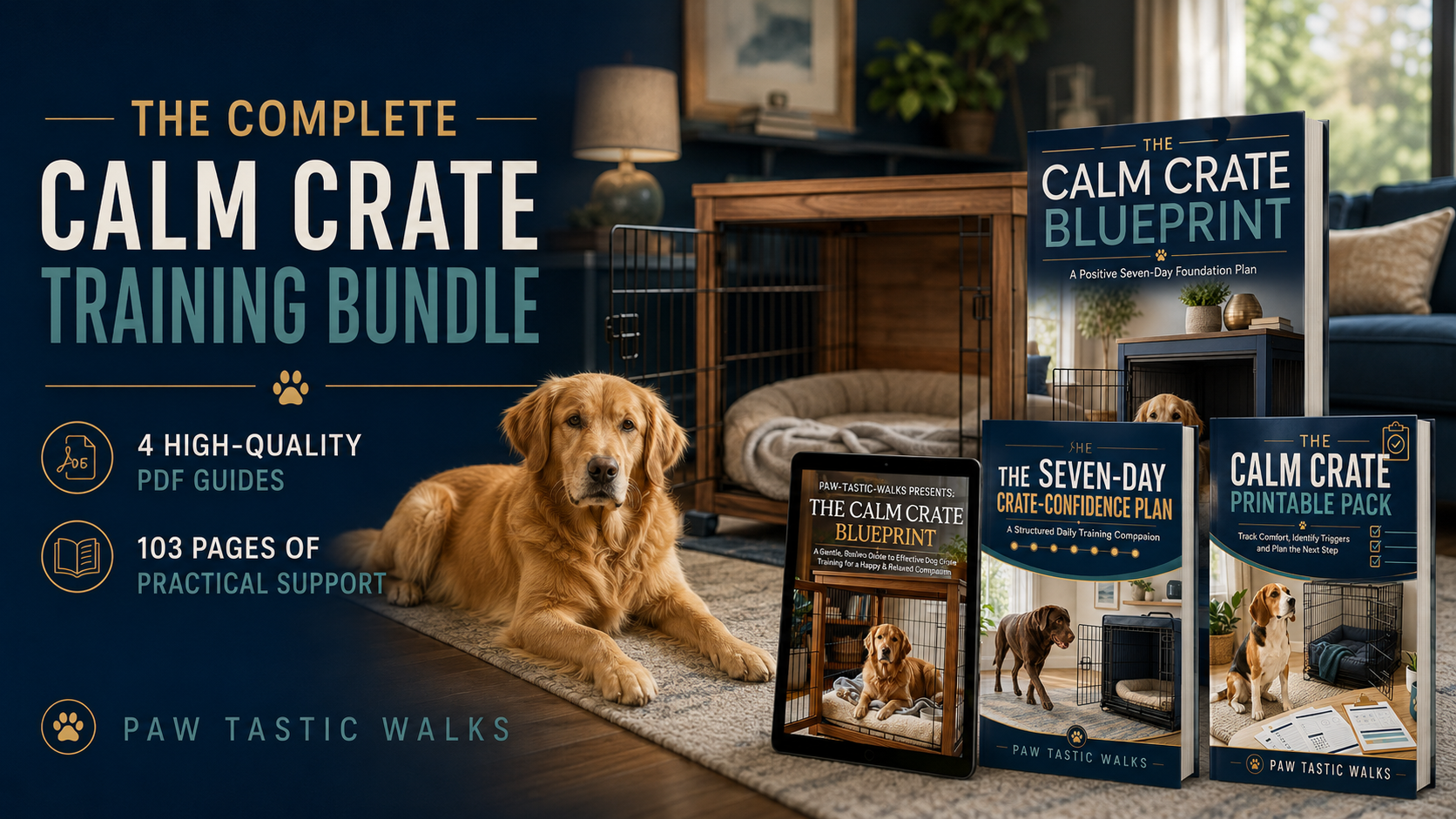
The Complete Calm Crate Training Bundle
Four High-Quality PDF Ebooks and Workbooks for Calmer, More Positive Crate Training
Crate training should help a dog feel comfortable, secure and able to rest.
Unfortunately, many owners find themselves dealing with whining, barking, refusal to enter, nighttime restlessness, toilet accidents or panic when the crate door begins to close.
The Complete Calm Crate Training Bundle provides a clear, compassionate and practical alternative to force, punishment and confusing online advice.
This substantial digital package contains four professionally presented PDF resources with 103 pages in total.
You will receive:
✅ A comprehensive 56-page Calm Crate Blueprint
✅ A practical 20-page crate-training handbook
✅ A structured 12-page seven-day action plan
✅ A reusable 15-page printable training workbook
Together, these four resources help you understand what may be happening beneath your dog’s behaviour, introduce the crate gradually, follow a manageable training structure and record genuine progress.
Start Building a Calmer Crate Experience Today
GET THE COMPLETE FOUR-PDF BUNDLE
Instant digital access. No physical product will be posted.
Does the Crate Feel More Like a Battle Than a Safe Resting Place?
You may have purchased a crate expecting your dog to settle naturally.
Instead, your dog may:
- Refuse to go inside
- Stretch towards food while keeping their back feet outside
- Whine or bark when the door moves
- Scratch, bite or push against the crate
- Become restless when you walk away
- Stop eating when confined
- Wake repeatedly during the night
- Have unexpected toilet accidents
- Rush out as soon as the door opens
- Show signs of fear before entering
- Become more distressed with every training attempt
- Settle beside you but struggle when left alone
These behaviours are not necessarily signs of stubbornness, spite or deliberate disobedience.
Your dog may be worried about confinement, uncertain about what will happen next, uncomfortable with the environment or progressing faster than they can manage.
Some dogs also have physical, medical or separation-related needs that ordinary crate-training advice cannot resolve.
The Calm Crate Training Bundle helps you stop guessing and begin observing what your individual dog is communicating.
A Complete Learn, Understand, Practise and Track System
Random tips can leave owners wondering which piece of advice to try next.
This package brings the different parts of crate training together into one coordinated system.
📘 Learn
Understand why dogs may struggle with confinement and why safety, predictability and choice matter.
📗 Understand
Discover how to choose and prepare a crate, read body language and introduce each training stage gradually.
📙 Practise
Follow a structured seven-day foundation plan with one clear training priority each day.
📝 Track
Record sessions, identify triggers, monitor body language and decide what to make easier next time.
You are not purchasing one short leaflet containing a few generic crate-training tips.
You are receiving four detailed PDF ebooks and workbooks containing 103 pages of practical guidance and reusable resources.
What Is Included in the Complete Bundle?
PDF 1: The Calm Crate Blueprint
A comprehensive 56-page guide to crate-related stress and confidence
The flagship ebook explores the emotional experience of crate training and explains why some dogs find confinement so difficult.
Rather than concentrating only on getting a dog inside and closing the door, the guide considers what may be happening before, during and after a stressful crate experience.
Topics include:
- When the crate becomes an emotional trigger
- What stress may look like inside the crate
- How fear can affect behaviour and physical control
- Why crate accidents are not always ordinary house-training failures
- The difference between mild frustration and genuine distress
- Why repeated overwhelming experiences can make crate fear worse
- Creating safety before expecting obedience
- Helping the dog develop more positive associations
- A seven-stage method for progressing from fear towards greater confidence
- Recognising when a training step is too difficult
- Troubleshooting without punishment
- Recovering after setbacks
- Making the crate part of a calmer household routine
- Knowing when an alternative arrangement may be more appropriate
- Building a positive long-term relationship with the crate
This guide is particularly helpful for owners who feel guilty, frustrated or confused because conventional crate-training advice has not worked for their dog.
DOWNLOAD THE COMPLETE CALM CRATE PACKAGE
PDF 2: The Calm Crate Blueprint Practical Guide
A focused 20-page handbook containing 15 practical chapters
The Practical Guide turns the principles of calm crate training into clear, manageable steps.
It helps you examine the complete setup—not merely the length of time your dog remains behind a closed door.
The 15 practical chapters cover:
- What successful crate training really looks like
- Deciding whether a crate is right for your dog
- Choosing the correct crate
- Preparing the crate and training environment
- Reading body language before progressing
- Building a positive crate association
- Teaching a clear crate cue
- Closing the door without creating fear
- Following the seven-day crate-confidence foundation
- Nighttime crate training
- Introducing distance and very short absences
- Adapting the plan for puppies, rescue dogs and adults
- Troubleshooting whining, barking and refusal
- Responding to accidents, setbacks and regression
- Moving beyond the crate
You will also find practical checkpoints, safety reminders, common mistakes and guidance about when to reduce the difficulty.
The guide does not treat every whine, bark or refusal in the same way. It encourages you to consider physical needs, timing, environment, training history and body language before deciding what to do next.
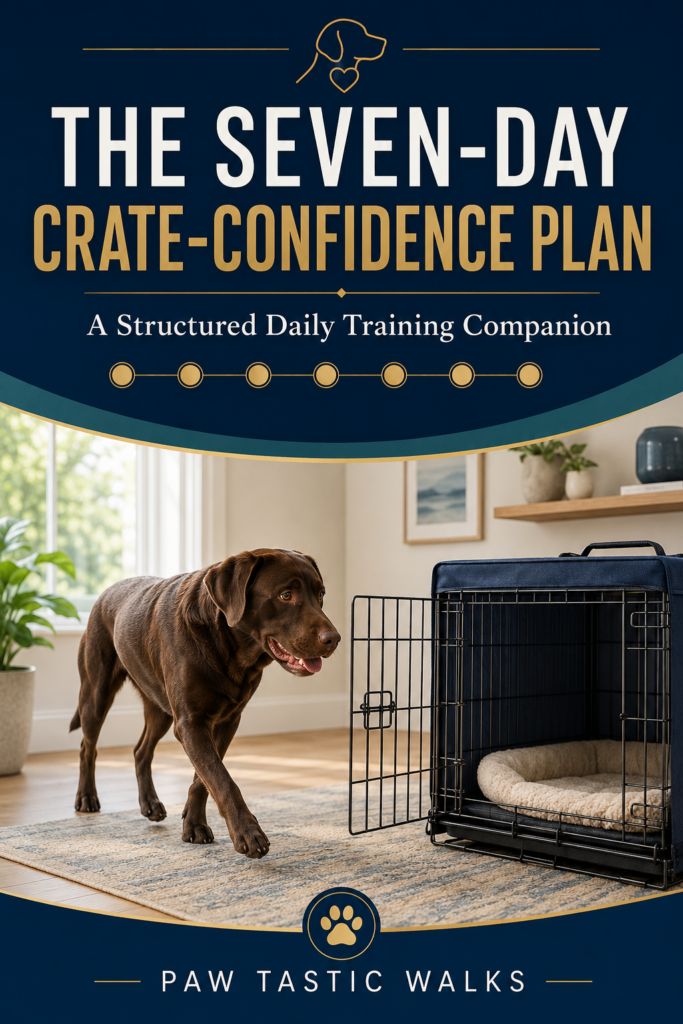
PDF 3: The Seven-Day Crate-Confidence Plan
A structured 12-page daily training companion
Understanding the theory is useful, but owners also need to know what to practise.
The Seven-Day Crate-Confidence Plan provides one manageable priority for each day.
Day 1: Observe and Invite Exploration
Allow your dog to investigate the crate while the door remains fully secured open. Begin at a distance where your dog can remain relaxed.
Day 2: Build Value Through Food and Calm Activity
Use suitable rewards, meals and supervised calm activities to help positive things happen in and around the crate.
Day 3: Introduce Crate and Release Cues
Add verbal cues only after the dog is already offering voluntary entry. Begin creating a predictable entry-and-release pattern.
Day 4: Make Door Movement Feel Ordinary
Introduce tiny pieces of door movement. A full closure is not the first step.
Day 5: Build Calm, Varied Duration
Add very small periods of duration while keeping the handler’s position easy and predictable.
Day 6: Introduce Small Handler Movements
Practise ordinary movements such as shifting in a chair, standing briefly or taking one step away.
Day 7: Review, Consolidate and Plan
Identify your dog’s strongest skill, earliest sign of tension and most appropriate training priority for the following week.
The action plan also contains:
- Five golden crate-training rules
- Recommended supplies
- Baseline assessment questions
- Daily preparation checklists
- Five exercises for each training day
- Suggested morning, midday and evening sessions
- Clear progression criteria
- End-of-day notes
- A sample household routine
- An accident troubleshooter
- An end-of-week review
- Guidance about when professional help may be appropriate
The seven days provide a helpful structure—not a rigid deadline.
You can repeat any day or return to an easier stage whenever your dog needs additional support.
GET INSTANT ACCESS TO ALL FOUR PDFS
PDF 4: The Calm Crate Printable Pack
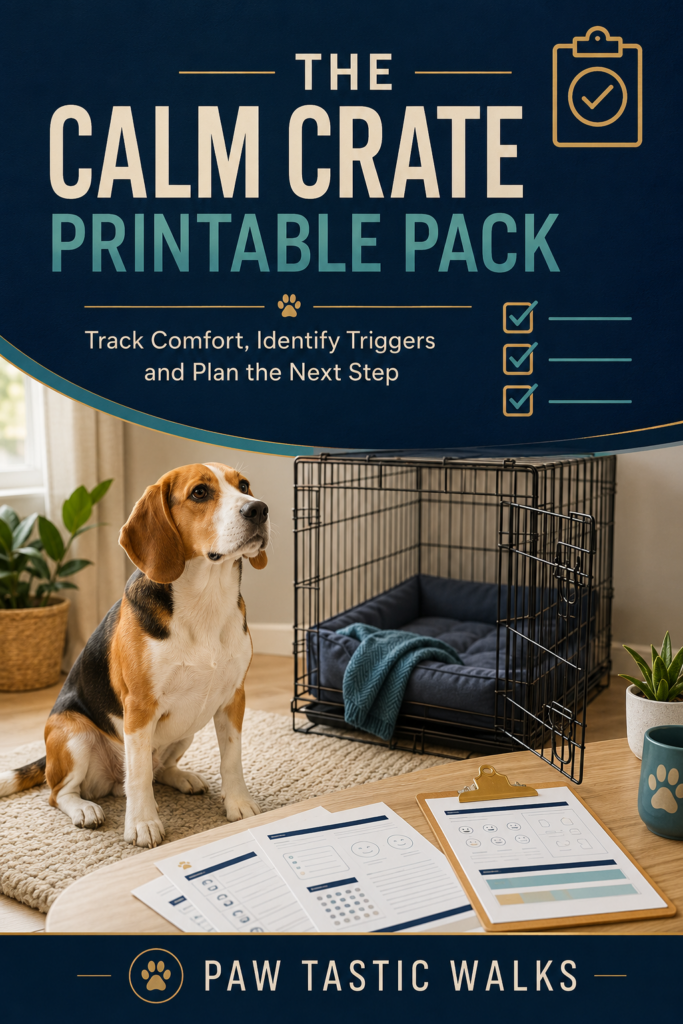
A reusable 15-page training and progress workbook
Memory can be surprisingly unreliable during a difficult training period.
A dog may appear to react “suddenly”, but written records can reveal that the door moved, food ended, the handler stepped away or the session lasted slightly longer immediately before the behaviour changed.
The Printable Pack helps you record what happened and identify useful patterns.
It includes:
Crate Setup and Safety Checklist
Review crate size, stability, airflow, temperature, bedding, water, placement and household safety rules.
Crate-Training Baseline
Describe your dog’s response at a distance, at the doorway, inside the crate, during door movement and when you begin to move away.
Daily Crate-Training Trackers
Record the exercise, door position, duration, body language and adjustment required for the next session.
Body-Language Observation Sheet
Monitor comfortable, uncertain and high-stress behaviours instead of recording only barking or whining.
Duration-Building Record
Compare the duration you planned with the duration your dog completed comfortably.
Distance and Movement Ladder
Introduce one small handler movement at a time and record the first movement that caused concern.
Whining and Barking Troubleshooter
Consider when the noise begins, what may be triggering it and which training step could be made easier.
Nighttime Crate and Toilet Log
Record bedtime, toilet breaks, waking patterns, resettling and relevant observations.
Seven-Day Progress Review
Compare all seven days and identify your dog’s strongest skill, comfortable stage, triggers and next priority.
Crate-Training Reset Plan
Use after a frightening event, refusal, accident or marked regression.
Questions for Your Vet or Behaviour Professional
Organise your observations and questions before seeking individual advice.
My Next Seven Days
Choose one realistic priority and plan a manageable second week.
Print fresh copies of the reusable worksheets whenever you need them.
Who Is This Dog Crate Training Bundle For?
This package is suitable for:
- First-time puppy owners
- Families preparing for a new dog
- Rescue and recently adopted-dog owners
- Owners introducing a crate for the first time
- People whose dogs refuse to enter the crate
- Owners dealing with barking or whining
- People struggling with nighttime crate routines
- Owners experiencing crate-related accidents
- People preparing dogs for travel or veterinary stays
- Owners supporting adult or senior dogs
- Multi-dog households needing structured routines
- Anyone seeking a positive, punishment-free approach
- People who prefer a clear programme instead of disconnected online advice
The principles can be adapted to different ages, breeds and backgrounds because progress is based on the individual dog’s response—not an inflexible timetable.
What Makes the Calm Crate Approach Different?
Choice Before Closure
The early exercises encourage voluntary investigation and entry. The dog is not pushed, pulled or placed into the crate simply to complete a training step.
Comfort Before Duration
Success is not measured only by the number of minutes behind a closed door. Body language, willingness to re-enter and recovery after release matter too.
One Difficulty at a Time
Duration, distance, door movement and environmental distraction are treated as separate challenges.
Observation Before Assumption
Whining, barking, refusal and accidents can have different causes. The bundle helps you examine what changed immediately before the behaviour occurred.
Progress Before the Calendar
The seven-day plan provides organisation, but it does not require every dog to reach the same stage by Day 7.
Welfare Before Convenience
A crate can be a useful household tool, but it should not replace appropriate exercise, enrichment, companionship, toilet opportunities or individual veterinary and behavioural support.
Important Distinction: Crate Training and Being Left Alone
A dog who rests comfortably in a crate while you sit nearby is not automatically ready to remain there when you leave the home.
Crate confidence and separation training are connected—but they are not identical skills.
Dogs experiencing separation-related distress may panic when a particular person prepares to leave, regardless of whether they are inside a crate, behind a gate or loose in the home.
Confinement can make this distress more intense for some dogs.
The Calm Crate Training Bundle introduces very small handler movements and brief changes in distance, but it does not claim to diagnose or treat separation anxiety.
If your dog shows intense distress connected with departure or being left alone, seek advice from your veterinary practice and a suitably qualified behaviour professional.
Why Owners Will Appreciate This Four-PDF Package
✅ Four coordinated digital resources
✅ 103 pages in total
✅ Detailed explanations and practical exercises
✅ Suitable for puppies, rescue dogs and adult dogs
✅ Positive, reward-based approach
✅ No forceful crate-entry instructions
✅ No “cry it out” programme
✅ Clear daily training priorities
✅ Reusable printable worksheets
✅ Nighttime and toilet tracking
✅ Troubleshooting support
✅ Setback and reset guidance
✅ Lifetime access to the downloaded files
✅ Read digitally or print selected pages
✅ Created by Paw Tastic Walks
This is not a promise that every dog will sleep through the night, remain alone or love the crate within seven days.
It is a detailed foundation designed to help you work more thoughtfully, recognise your dog’s limits and build confidence at an appropriate pace.
Four Resources—One Coordinated Training System
The 56-Page Blueprint
Understand crate-related stress and the importance of emotional safety.
The 20-Page Practical Guide
Learn how to prepare the crate and introduce each training stage.
The 12-Page Action Plan
Follow one clear training priority each day.
The 15-Page Printable Pack
Track body language, triggers, duration and progress.
Total Package: 103 Pages Across Four High-Quality PDF Files
BUY THE COMPLETE DOG CRATE TRAINING BUNDLE
Your Instant Digital Download
After completing your purchase, you will receive access to four separate PDF files:
- The Calm Crate Blueprint — 56 pages
- The Calm Crate Blueprint Practical Guide — 20 pages
- The Seven-Day Crate-Confidence Plan — 12 pages
- The Calm Crate Printable Pack — 15 pages
You can:
- Read the guides on a computer
- View them on a tablet or smartphone
- Save the files for future reference
- Print the complete guides if desired
- Print fresh copies of reusable worksheets
- Return to the resources after a setback or change in routine
This is a digital-download product.
No physical books, crates or printed worksheets will be posted.
Printing results and colours may vary depending on your screen, printer, paper and settings.
Frequently Asked Questions
Is this bundle suitable for puppies?
Yes. The guides include puppy-specific considerations such as short sessions, changing physical ability, nighttime routines, toilet opportunities, rest and avoiding excessive confinement.
Very young puppies should not be expected to remain dry, sleep through the night or tolerate long periods alone according to an adult dog’s schedule.
Can I use the programme with a rescue dog?
Yes. The guides discuss newly adopted and rescue dogs, including the importance of decompression, choice, predictable routines and avoiding assumptions about the dog’s previous crate history.
Some rescue dogs require a much slower introduction, while others may already be familiar with crates.
Will my dog be completely crate trained in seven days?
The seven-day plan establishes foundations and gives you a clear training structure.
It cannot guarantee that every dog will tolerate a closed crate, sleep through the night or remain alone after seven days. Progress depends on age, health, history, environment and individual temperament.
Repeat any stage whenever necessary.
Does the bundle use food rewards?
The exercises can use ordinary food, higher-value treats, meals and suitable supervised enrichment.
However, rewards do not always need to be food. Some dogs may value calm praise, release, access to a resting place or an opportunity to sniff and explore.
Does the programme recommend letting a dog cry it out?
No.
A comfortable dog giving a brief complaint is different from a frightened dog whose distress is escalating. The guides encourage owners to examine the complete situation instead of applying one rule to every sound.
Persistent or panic-like distress should not be ignored.
What if my dog has toilet accidents in the crate?
The bundle includes accident guidance and tracking pages to help identify possible patterns.
Accidents can relate to timing, physical ability, incomplete house training, stress, illness, medication or unsuitable expectations.
Repeated, painful, sudden or unexplained elimination should be discussed with your veterinary practice.
Is the crate suitable for every dog?
No single management tool is ideal for every dog.
Some dogs may be more comfortable in a pen, gated room or carefully dog-proofed area. The package helps you assess whether the crate is genuinely benefiting your individual dog.
Can the printables be reused?
Yes. The printable pages are designed to be used repeatedly for your own household training records.
Print additional copies of the trackers, logs and planning sheets whenever needed.
Is this a physical product?
No. This is an instant digital package containing four downloadable PDF files. Nothing will be delivered through the post.
Can this replace a dog trainer, behaviourist or veterinarian?
No. The bundle provides general educational guidance and practical organisation.
It cannot diagnose pain, illness, separation-related distress, phobias or other medical and behavioural conditions.
Important Welfare and Veterinary Disclaimer
The Complete Calm Crate Training Bundle provides general educational information about humane crate introduction and training.
It is not veterinary advice, a behavioural diagnosis or a substitute for an individual professional assessment.
Pain, illness, medication effects, urinary or digestive problems, cognitive change and separation-related distress can affect a dog’s ability to settle.
Contact your veterinary practice if:
- Behaviour changes suddenly
- You suspect pain or illness
- Your dog repeatedly toilets in the crate
- Distress is intense or persistent
- Your dog attempts to escape frantically
- There is a risk of self-injury
- Your dog shows heavy panting or drooling unrelated to heat or exercise
- Your dog trembles, screams or throws their body against the crate
- Your dog cannot recover normally after release
- Distress appears closely linked to your departure
Never force a frightened dog into a crate, use the crate as punishment or leave a distressed dog to panic.
Check bedding, bowls, covers and enrichment items carefully for your individual dog’s safety. Supervise new items before leaving them in or around the crate.
Help Your Dog Discover a Calmer Way Forward
Successful crate training is not about proving how long a dog can tolerate confinement.
It is about creating many small, predictable experiences in which the dog learns that their choices are safe and that the crate does not automatically lead to fear, isolation or pressure.
The Complete Calm Crate Training Bundle gives you the knowledge, practical structure and reusable resources needed to begin that process.
Four coordinated PDF resources.
103 pages of detailed guidance.
One clear, positive and welfare-first approach.
Begin Your Calm Crate Training Journey Today
GET THE COMPLETE FOUR-PDF PACKAGE
Instant digital download from Paw Tastic Walks.