Newfoundland Dog Breed Guide: Temperament, Care & Training
🐾 NEWFOUNDLAND DOG BREED GUIDE
Meet the Magnificent Gentle Giant of the Dog World
Huge heart. Huge paws. And quite possibly an even bigger personality.
Few breeds make an impression quite like the Newfoundland.
Powerful, heavily built and wrapped in a magnificent thick coat, the Newfoundland might look imposing at first glance.
Spend a little time with one, however, and you’ll quickly discover why these extraordinary dogs have earned one of the most affectionate nicknames in the canine world:
The Gentle Giant.
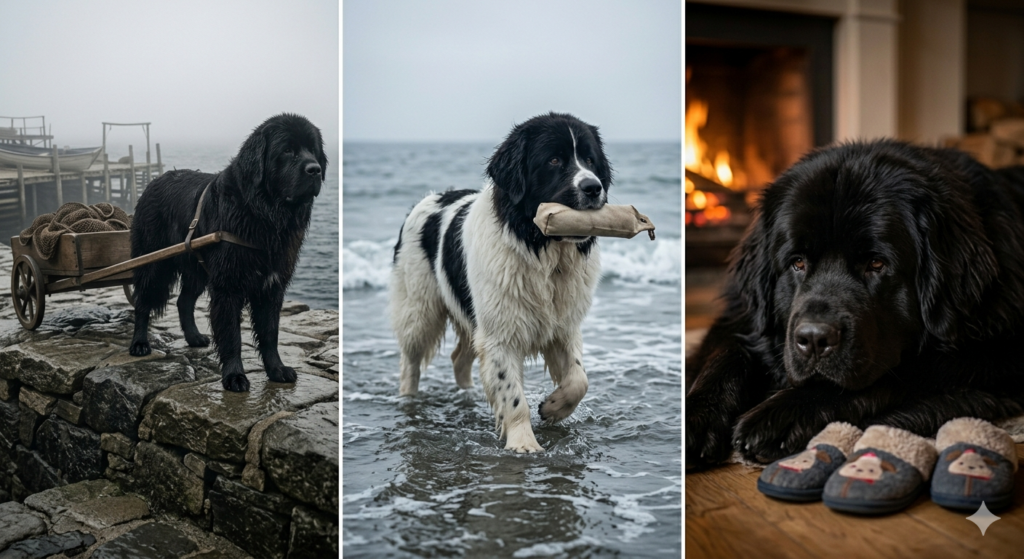
Newfoundlands are renowned for their calm, affectionate nature and have a fascinating working history closely associated with fishermen, swimming and water rescue.
But owning a dog this large comes with responsibilities.
From feeding and grooming to training, exercise, socialisation and health, understanding the breed before bringing one home can make an enormous difference.
Whether you’re considering your first Newfoundland, raising a puppy or already sharing your home with one of these wonderful dogs, this guide will help you understand what life with a Newfoundland is really like.
📘 WANT THE COMPLETE NEWFOUNDLAND GUIDE?
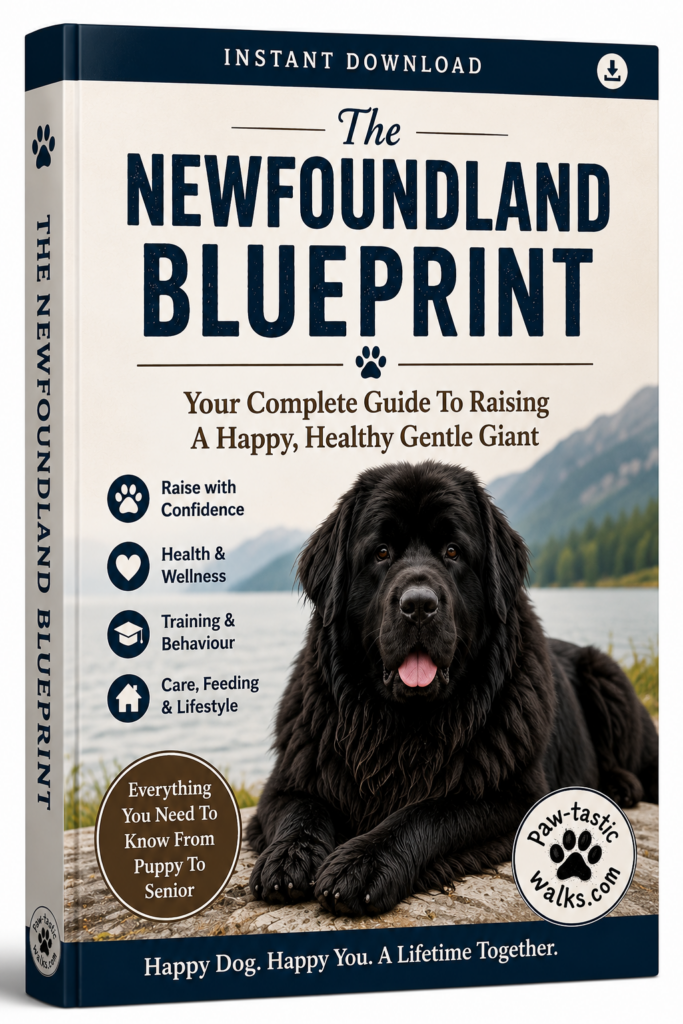
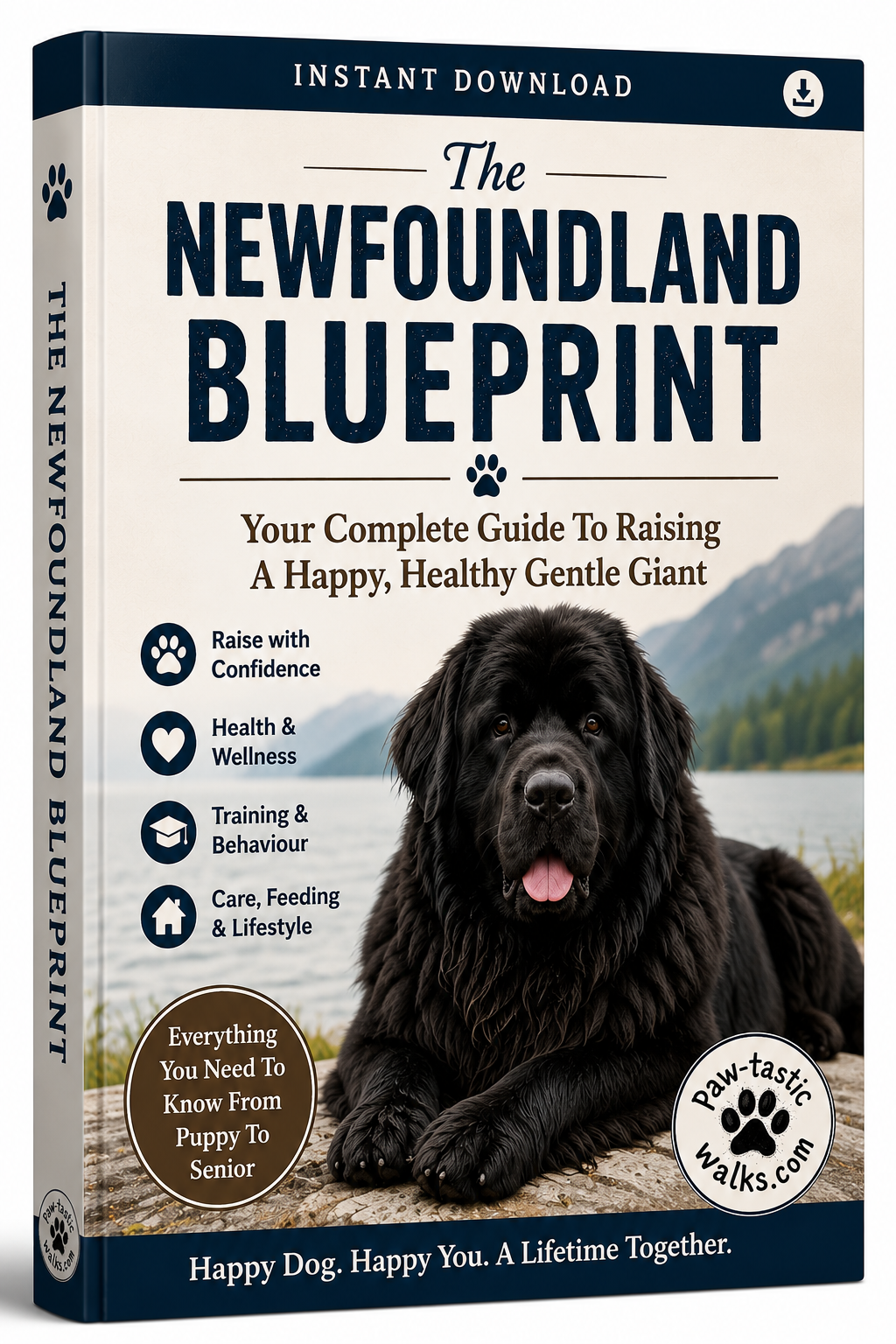
The Newfoundland Blueprint
If you’re serious about understanding and caring for this remarkable breed, we’ve created a complete Newfoundland ownership guide.
The Newfoundland Blueprint takes you far beyond a basic breed profile, with dedicated chapters covering nutrition, training, preventative health care, grooming, socialisation, exercise, behaviour, preparing your home, travelling with a Newfoundland, and adoption and rescue.
🐾 INSTANT DIGITAL DOWNLOAD
👉 GET THE NEWFOUNDLAND BLUEPRINT HERE
🐕 NEWFOUNDLAND AT A GLANCE
Breed: Newfoundland
Breed Type: Large working dog
Size: Giant
Typical Character: Gentle, affectionate, calm and loyal
Coat: Thick, water-resistant double coat
Exercise: Moderate, with swimming particularly well suited to the breed
Grooming: High maintenance
Training: Intelligent and responsive to patient, positive training
Family Life: Often exceptionally devoted to their family
Special Talent: Swimming and water work
Best Known As: The Gentle Giant
🌊 A DOG BUILT FOR THE WATER
You don’t have to look at a Newfoundland for long before realising this isn’t an ordinary dog.
Their history is intimately connected with water.
Newfoundlands developed as powerful working dogs associated with fishermen, and their physical characteristics made them remarkably well suited to aquatic work.
That legacy can still be seen in the modern Newfoundland.
Their substantial build, thick water-resistant coat, large feet and powerful tail all contribute to their famous swimming ability.
And swimming isn’t simply an interesting piece of Newfoundland history.
For suitable adult dogs, safe swimming can provide a fantastic form of physical activity and mental stimulation.
There’s something rather wonderful about watching a Newfoundland enter the water.
On land, they’re enormous fluffy bears.
In water, suddenly everything about their design makes perfect sense.
❤️ NEWFOUNDLAND TEMPERAMENT: WHY ARE THEY CALLED GENTLE GIANTS?
The nickname is extremely appropriate.
Despite their considerable size, Newfoundlands are famous for their generally calm, friendly and affectionate disposition.
They can form incredibly strong relationships with their families and often enjoy being involved in everyday household life.
A well-socialised Newfoundland can be:
🐾 Affectionate
🐾 Loyal
🐾 Patient
🐾 Calm
🐾 Sociable
🐾 Intelligent
🐾 People-oriented
But breed descriptions should never replace understanding the individual dog.
Every Newfoundland has their own personality, experiences and upbringing.
Early training, thoughtful socialisation and responsible ownership remain enormously important — particularly when your adorable fluffy puppy is eventually going to become an extremely powerful adult.
👨👩👧👦 ARE NEWFOUNDLANDS GOOD FAMILY DOGS?
For the right household, they can be wonderful family companions.
Newfoundlands are widely associated with a gentle temperament and can form close bonds with children.
However, there’s an important practical consideration:
They are enormous.
Even the friendliest Newfoundland can accidentally knock over a small child simply by turning around enthusiastically.
Children and dogs should therefore be appropriately supervised, and youngsters should be taught how to interact respectfully with dogs.
The same principle applies when introducing a Newfoundland to other pets.
Their generally sociable reputation is encouraging, but careful introductions and appropriate socialisation are still important.
The goal shouldn’t simply be to own a “family-friendly breed.”
It’s to raise a well-adjusted individual dog.
🏡 HOW MUCH SPACE DOES A NEWFOUNDLAND NEED?
Here’s where prospective owners need to think beyond that gorgeous face.
Newfoundlands take up a lot of physical space.
We’re talking:
big dog + big bed + big food bowls + big grooming sessions + big wet footprints.
You don’t necessarily need a country estate, but your Newfoundland should have enough room to move and rest comfortably.
Consider practical questions such as:
- Is there enough room for a giant dog to move comfortably?
- Can you accommodate a suitably large bed?
- Is your vehicle big enough?
- Can you physically manage a very large dog?
- Do you have suitable outdoor walking areas nearby?
- Can you cope with mud, wet fur and shedding?
- Is your home likely to become uncomfortably warm in summer?
These questions aren’t designed to put anyone off.
They’re part of making sure the Newfoundland fits your actual lifestyle rather than just your dream of owning one.
🎓 TRAINING A NEWFOUNDLAND
Training should begin while your Newfoundland is still small enough that you can pretend they’re small.
Because that stage doesn’t last long.
The Newfoundland is intelligent and generally responds particularly well to patient, reward-based training.
Useful early priorities include:
🐾 Recall
🐾 Loose-lead walking
🐾 Sit and stay
🐾 Calm greetings
🐾 Handling and grooming tolerance
🐾 Settling
🐾 Waiting at doors
🐾 Polite behaviour around food
🐾 Comfortable car travel
Loose-lead walking deserves particular attention.
A poorly trained small dog pulling on the lead can be annoying.
A poorly trained Newfoundland pulling on the lead can take you somewhere you had absolutely no intention of visiting.
Starting early is considerably easier than trying to correct established habits once your dog reaches full size.
🐶 SOCIALISING A NEWFOUNDLAND
Socialisation isn’t about making your puppy meet as many dogs and people as physically possible.
Good socialisation means helping them develop positive, controlled experiences with the world.
That might include:
- different people
- calm dogs
- traffic
- household noises
- grooming
- veterinary handling
- travelling
- different surfaces
- unfamiliar environments
- visitors to the home
Quality matters more than quantity.
A young Newfoundland should learn that new experiences don’t need to be frightening or overwhelmingly exciting.
You’re helping to create something incredibly valuable:
a giant dog who can remain calm when the world gets interesting.
🚶 HOW MUCH EXERCISE DOES A NEWFOUNDLAND NEED?
Newfoundlands need regular exercise, but this isn’t a breed where owners should automatically assume that more miles are always better.
Exercise should suit the individual dog’s:
age, health, fitness and physical development.
Growing puppies require particular consideration because they’re developing into very large dogs.
Adult Newfoundlands can enjoy walks, exploring and appropriately managed swimming.
Mental exercise matters too.
Training, scent games, puzzle activities and opportunities to explore can provide stimulation without relying solely on physical exercise.
The Newfoundland’s famous affinity with water also opens the door to activities that connect beautifully with the breed’s working heritage.
🧠 NEWFOUNDLAND BEHAVIOUR
Understanding behaviour becomes especially important when you’re dealing with a dog of this size.
Fortunately, Newfoundlands are commonly described as intelligent, affectionate and eager to please.
But even a naturally gentle dog needs guidance.
Owners should establish clear, consistent expectations without relying on intimidation or harsh training.
Positive reinforcement can help you build cooperation rather than conflict.
And because Newfoundlands tend to thrive on companionship, training can become much more than teaching commands.
It’s an opportunity to build communication and trust.
🪮 NEWFOUNDLAND GROOMING: PREPARE FOR THE FLOOF
Let’s address the elephant-sized dog in the room.
That magnificent coat requires work.
The Newfoundland has a thick coat that needs regular grooming to help prevent tangles and matting and to manage shedding.
You’ll need to pay attention to areas such as:
🐾 Coat and undercoat
🐾 Ears
🐾 Feet and paws
🐾 Nails
🐾 General skin condition
Seasonal shedding can be substantial.
And because Newfoundlands have a natural relationship with water, owners may also discover the particular joy of living with a very large wet dog.
A Newfoundland shaking themselves dry inside the house is less an event and more a localised weather system.
If you like an immaculate home with no visible dog hair, this probably isn’t your breed.
If you don’t mind some fluff in exchange for a wonderful companion, that’s another matter entirely.
🍽️ FEEDING A NEWFOUNDLAND
Nutrition is particularly important with giant breeds.
Newfoundlands require an appropriate, balanced diet suited to their age, size, activity level and individual needs.
Maintaining a healthy body condition matters because excess weight places unnecessary strain on an already large frame.
Owners should monitor:
- body condition
- portion sizes
- treats
- activity levels
- changes in weight
Puppies have different nutritional requirements from adults, and senior dogs may need further adjustments.
Your veterinarian is the right person to advise you about your individual Newfoundland’s diet, particularly during growth or where health concerns are involved.
🩺 NEWFOUNDLAND HEALTH
Like all breeds, Newfoundlands can be affected by particular health problems.
The Newfoundland Blueprint specifically discusses preventative health care and highlights concerns including hip dysplasia and heart conditions.
Prospective owners should therefore research responsible breeding and appropriate health testing rather than choosing a puppy solely because it is available or inexpensive.
Existing owners should maintain regular veterinary care and pay attention to changes in:
🐾 Mobility
🐾 Weight
🐾 Appetite
🐾 Energy
🐾 Breathing
🐾 Skin and coat
🐾 General behaviour
Nobody can guarantee that a dog will never become ill.
Responsible ownership is about reducing avoidable risks and recognising potential problems early.
☀️ NEWFOUNDLANDS AND HOT WEATHER
That beautiful heavy coat comes with an obvious consideration.
Heat needs to be taken seriously.
Newfoundlands are strongly associated with colder conditions, and owners need to manage exercise carefully during warm weather.
On hot days, consider:
- walking during cooler periods
- providing constant access to fresh water
- ensuring shade is available
- avoiding strenuous exercise
- watching closely for signs of overheating
- keeping indoor resting areas comfortable
Don’t judge whether exercise is safe simply by how enthusiastic your dog seems.
Sometimes we need to make the sensible decision for them.
🚗 TRAVELLING WITH A NEWFOUNDLAND
Travelling with a Newfoundland requires slightly more logistical planning than travelling with a Chihuahua.
Your vehicle needs enough room for the dog to travel comfortably and safely.
Long journeys should include sensible breaks and access to water, while temperature management becomes especially important during warmer months.
Introducing car travel positively when your Newfoundland is young can make future journeys considerably easier.
Because once they’re fully grown, “I’ll just pick him up and put him in the car” is no longer much of a strategy.
🏠 IS A NEWFOUNDLAND RIGHT FOR YOU?
A Newfoundland may be a wonderful choice if you’re looking for a dog who is typically:
❤️ Affectionate
🐾 Gentle
🌊 Naturally drawn to water
👨👩👧👦 Family-oriented
🎓 Intelligent and trainable
🏡 Happy being part of household life
But think carefully if you’re uncomfortable with:
❌ Owning a giant dog
❌ Significant grooming
❌ Heavy shedding
❌ Wet and muddy coats
❌ Large food and equipment costs
❌ Managing a physically powerful animal
❌ The health considerations associated with giant breeds
❌ Making adjustments during hot weather
The Newfoundland can be an extraordinary companion.
But the right question isn’t simply:
“Do I want a Newfoundland?”
It’s:
“Can I give a Newfoundland the lifestyle, training, care and companionship they need?”
If the answer is yes, you could be in for a very special relationship.
📘 THE NEWFOUNDLAND BLUEPRINT
Your Complete Guide to Raising a Happy, Healthy Gentle Giant
There’s a huge difference between admiring a Newfoundland and truly understanding one.
That’s why we’ve created The Newfoundland Blueprint.
This comprehensive digital guide brings together the essential areas of Newfoundland ownership in one convenient resource.
Inside you’ll discover dedicated guidance covering:
🥩 Nutrition & Diet
Understand the nutritional considerations involved in feeding a giant breed and maintaining an appropriate body condition.
🎓 Training Techniques
Explore positive, consistent training approaches designed to help develop a cooperative and well-mannered Newfoundland.
🩺 Health & Preventative Care
Learn about preventative care and some of the health considerations Newfoundland owners should understand.
🪮 Grooming & Coat Care
Discover how to manage that magnificent thick coat and establish a practical grooming routine.
🐕 Socialisation
Help your Newfoundland become confident and comfortable around people, animals and different environments.
🌊 Exercise & Activities
Explore appropriate physical and mental activities, including the Newfoundland’s famous connection with swimming.
🧠 Newfoundland Behaviour
Develop a better understanding of the temperament and behaviour behind the gentle giant.
🏡 Preparing Your Home
Learn what to consider when you’re about to bring a very large dog into everyday family life.
🚗 Travelling With Your Newfoundland
Prepare for journeys and adventures with a canine passenger who requires rather more room than most.
❤️ Adoption & Rescue
Explore considerations surrounding Newfoundland adoption and rescue.
🐾 FROM NEWFOUNDLAND PUPPY TO GENTLE GIANT
That fluffy Newfoundland puppy won’t stay little for long.
The habits you encourage early can have an enormous impact when your puppy becomes a powerful adult dog.
Training, nutrition, socialisation, grooming and appropriate exercise aren’t separate pieces of Newfoundland ownership.
They work together.
And the more you understand your Newfoundland, the better prepared you’ll be to give them the life they deserve.
Get The Newfoundland Blueprint Today
Everything you need to better understand one of the world’s most extraordinary gentle giants — in one convenient digital guide.
📘 INSTANT DIGITAL DOWNLOAD
👉 GET THE NEWFOUNDLAND BLUEPRINT NOW
Big dog. Bigger heart. Be ready for both.
Frequently Asked Questions About Newfoundlands
Are Newfoundlands good family dogs?
Newfoundlands are widely known for their affectionate and gentle temperament and can make excellent companions for suitable families. Their enormous size means interactions with young children should always be appropriately supervised.
Are Newfoundlands easy to train?
They are intelligent dogs that can respond very well to patient, consistent and positive training. Starting early is particularly important because an adult Newfoundland is extremely powerful.
Do Newfoundlands need lots of exercise?
They need regular exercise and mental stimulation, but exercise should be appropriate for the dog’s age, fitness and health. Swimming can be particularly well suited to many Newfoundlands.
Do Newfoundlands shed?
Yes. Their substantial double coat requires regular grooming, and owners should expect significant shedding, particularly at certain times of year.
Do Newfoundlands like water?
The breed has a remarkable history connected with fishermen and water work, and Newfoundlands are famous for their swimming ability.
Are Newfoundlands suitable for first-time dog owners?
Potentially, but a first-time owner needs to be realistic about the challenges of managing a giant breed. Training, grooming, feeding costs, physical strength, space and health considerations all deserve careful thought.
How big do Newfoundlands get?
They are a giant breed. The Newfoundland Blueprint describes them as typically weighing around 100–150 lb and reaching up to approximately 28 inches at the shoulder, although individual dogs vary.
What is the Newfoundland Blueprint?
The Newfoundland Blueprint is a comprehensive Paw Tastic Walks digital guide covering the major areas of Newfoundland ownership, including training, nutrition, health, grooming, socialisation, exercise, behaviour, home preparation, travel and adoption.
👉 GET THE NEWFOUNDLAND BLUEPRINT