Can an American Coonhound Ever Be Trusted Off Lead?
The American Coonhound is intelligent, athletic and usually eager to explore. Unfortunately, this combination does not always produce a dog with naturally dependable recall.
Once a Coonhound catches an interesting scent, everything else can temporarily become far less important. The owner, treats and carefully practised recall cue may all be competing with an instinct that has been strengthened over many generations.
So, can an American Coonhound ever be trusted off lead?
Some individual American Coonhounds can earn limited off-lead freedom in carefully selected, secure environments.
However, many should never be allowed off lead in open or uncontrolled areas.
This is not a failure of the dog or owner. It is responsible recognition of what the breed was developed to do.
The goal should not be to prove that your Coonhound can walk everywhere without a lead. The real goal is to provide enjoyable freedom without taking unnecessary risks.
For a broader introduction to the breed’s training, behaviour, exercise and care requirements, visit The American Coonhound Blueprint.
Why Is Recall So Difficult for an American Coonhound?
The American English Coonhound—also known as the English Coonhound or Redtick Coonhound—is a highly capable scent hound.
These dogs were developed to:
- Locate and follow animal scent trails
- Work across considerable distances
- Continue tracking through challenging terrain
- Make independent decisions
- Remain focused despite distractions
- Use their distinctive bay to communicate their position
These qualities made the breed an excellent working partner.
In an ordinary park or countryside setting, however, the same instincts can create difficulties. A Coonhound that detects the scent of a rabbit, fox, deer or another animal may immediately become intensely focused.
At that moment, the dog may not be deliberately ignoring its owner. Its attention has been captured by something extraordinarily important from the dog’s perspective.
The American Kennel Club describes the American English Coonhound as having a very strong prey drive and advises against allowing the breed off lead in uncontrolled areas.
That does not mean recall training is pointless. It means that owners need realistic expectations and reliable safety measures.
Training Cannot Completely Remove Instinct
Good training can significantly improve an American Coonhound’s recall.
It can teach the dog to:
- Respond quickly in everyday situations
- Check in with its owner voluntarily
- Turn away from mild distractions
- Return when exploring on a long line
- Pause before moving through a doorway or gate
- Respond to an emergency recall cue
- Remain engaged during walks
What training cannot do is guarantee that natural instinct will never take over.
Recall is not a switch that permanently changes from “untrained” to “trained.” It is a behaviour that must be practised, rewarded and maintained throughout the dog’s life.
Even a Coonhound with an excellent training history may struggle when faced with a completely new or unusually powerful scent.
What Does Reliable Recall Actually Mean?
Many owners believe their dog has good recall because it returns successfully at home, in the garden or when no distractions are present.
That is a valuable beginning, but it is not yet reliable recall.
A dependable response must be practised around gradually increasing distractions, including:
- New smells
- Other dogs
- Moving animals
- People
- Cyclists and runners
- Woodland paths
- Open fields
- Water
- Unfamiliar environments
A dog that returns nine times out of ten may sound reliable. Unfortunately, the missing tenth response could occur beside a road, near livestock or when the dog is following wildlife.
With an American Coonhound, owners should assess recall according to the most challenging realistic situation—not the easiest one.
A Step-by-Step American Coonhound Recall Plan
Step 1: Choose a Clear Recall Cue
Select a word that will be used specifically for recall.
Common examples include:
- Come
- Here
- This way
- With me
Avoid repeatedly using the dog’s name as the entire recall cue. A name is useful for gaining attention, but it may also be used in dozens of other situations throughout the day.
Say the chosen cue once and reward the dog generously when it responds.
Repeating “come, come, come” teaches the dog that the first cue is optional.
Step 2: Begin Indoors
Start in a quiet room with very few distractions.
Move a short distance away, use your recall cue in an upbeat voice and reward your Coonhound for approaching.
The reward should be valuable enough to compete with the environment. Depending on the dog, this might include:
- Small pieces of cooked chicken
- Cheese
- A favourite commercial training treat
- A short game
- Enthusiastic praise
- Permission to return to an enjoyable activity
Keep each session short and successful.
Five enthusiastic recalls are more valuable than 20 repetitions during which the dog gradually loses interest.
Step 3: Practise in a Secure Garden
Once your dog responds consistently indoors, move into a securely enclosed garden.
Allow the dog to investigate for a few moments before using the cue. Reward generously when it turns away from the environment and comes back to you.
Do not call only when outdoor time is about to end. If recall always leads to the door being closed, your Coonhound may quickly learn that returning makes good things disappear.
Practise calling, rewarding and then releasing the dog to explore again.
This teaches an important lesson:
Coming back does not always mean the fun is over.
Step 4: Introduce a Long Training Line
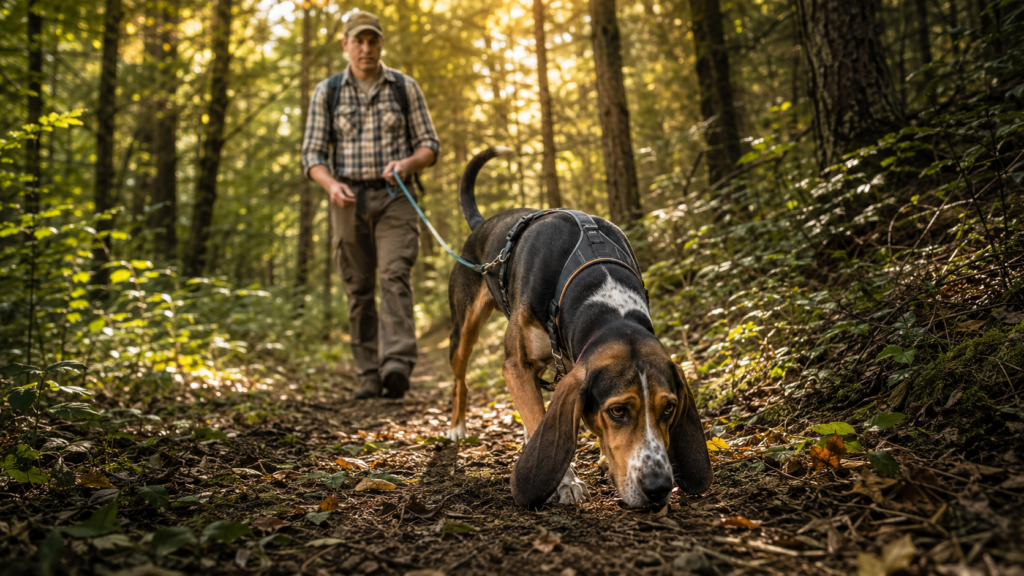
A long line is one of the most useful pieces of equipment for an American Coonhound.
It allows the dog to:
- Sniff and explore
- Move more freely
- Practise recall at a distance
- Make choices
- Experience appropriately controlled freedom
At the same time, it prevents a failed recall from turning into an escaped dog.
Attach the long line to a well-fitted harness rather than directly to a collar. A sudden stop at speed could place considerable force on a dog’s neck.
Hold the line carefully and avoid wrapping it around your hand. Wear gloves if necessary, and remain aware of nearby people, dogs, trees and undergrowth.
A long line should be treated as a training and safety tool—not simply as an extra-long lead.
Step 5: Reward Voluntary Check-Ins
Do not wait until you need your dog before becoming interesting.
Whenever your Coonhound voluntarily looks towards you during a walk, mark and reward that choice.
You can use a word such as “yes” before offering a treat or praise.
Over time, the dog learns that checking where you are is worthwhile.
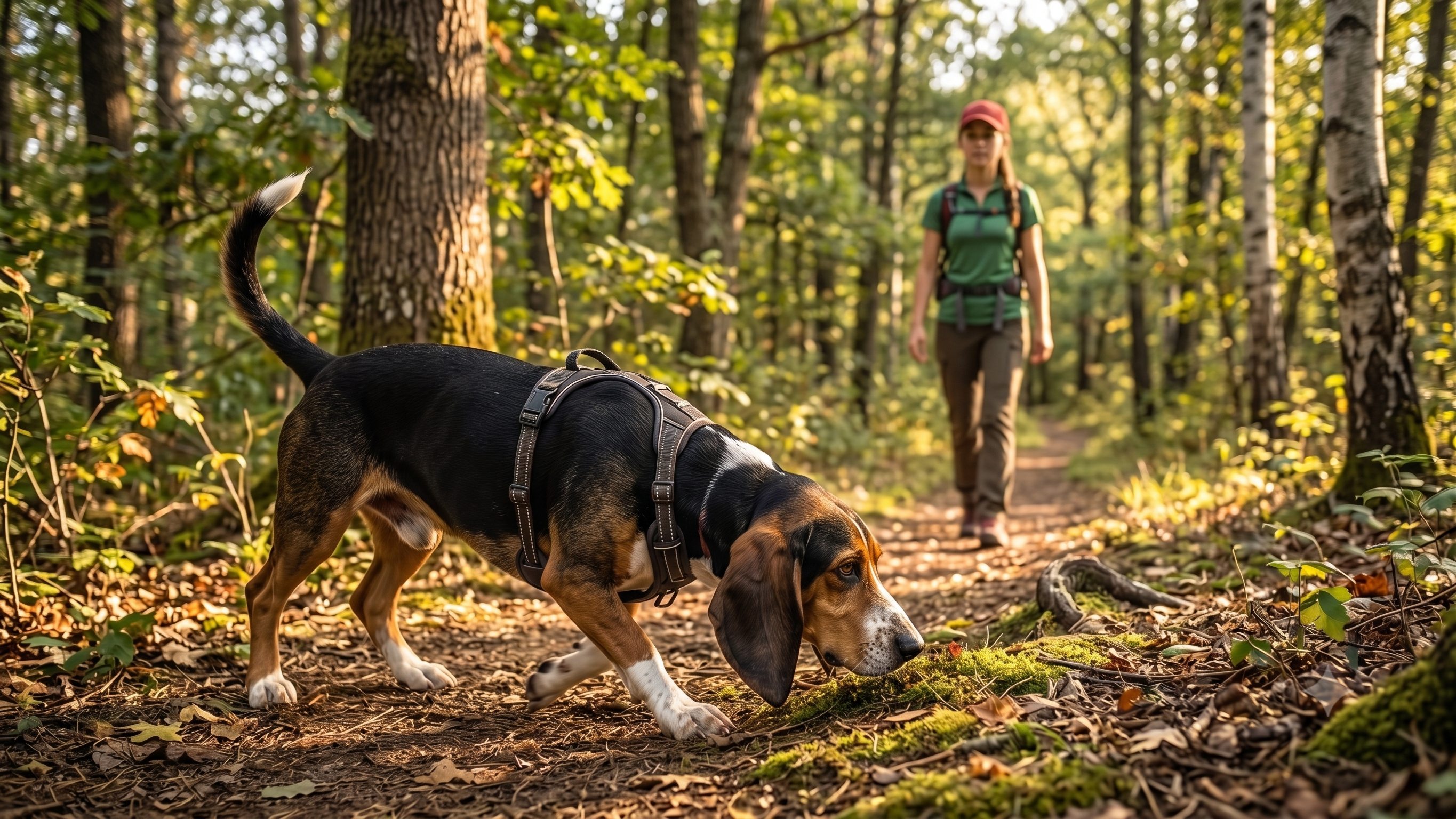
This may be particularly valuable for a scent hound. You are not preventing the dog from sniffing; you are teaching it to remain connected to you while exploring.
Step 6: Use Sniffing as a Reward
Food is useful, but it is not the only reward available.
For an American Coonhound, permission to return to a scent can be extremely powerful.
Try the following sequence:
- Allow your dog to investigate on the long line.
- Use your recall cue.
- Reward the return.
- Say a release phrase such as “go sniff.”
- Allow the dog to resume exploring.
This makes recall part of the activity rather than an interruption to it.
Your Coonhound learns that returning to you may be the route back to the thing it wanted.
Step 7: Increase Distractions Gradually
Do not move directly from a quiet garden to an open field filled with wildlife.
Build difficulty gradually.
A sensible progression might include:
- Inside the home
- Secure garden
- Empty enclosed training field
- Quiet outdoor area on a long line
- Familiar walking route
- New environment with mild distractions
- Controlled practice at a safe distance from stronger distractions
If your dog cannot respond at a particular level, reduce the difficulty.
Moving farther away from a distraction is not giving up. It creates a situation in which the dog can think and succeed.
Step 8: Create an Emergency Recall
An emergency recall is a separate cue reserved for urgent situations.
Choose a distinctive word or whistle that the dog does not hear during ordinary conversation.
Build a powerful association by pairing it with exceptional rewards. At first, practise only in easy situations where success is almost certain.
When the dog responds, provide several high-value treats one after another.
Do not use the emergency cue casually or test it repeatedly around impossible distractions. Its value depends on a history of successful, heavily rewarded responses.
An emergency recall is an additional safety measure—not permission to take avoidable risks.
When Might Off-Lead Exercise Be Appropriate?
An American Coonhound may be allowed off lead when all of the following apply:
- The area is completely and securely enclosed
- Gates and fencing have been checked
- There is no access to a road
- There is no livestock or vulnerable wildlife
- Other users are comfortable with dogs being loose
- Your dog is not aggressive or dangerously overexcited
- You can see the dog clearly
- Local rules permit off-lead exercise
- The dog has demonstrated a good recall in that environment
Secure dog fields can be an excellent choice.
They allow Coonhounds to run, sniff and explore without the same risks found in open countryside. Check the fencing personally before removing the lead, particularly around gates, corners and areas where dogs may have dug.
“Enclosed” should never be assumed to mean escape-proof.
When Should an American Coonhound Stay on Lead?
Keep your Coonhound on a lead or long line when:
- Walking near roads or car parks
- Livestock may be present
- Wildlife is active
- The area is unfamiliar
- Visibility is poor
- There are unfenced boundaries
- Signs require dogs to be kept on leads
- Recall is still being developed
- Your dog has escaped or pursued animals previously
- Your dog is frightened by noises
- Other dogs are on leads
- Your Coonhound becomes too excited to respond
- You are uncertain about the environment
If you are debating whether the situation is safe, keeping the lead attached is usually the sensible decision.
Warning Signs That Your Dog Is About to Follow a Scent
Learning to recognise the early stages of scent fixation can help you respond before your dog becomes completely absorbed.
Watch for:
- Nose suddenly dropping to the ground
- Rapid zigzag movements
- Sudden tension through the body
- Tail becoming higher or more active
- Faster, more determined movement
- Ignoring familiar sounds
- Pulling strongly in one direction
- Air scenting with the head raised
- Whining, baying or increased excitement
- Refusing food that the dog usually enjoys
At this stage, increase distance from the trigger and calmly regain your dog’s attention.
Do not wait until your Coonhound is at the end of the line and completely committed to pursuit.
Common Recall Mistakes
Punishing the Dog After It Returns
Never punish your Coonhound for eventually coming back, even if you have been waiting for several frustrating minutes.
The dog will associate the consequence with returning to you—not with the earlier decision to run away.
You want arriving beside you to feel safe and worthwhile.
Calling When Success Is Unlikely
Repeatedly calling a dog that is already chasing something allows it to practise ignoring the cue.
Use your long line to prevent rehearsal of unwanted behaviour and practise at a more manageable level.
Ending Every Enjoyable Activity
If recall always means the lead goes on and the walk ends, returning becomes less attractive.
Call your dog at different points during a walk, reward it and allow exploration to continue.
Progressing Too Quickly
Recall around the home is not the same as recall beside wildlife.
Increase distractions gradually and return to easier practice whenever your dog begins struggling.
Using Low-Value Rewards
Dry biscuits may not compete with a fresh scent trail.
Use rewards that genuinely matter to your dog and remember that permission to sniff can be more valuable than food.
Assuming Exercise Alone Will Fix Recall
An under-stimulated Coonhound may be harder to engage, but simply exhausting the dog does not produce dependable recall.
Training, mental enrichment, management and an appropriate outlet for scenting all matter.
Is Using a Long Line a Failure?
Absolutely not.
A long line can provide far more meaningful freedom than repeatedly walking a Coonhound on a short lead while preventing every opportunity to sniff.
With thoughtful handling, a dog on a long line can:
- Explore natural scents
- Choose its walking pace
- Practise returning from a distance
- Enjoy more freedom of movement
- Participate in tracking games
- Build a stronger connection with its owner
The purpose of walking is not to display how little equipment your dog needs. It is to meet your dog’s needs safely.
For some American Coonhounds, a long line may remain part of outdoor life permanently. That can still represent excellent, responsible ownership.
Can a GPS Tracker Make Off-Lead Exercise Safe?
A GPS tracker may help locate a missing dog, but it cannot prevent that dog from:
- Reaching a road
- Chasing livestock
- Becoming injured
- Frightening wildlife
- Approaching an unsuitable dog
- Travelling beyond the owner’s reach
A tracker should be considered a backup safety measure, not a replacement for a lead, secure fencing or recall training.
It is also essential to keep your dog’s microchip information current and use an identification tag that complies with the law where you live.
How Can You Provide Freedom Without Going Off Lead?
A Coonhound does not need unrestricted off-lead access to enjoy a fulfilling life.
Safe alternatives include:
- Secure private dog fields
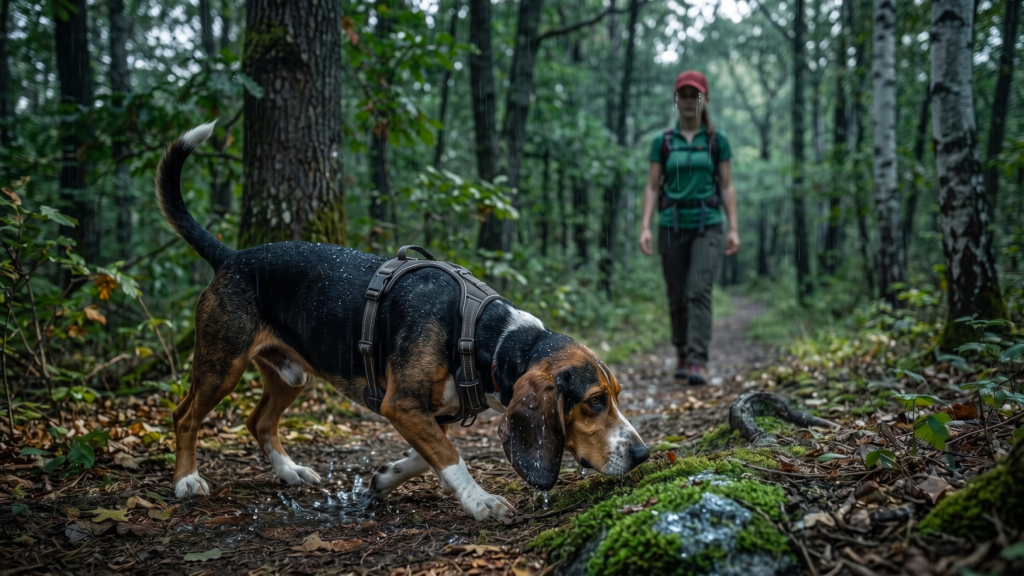
- Long-line woodland walks
- Structured scent games
- Tracking exercises
- Mantrailing
- Food-search games
- Snuffle mats
- Garden scent trails
- Reward-based training sessions
- Canicross with appropriate preparation
- Hiking on a suitable lead and harness
- Supervised exploration in securely fenced areas
Mental enrichment can be just as important as covering long distances.
Ten minutes of focused scent work may satisfy your Coonhound in a way that a hurried pavement walk cannot.
So, Can an American Coonhound Ever Be Trusted Off Lead?
The honest answer is: sometimes, but only under the right conditions—and never with complete certainty.
Some individual Coonhounds develop very good recall and can enjoy off-lead time inside secure spaces. Others remain likely to follow scent regardless of how much training they receive.
Genetics, early experience, training history, age, temperament and the environment all affect the outcome.
Responsible ownership means evaluating the dog in front of you rather than trying to prove something about the breed.
A Coonhound kept on a long line is not missing out when that line allows safe sniffing, exploration and engagement. In many situations, it is the most considerate choice for the dog, wildlife, livestock and everyone else using the area.
The strongest recall plan combines:
- Positive reinforcement
- Gradual training
- Valuable rewards
- Safe long-line practice
- Scent-based enrichment
- Careful environmental assessment
- Realistic expectations
Most importantly, never gamble with your dog’s safety simply because recall worked yesterday.
Understand the Remarkable Hound Behind the Nose
Recall is only one part of living successfully with an American Coonhound.
Understanding the breed’s history, temperament, exercise requirements, prey drive, health and training style can make everyday life considerably easier.
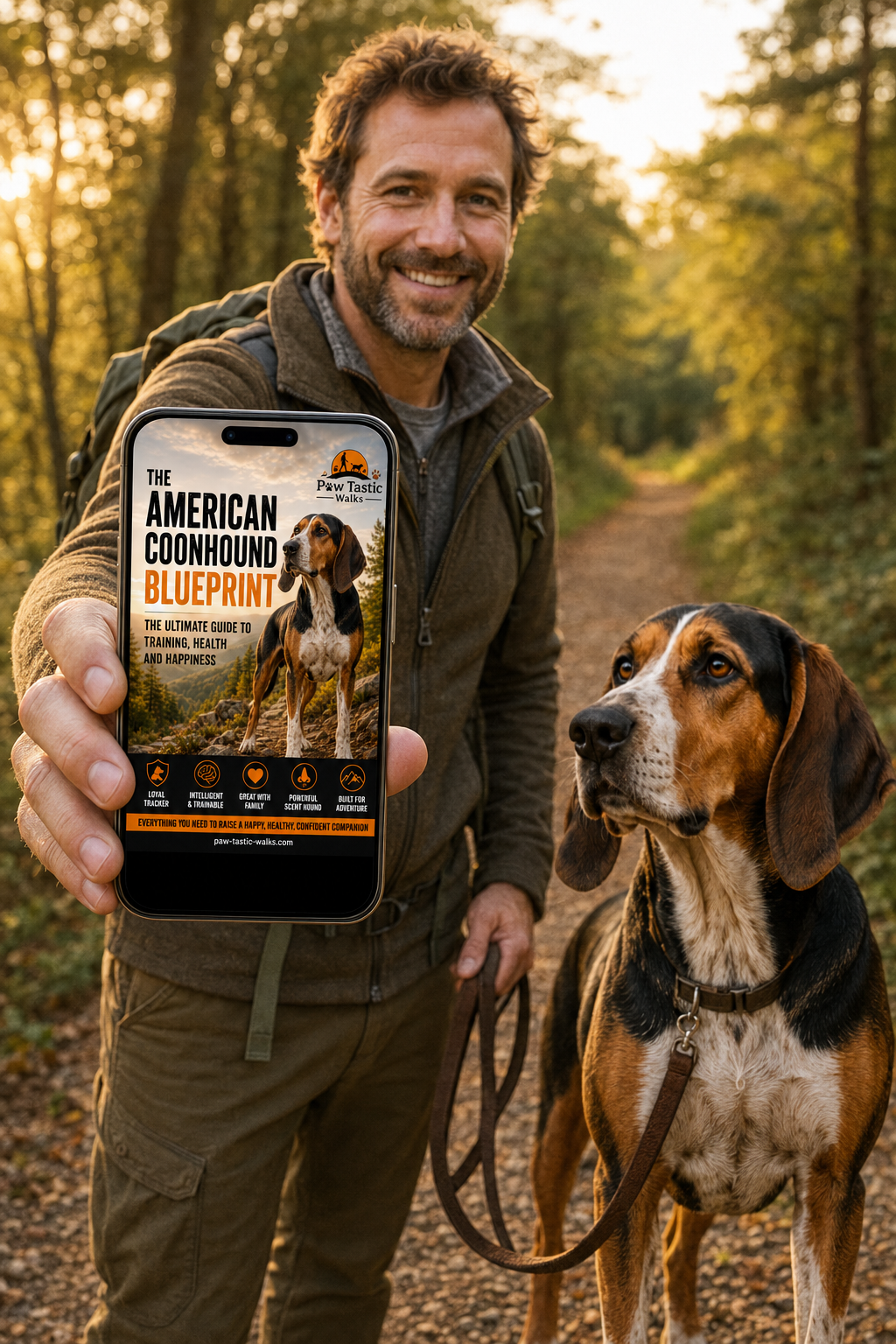
The American Coonhound Blueprint is a comprehensive 74-page digital guide covering:
🐾 Breed history and characteristics
🎓 Training techniques
❤️ Health and nutrition
🧼 Grooming and ear care
🧠 Behaviour and temperament
👃 Hunting instincts and field activities
🐶 Socialisation
🌳 Exercise and enrichment
🏡 Rescue and adoption
📘 Responsible ownership and useful resources
EXPLORE THE AMERICAN COONHOUND BLUEPRINT
Frequently Asked Questions
Do American Coonhounds have good recall?
Some can develop good recall through consistent, reward-based training. However, their strong scent drive and independent working history mean recall may be less dependable around wildlife and fresh scent trails.
Should an American Coonhound be allowed off lead in woodland?
Open woodland can contain wildlife, livestock access, roads and poor visibility. A long line attached to a suitable harness is generally the safer choice unless the woodland is securely enclosed.
Can you train prey drive out of a Coonhound?
Training and management can improve self-control and responsiveness, but owners should not expect to remove an instinct developed over generations. Providing safe outlets for scenting is usually more realistic.
How long should a recall training line be?
The appropriate length depends on the environment and handler’s experience. Many owners begin with a manageable line and increase the distance as their handling skills and dog’s response improve. It should be attached to a well-fitted harness.
What is the safest place for an American Coonhound to run freely?
A securely fenced private dog field or properly enclosed garden is usually the safest option. Check boundaries and gates before releasing your dog.
Will neutering improve an American Coonhound’s recall?
Neutering is not a substitute for recall training and will not remove scenting or hunting instincts. Discuss individual health and behavioural considerations with your veterinarian.
Helpful Resources
- American English Coonhound breed information – American Kennel Club
- Exercise and recall advice – PDSA
- The American Coonhound Blueprint – Paw Tastic Walks
This article provides general educational information and does not replace individual guidance from a qualified veterinarian or appropriately accredited reward-based canine professional.