
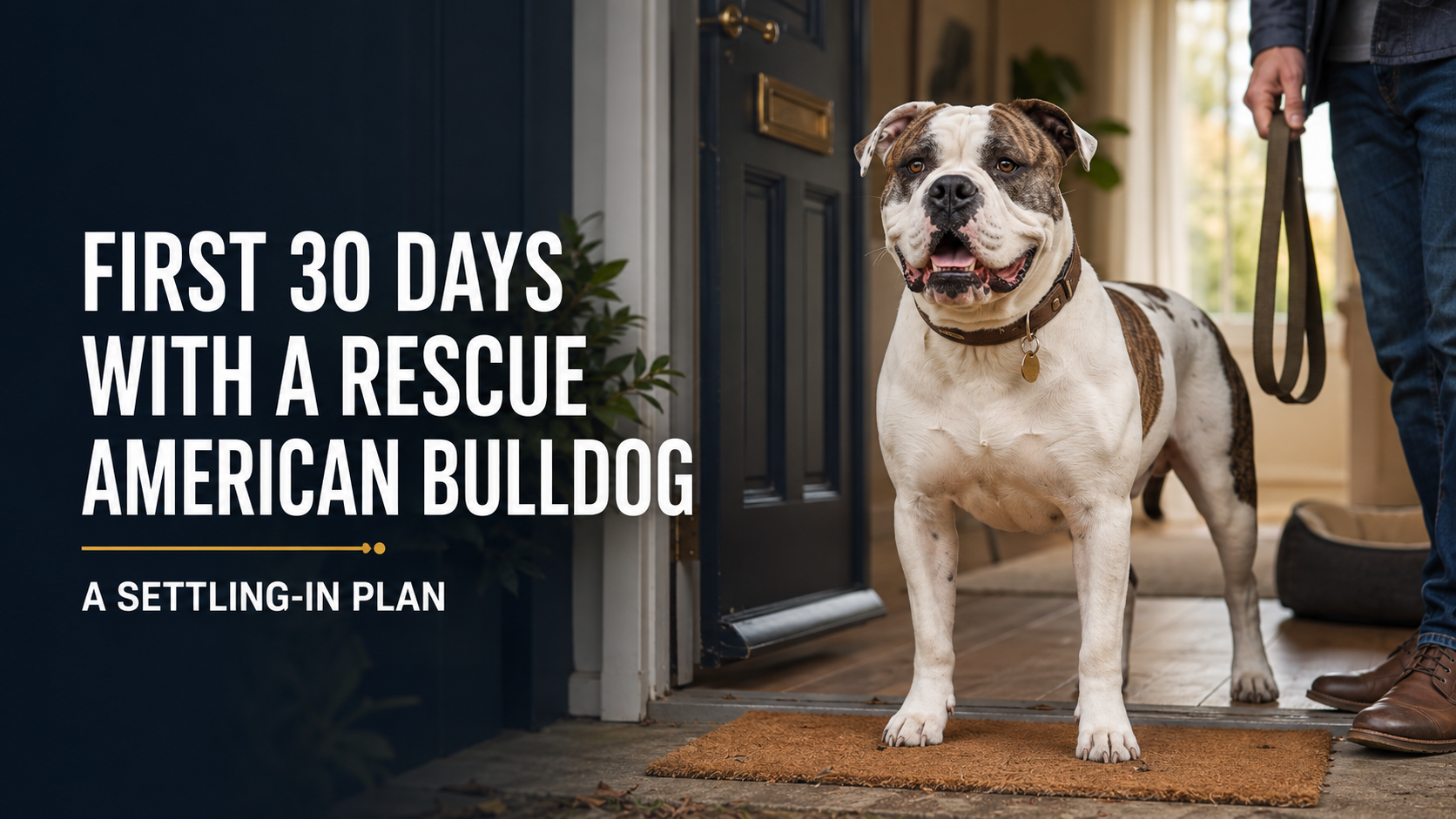
A Settling-In Plan
Bringing home a rescue American Bulldog can be the beginning of an incredibly rewarding friendship.
These powerful, affectionate dogs often form deep bonds with their families, but arriving in a new home can also be confusing and overwhelming.
Your new dog may have experienced several changes before reaching you. They might have lived in another home, spent time in kennels or faced disruption that you know very little about. Even a confident-looking American Bulldog may initially feel uncertain.
The first 30 days should therefore focus on three things: safety, predictability and trust.
This week-by-week plan will help you introduce your rescue American Bulldog to its new life without asking for too much, too soon.
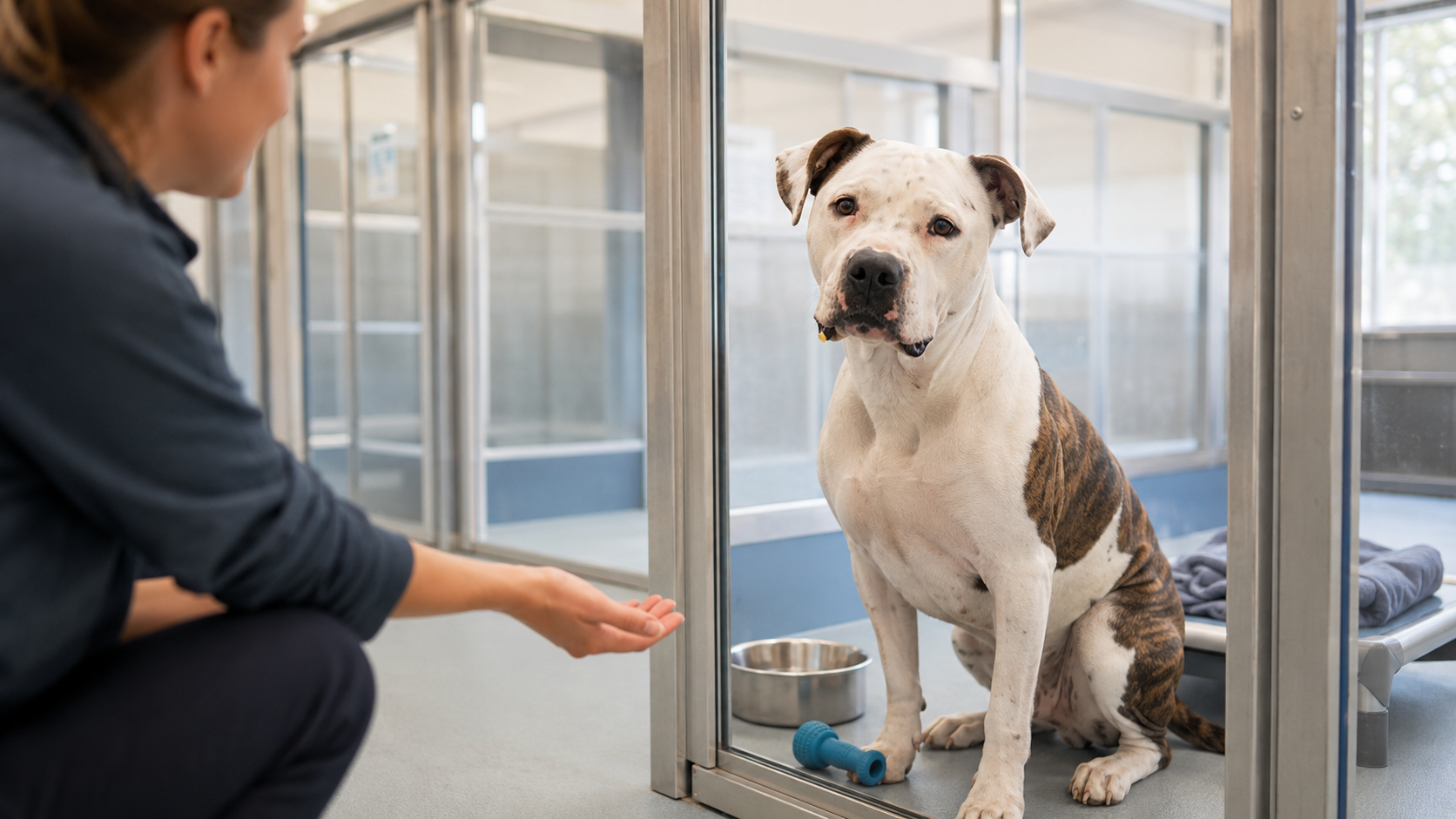
The Quick Answer
During the first 30 days with a rescue American Bulldog:
- Keep the household calm and predictable
- Give your dog a quiet space of its own
- Follow the rescue centre’s existing feeding routine initially
- Use secure walking equipment
- Keep early walks short and quiet
- Limit visitors and unfamiliar experiences
- Begin gentle, reward-based training
- Introduce children and other pets carefully
- Avoid forcing affection or interaction
- Ask the rescue organisation for help if problems arise
Some dogs settle remarkably quickly, while others require several months. Your dog’s progress should determine the pace—not a fixed deadline.
Before Your Rescue American Bulldog Arrives
Preparation can make the transition considerably easier.
American Bulldogs are strong, athletic dogs, so check your home and garden carefully before their arrival. Fences and gates should be secure, and household members should understand the importance of keeping external doors closed.
Prepare the following essentials:
- A comfortable bed in a quiet location
- Food and water bowls
- The food currently provided by the rescue centre
- A strong lead and well-fitted harness
- An identification tag
- Safe chew toys
- Food-dispensing toys
- Dog-safe cleaning products
- Stair gates or room dividers if required
- A suitable method of securing the dog in your car
- Contact details for your veterinary practice and rescue organisation
Ask the rescue centre for as much information as it can provide about the dog’s routine, diet, health, training and behaviour.
Useful questions include:
- What food is the dog eating, and at what times?
- How does the dog behave around unfamiliar people?
- Has the dog lived with children, cats or other dogs?
- Is the dog comfortable being left alone?
- Are there any known fears or triggers?
- What walking equipment has the dog used?
- Does the dog guard food, toys or resting places?
- Are there any medical conditions or medications?
- Which commands or cues does the dog already understand?
Do not worry if the rescue cannot answer everything. Some dogs arrive with limited histories. The information you gather during the first month will help you understand your individual dog.
Create a Safe Settling Area
Give your American Bulldog a quiet area where it can rest without being disturbed.
This does not necessarily need to be a separate room. It could be a comfortable bed in a quiet corner, an open crate if the dog is already happy using one, or an area separated by a stair gate.
Place fresh water nearby and make sure everyone understands one simple rule:
When the dog is resting in its safe area, leave it alone.
Children should never follow the dog into its bed, climb on it or attempt to remove toys from its resting place.
Dogs Trust recommends allowing rescue dogs to settle at their own pace and giving them the choice to approach when they feel ready. Hiding, avoiding contact or showing little interest in interaction can be perfectly understandable during the initial adjustment. Read the Dogs Trust settling-in advice.
Day One: Keep Everything Quiet
The first day should be intentionally uneventful.
When you arrive home, take your dog calmly to the garden or designated toilet area. Keep the dog on a lead initially, even in an enclosed garden, until you have checked the boundaries and started to understand its behaviour.
Allow your dog to explore a small part of the house at its own pace. Opening every room immediately can be overwhelming, so begin with the areas it will use most often.
Show your dog:
- Where the water is located
- Where it will be fed
- Where it can sleep
- How to reach the garden
- Which area offers peace and quiet
Avoid inviting friends and relatives to meet the new arrival. Although everyone may be excited, your dog does not yet know that these people are friendly.
Keep voices calm and movements unhurried. Sit nearby without constantly calling the dog or trying to stroke it. If it chooses to approach, allow it to sniff and investigate.
Do not attempt to test whether it will surrender food, tolerate hugging or accept its paws being handled. The first day is about helping the dog feel safe, not discovering how much it will tolerate.
The First Night
Some rescue dogs sleep deeply on their first night. Others may pace, pant, whine or struggle to settle.
Take your dog outside for a final toilet opportunity, then guide it calmly towards its sleeping area. Keep the environment quiet and avoid turning bedtime into an exciting event.
If your dog is extremely distressed, consider sleeping nearby temporarily or moving its bed closer to you. This is not necessarily “rewarding bad behaviour.” A newly rehomed dog may genuinely need reassurance while learning that it is safe.
Avoid shutting the dog inside a crate unless the rescue centre has confirmed that it is already comfortable and relaxed in one. A crate should be introduced positively and should never be used as punishment.
Days Two and Three: Establish a Predictable Routine
Your American Bulldog may begin showing more interest in the household during the next few days. Alternatively, it may remain quiet and withdrawn.
Both responses can be normal.
Begin establishing consistent times for:
- Waking up
- Toilet breaks
- Meals
- Walks
- Quiet time
- Short training sessions
- Bedtime
Dogs cannot read clocks, but they quickly recognise patterns. A predictable routine helps a rescue dog understand what happens next and reduces uncertainty.
A simple daily routine
| Time of day | Suggested activity |
|---|---|
| Morning | Toilet break, breakfast and a calm walk |
| Late morning | Rest and a brief training game |
| Lunchtime | Toilet break and quiet enrichment |
| Afternoon | Rest, companionship and another short walk |
| Evening | Dinner, calm activity and toilet break |
| Bedtime | Final toilet opportunity and quiet settling |
This is only an example. Adapt the routine around your dog’s age, health, energy level and the information provided by the rescue centre.
Keep the Diet Familiar
Moving home is already a major change, so avoid changing your dog’s food immediately unless a veterinary surgeon advises otherwise.
Use the same food and approximate schedule provided by the rescue organisation. If you eventually wish to change the diet, make the transition gradually.
Monitor:
- Appetite
- Water consumption
- Bowel movements
- Vomiting
- Signs of abdominal discomfort
- Sudden changes in weight
- Persistent itching or skin irritation
Stress can affect a dog’s appetite and digestion, but persistent symptoms should not simply be blamed on anxiety. Contact your veterinary practice if you are concerned, particularly if your dog refuses food, repeatedly vomits, develops prolonged diarrhoea, appears painful or becomes unusually lethargic.
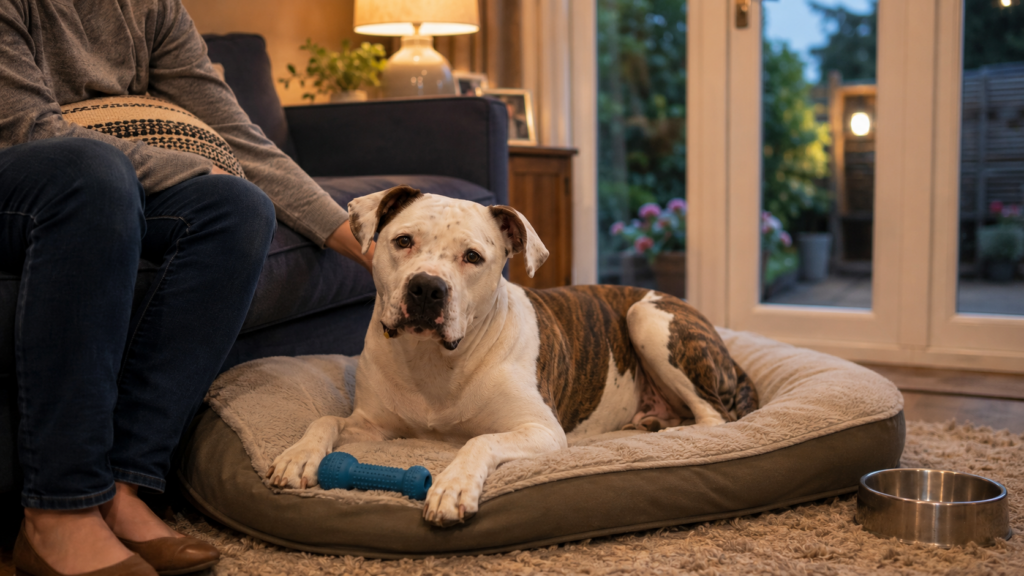
Keep Early Walks Short and Manageable
It can be tempting to tire a newly adopted American Bulldog with long walks. However, too much stimulation can make an anxious or overexcited dog more difficult to settle.
For the first few days, choose short walks in quiet locations. Allow plenty of time for sniffing and avoid crowded parks, busy high streets and close encounters with unfamiliar dogs.
Use secure equipment appropriate for a powerful breed. A well-fitted harness used with a strong lead may provide greater control. Some owners also use a backup connection between the harness and collar.
Check that the dog cannot reverse out of its equipment. Do not let it off lead simply because its recall appeared reliable in the rescue centre or because it seems attached to you at home.
A new rescue dog does not yet have a secure relationship with you and may run if startled.
Days Four to Seven: Begin Building Communication
Towards the end of the first week, introduce a few easy training exercises.
Keep sessions short—often one or two minutes is enough. Use food, toys or gentle praise to reward the behaviour you want.
Useful early exercises include:
- Responding to the dog’s name
- Making eye contact voluntarily
- Touching your hand with its nose
- Sitting calmly before a door opens
- Waiting while the lead is attached
- Following you for a few steps
- Settling on a bed or mat
- Exchanging an item for a reward
Avoid physical corrections, lead jerks, shouting or attempts to establish “dominance.” These methods can damage trust and may increase anxiety or defensive behaviour.
If your dog makes a mistake, ask whether the situation was too difficult. Reduce the distraction, make the task easier and reward the next successful attempt.
Do Not Rush Introductions
During the first week, avoid introducing your rescue American Bulldog to everyone you know.
When visitors eventually arrive, ask them to ignore the dog initially. They should avoid staring, leaning over it or reaching towards its face.
Let the dog decide whether to approach.
If children live in the home, supervise every interaction. Teach them not to:
- Hug the dog
- Disturb it while sleeping
- Approach while it is eating
- Take toys away
- Climb on its back
- Put their faces near its face
- Run or scream around it
- Follow it into its safe area
A dog that walks away is making a sensible choice. Always allow it to leave an interaction.
Week Two: Gently Expand Your Dog’s World
By the second week, you may notice more of your dog’s natural personality.
A previously quiet dog may become playful, energetic or demanding. A dog that appeared completely relaxed may begin displaying fears or unwanted behaviours.
This does not necessarily mean the adoption is failing. It may mean the dog feels secure enough to behave more naturally.
During week two, you can gradually:
- Explore a slightly wider range of walking routes
- Introduce one calm visitor at a time
- Extend reward-based training
- Practise settling while household activity continues
- Introduce grooming in very small steps
- Begin brief periods of separation
- Observe reactions to dogs, traffic and unfamiliar environments
Change only one or two things at a time. If your dog becomes overwhelmed, return to an easier routine.
Begin Alone-Time Training Carefully
Do not wait until you must leave for several hours before discovering how your American Bulldog copes alone.
Begin with extremely short separations. You might step behind a stair gate for a few seconds, return calmly and gradually increase the duration.
Watch for signs of distress:
- Persistent barking or howling
- Scratching at doors
- Destructive chewing
- Heavy panting
- Drooling
- Pacing
- Toileting indoors
- Refusing a normally valued treat
- Frantic behaviour when you return
A camera can help you observe what happens after you leave.
If the dog becomes distressed, the exercise has progressed too quickly. Reduce the duration and seek qualified help if the problem continues.
PDSA recommends building alone time gradually and warns against punishing destructive behaviour or indoor accidents caused by distress. Read PDSA’s separation guidance.
Introducing Another Dog
If you already have a dog, ideally the rescue organisation will have helped arrange a controlled introduction before adoption.
Early meetings should be calm, supervised and conducted with enough space. Give each dog its own handler and begin with parallel walking rather than forcing face-to-face contact.
At home:
- Feed the dogs separately
- Provide separate beds
- Remove high-value items initially
- Supervise access to toys
- Give both dogs individual attention
- Use gates to provide safe separation
- Do not leave them alone together too soon
Dogs Trust recommends an initial meeting outside the home where possible, with both dogs on leads and one person responsible for each dog. See the complete Dogs Trust introduction guide.
Introducing a Cat
Keep the dog and cat physically separated initially. Scent swapping with bedding can help each animal become familiar with the other before direct interaction.
Use gates and leads to prevent chasing. Make sure the cat has high escape routes and dog-free areas containing its food, water, bed and litter tray.
A relaxed response during one meeting does not mean the animals can immediately be left together unsupervised. Introductions may take days, weeks or considerably longer.
Week Three: Develop Useful Everyday Skills
During week three, place greater emphasis on behaviours that make daily life safer and easier.
Focus on:
- Loose-lead walking
- Waiting at doors
- Coming when called inside the home
- Leaving dropped objects
- Moving away from food or toys willingly
- Settling while people eat
- Remaining calm when the doorbell rings
- Comfortable handling for veterinary care
- Wearing a muzzle positively, if appropriate
Muzzle training is a useful life skill for any dog. A muzzle may be required during veterinary treatment, after an injury or when following professional behavioural advice.
Choose a basket-style muzzle that permits panting, drinking and taking treats. Introduce it gradually rather than simply fastening it onto the dog.
Learn to Read Your American Bulldog’s Body Language
American Bulldogs can look imposing even when they feel worried. Do not assume that stillness means calmness or that a wagging tail always indicates friendliness.
Possible signs of discomfort include:
- Turning the head away
- Lip licking when no food is present
- Yawning
- Showing the whites of the eyes
- Lowering the body
- Tucking the tail
- Freezing
- Staring
- Becoming suddenly still
- Growling
- Attempting to leave
Respond to early signs by creating distance and reducing pressure.
Never punish a growl. Growling is valuable communication that tells you the dog is uncomfortable. Punishment may suppress the warning without changing the underlying emotion.
Week Four: Review Progress Without Expecting Perfection
By the fourth week, your rescue American Bulldog may understand the household routine and show a growing attachment to you.
Signs of progress might include:
- Resting deeply in your presence
- Eating normally
- Exploring the house confidently
- Approaching you for interaction
- Playing with toys
- Responding to familiar cues
- Recovering more quickly after a surprise
- Settling after walks
- Showing relaxed, loose body language
- Choosing to spend time near family members
However, 30 days is not a deadline.
A dog with a difficult history may need far longer to feel secure. Progress is rarely a straight line, and stressful events can temporarily cause old behaviours to return.
At the end of the first month, review:
- Which situations make your dog feel comfortable?
- What appears to cause fear or overexcitement?
- Which rewards does it value most?
- How does it respond to being left?
- How does it behave around visitors?
- Are walks becoming easier?
- Is it showing any signs of pain or poor health?
- What training support might benefit you both?
When Should You Ask for Help?
Contact your veterinary surgeon if you notice:
- Persistent vomiting or diarrhoea
- Refusal to eat
- Sudden lethargy
- Lameness or stiffness
- Breathing difficulties
- Significant skin irritation
- Signs of pain
- Unexplained changes in behaviour
Pain and illness can contribute to behavioural changes, so a veterinary assessment is an important first step when a dog’s behaviour changes unexpectedly.
Ask the rescue centre or a qualified, reward-based behaviour professional for help if your dog displays:
- Aggression towards people or animals
- Serious resource guarding
- Intense separation distress
- Repeated attempts to escape
- Extreme fear
- Unmanageable lead reactivity
- Predatory behaviour towards other household pets
- Behaviour that places anyone at risk
Do not wait for a serious incident before seeking advice. Early support can prevent a manageable concern from becoming an established problem.
Common First-Month Mistakes
Giving the dog too much freedom
Allowing immediate access to the entire house, garden and every family activity can be overwhelming. Expand freedom gradually.
Inviting too many visitors
Your dog does not need a welcome party. It needs time to learn that its new home is safe.
Attempting long, exhausting walks
Mental overload and physical exhaustion do not necessarily create calm behaviour. Use shorter walks, sniffing and gentle enrichment.
Changing food immediately
Keep the existing diet stable initially unless a veterinary professional recommends a change.
Forcing physical affection
Some rescue dogs enjoy cuddles immediately; others need space. Let the dog initiate contact.
Testing the dog
Do not deliberately take away food, disturb sleep or create confrontations to see how the dog reacts.
Expecting instant gratitude
A rescue dog does not understand the story humans tell about being “saved.” Trust grows through safe, predictable experiences.
Frequently Asked Questions
How long does a rescued American Bulldog take to settle?
Some dogs begin relaxing within days, while others require several weeks or months. Age, previous experiences, kennel stress, health and household environment can all affect the timescale.
Should I walk my rescue American Bulldog on the first day?
A brief toilet walk may be appropriate, but avoid a long or highly stimulating outing. Follow the rescue centre’s advice and use secure equipment.
When can friends meet my new dog?
Wait until your dog appears comfortable with the immediate household. Introduce one calm visitor at a time and allow the dog to approach voluntarily.
Should my rescue dog sleep downstairs alone?
This depends on the individual dog. Some settle well, while others experience considerable distress. You may need to remain nearby initially and create distance gradually.
Can I let my American Bulldog off the lead after 30 days?
Thirty days does not guarantee reliable recall. Use a secure area or long training line until recall has been thoroughly practised around distractions.
What if my rescue dog has an accident indoors?
Clean the area without punishment and provide more frequent toilet opportunities. Stress, unfamiliar routines and medical issues can all contribute to accidents.
When should training begin?
Gentle learning begins immediately through routine and reinforcement. Formal sessions should be short, positive and appropriate for the dog’s emotional state.
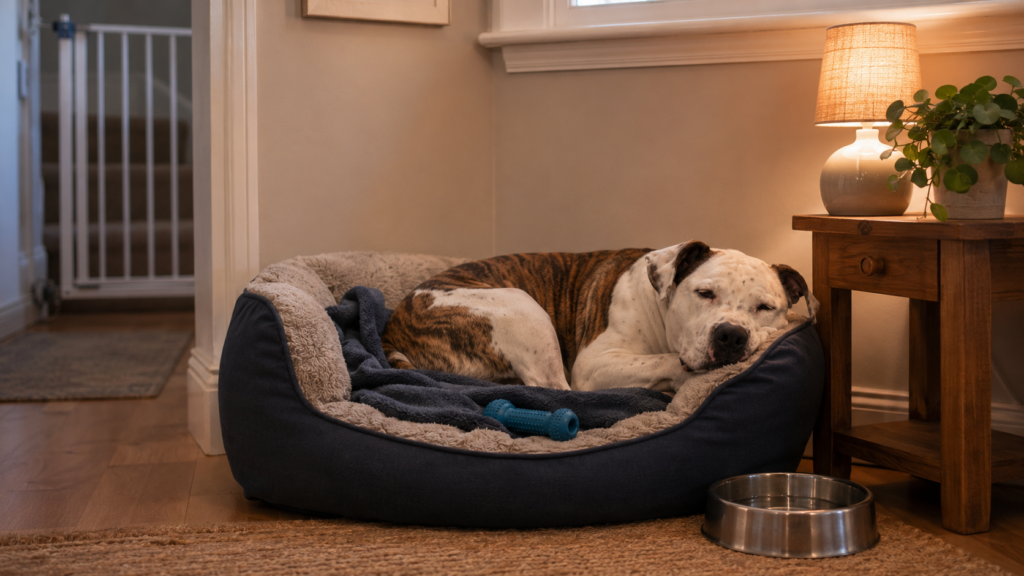
Give Your American Bulldog Time
The first month is not about creating a perfectly trained dog. It is about building the foundations of a secure relationship.
Offer predictable routines, quiet companionship, appropriate boundaries and plenty of opportunities to make safe choices. Notice small improvements and avoid comparing your dog with anyone else’s.
Your rescue American Bulldog may not reveal its full personality during the first 30 days. With patience, consistency and suitable professional support when necessary, you can help it understand that it is finally home.
Discover The American Bulldog Blueprint
Would you like a more complete guide to American Bulldog training, behaviour, feeding, exercise, health, grooming and responsible ownership?
Explore The American Bulldog Blueprint—a comprehensive resource created to help you understand your American Bulldog and provide the care, structure and companionship it needs.