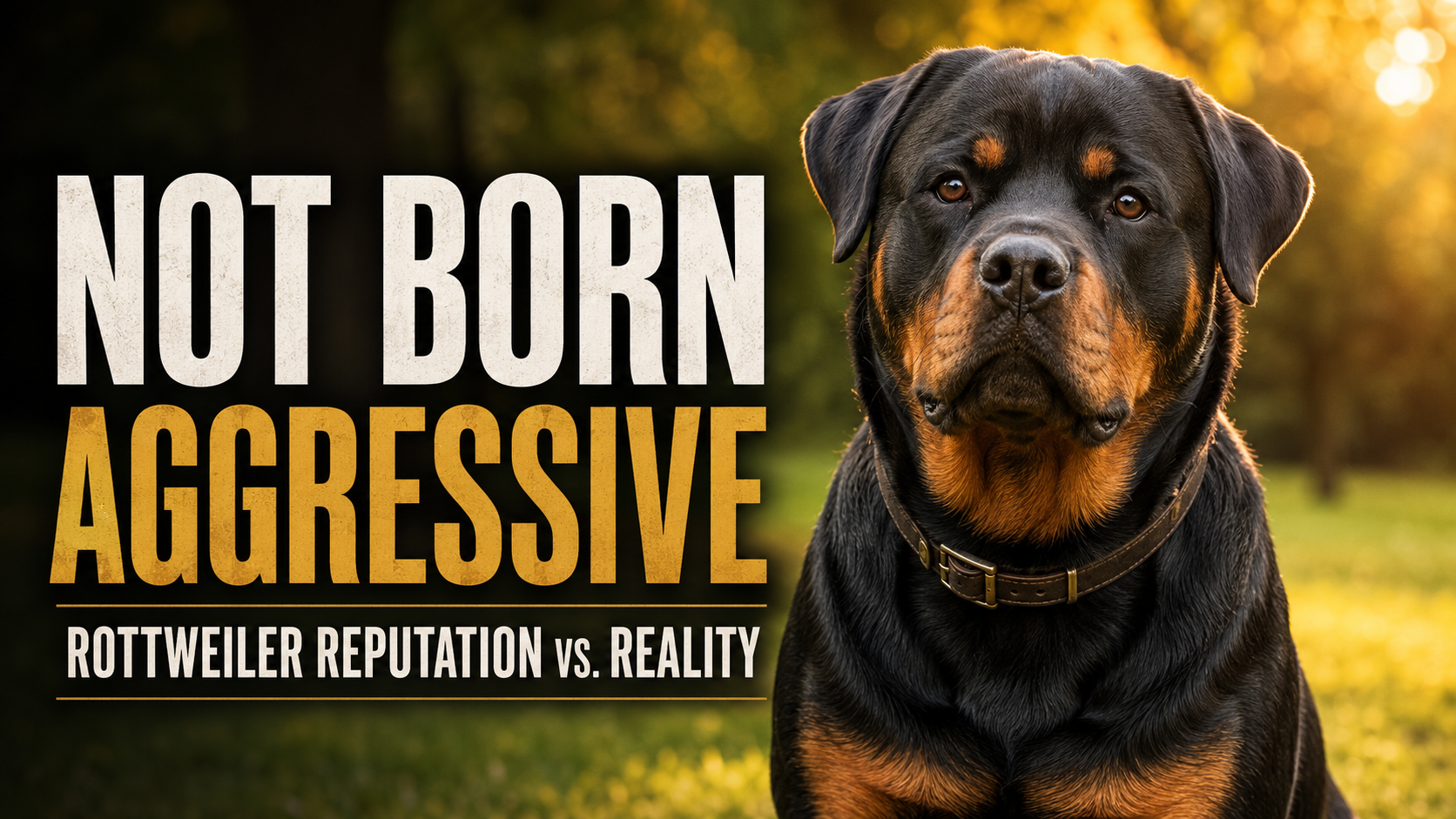
Not Born Aggressive: The Science Behind Rottweiler Reputation vs. Reality
Few dog breeds divide opinion quite like the Rottweiler.
To those who know the breed well, a properly raised Rottweiler can be calm, deeply affectionate, intelligent and extraordinarily loyal.
To others, the breed’s muscular build, guarding history and portrayal in films and news reports make it seem naturally threatening.
So, where does the truth lie?
Rottweilers are powerful working dogs with strong protective instincts, but describing them as “born aggressive” is both inaccurate and unhelpful.
Canine behaviour develops through a complicated interaction between genetics, early experiences, health, socialisation, training and the environment in which a dog lives.
This does not mean breed characteristics are irrelevant. Nor does it mean every Rottweiler is automatically suitable for every household. It means that reputation alone cannot predict how an individual dog will behave.
Let’s examine what science and responsible breed ownership tell us about the real Rottweiler.
Are Rottweilers Naturally Aggressive?
No dog is born with a fully formed intention to be aggressive.
Puppies may inherit behavioural tendencies such as confidence, sensitivity, persistence, sociability or a readiness to respond to potential threats. However, those predispositions are not the same as inevitable aggression.
A Rottweiler puppy may naturally be more watchful and less immediately welcoming towards strangers than a breed developed primarily for companionship. That does not mean the puppy is vicious.
It means the dog may require thoughtful socialisation and clear guidance while learning which situations are genuinely threatening and which are part of ordinary life.
The Royal Kennel Club’s Rottweiler breed standard describes the correct temperament as:
Good-natured, courageous and biddable, with natural guarding instincts—but not nervous, aggressive or vicious.
Unprovoked aggression is therefore not considered a desirable or correct feature of the breed.
What Does “Aggression” Actually Mean?
Aggression is not a single personality trait. It is a collection of behaviours that may include:
- Stiffening or freezing
- Hard staring
- Growling
- Baring the teeth
- Snapping
- Lunging
- Biting
These behaviours can occur for many different reasons. A dog may behave aggressively because it is frightened, in pain, guarding something valuable, protecting its territory or attempting to increase its distance from a perceived threat.
A growl from a frightened dog and a territorial lunge at a garden gate may look different, but both are forms of communication.
The RSPCA’s guidance on canine aggression explains that aggression is not one simple characteristic. Understanding the reason behind the behaviour is essential if it is to be managed safely and effectively.
Punishing the visible warning without addressing its cause may suppress growling while leaving the dog’s underlying fear or discomfort untouched.
What Science Says About Breed and Behaviour
Scientific evidence does not support the idea that a breed label can reliably determine the complete behaviour of an individual dog.
A major 2022 study published in Science examined genetic information from more than 2,000 dogs alongside extensive behavioural survey data.
Researchers found that breed explained only around 9% of behavioural variation between individual dogs.
Certain breed-associated tendencies did exist, particularly behaviours connected with historical working functions. However, breed was a relatively poor predictor of how any particular dog would behave.
This does not mean genetics have no influence. Research has identified inherited differences in behavioural tendencies between breeds and breed groupings. The more accurate conclusion is that:
Genetics can influence behavioural potential, but they do not write an individual dog’s entire future.
A Rottweiler’s temperament develops through the interaction of:
- Inherited characteristics
- The temperament of its parents
- Prenatal and early puppy development
- Early socialisation
- Training methods
- Previous experiences
- Physical and emotional health
- Home environment
- Owner handling and management
Two Rottweilers from different breeders and raised in different homes may consequently develop very different personalities.
Why Do Rottweilers Have Such a Fearsome Reputation?
The Rottweiler’s reputation has several overlapping causes.
Their appearance is imposing.
An adult Rottweiler is a large, heavily built dog with substantial physical strength. Its broad head, dark colouring and confident posture can appear intimidating—even when the dog is completely relaxed.
People often interpret an unfamiliar dog partly through its appearance. The same behaviour may be perceived very differently when displayed by a small companion dog and a 50kg working dog.
They were bred to guard and work
Rottweilers descend from versatile working dogs used for driving and protecting livestock. They later guarded property and served in policing, military work and other demanding roles.
This history helped produce qualities such as:
- Courage
- Physical resilience
- Environmental awareness
- Loyalty
- Confidence
- Trainability
- Natural guarding ability
Those qualities are valuable when properly directed. Without appropriate guidance, however, vigilance can develop into excessive suspicion and guarding can become difficult to control.
Serious incidents receive greater attention
A bite from any dog matters, but the physical consequences can be considerably more severe when the dog is large and powerful.
The RSPCA notes that breeds with particular physical and temperamental attributes may not necessarily be more likely to show aggression, but the consequences can be more serious if they do.
This distinction is important. Frequency and severity are not the same measurement.
Media coverage influences perception
Incidents involving powerful breeds tend to attract prominent headlines. Calm, friendly Rottweilers living ordinary family lives are not considered newsworthy, even though they represent a huge number of everyday experiences.
Repeated exposure to negative stories can create the impression that serious aggression is typical rather than exceptional.
Irresponsible breeding damages the breed
Poor breeding can produce dogs with unstable, excessively fearful or unpredictable temperaments. Selecting parents primarily for size, intimidating appearance or defensive behaviour can magnify serious problems.
Responsible breeders place considerable importance on:
- Stable parental temperament
- Appropriate health testing
- Early puppy handling
- Careful social development
- Suitable owner selection
- Lifelong breeder support
Anyone considering a Rottweiler puppy should spend time with the mother and, where possible, learn about the father’s temperament too.
Genetics Matter—but Environment Matters Too
Discussions about aggression sometimes become trapped between two extreme claims:
- Behaviour is entirely determined by breed.
- Behaviour is entirely determined by upbringing.
Neither position accurately reflects modern behavioural science.
A dog’s genes may influence how quickly it notices a potential threat, how intensely it responds and how readily it recovers afterwards. Its experiences then influence how those tendencies are expressed.
For example, a naturally watchful puppy that encounters many people through calm, positive experiences may mature into a sensible adult that observes strangers without overreacting.
The same puppy, if isolated during early development or repeatedly frightened, could become suspicious and defensive.
Responsible ownership cannot guarantee that a dog will never develop a behavioural difficulty.
Nevertheless, good breeding, socialisation, training and management can greatly improve the likelihood of a stable adult temperament.
The Importance of Early Socialisation
Socialisation is one of the most important foundations for a young Rottweiler.
The aim is not to make the puppy enthusiastically greet every person or dog it sees. The goal is to help it feel safe, composed and responsive to its owner in different environments.
A well-planned socialisation programme may include positive exposure to:
- Adults of different appearances
- Calm, dog-aware children
- Friendly, well-mannered dogs
- Veterinary handling
- Grooming and body examination
- Traffic and household noises
- Visitors entering the home
- People using walking sticks or wheelchairs
- Different floors, surfaces and environments
- Safe journeys in the car
- Livestock and other animals where appropriate
Exposure must be gentle and carefully controlled. Overwhelming a puppy, forcing unwanted contact or allowing frightening encounters is not good socialisation.
Quality matters more than quantity.
A puppy should be able to observe, investigate and retreat without being pressured. Food, play and reassurance can help create positive associations.
Why Reward-Based Training Is So Important
Rottweilers are intelligent, capable dogs that generally respond very well to clear, consistent training.
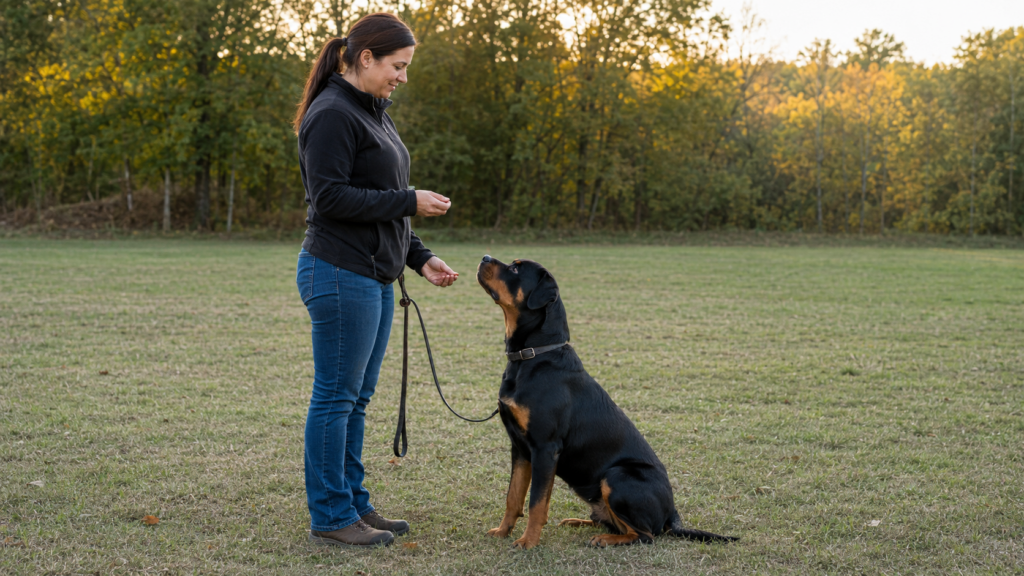
Reward-based methods teach the dog which behaviours are successful while protecting trust between dog and owner. Rewards may include food, praise, access to an activity or a favourite toy.
Particularly useful skills include:
- Responding reliably to their name
- Recall
- Loose-lead walking
- Settling on a mat
- Leaving and dropping objects
- Waiting at doors
- Remaining calm around visitors
- Accepting handling
- Wearing a muzzle comfortably
- Disengaging from distractions
Harsh physical corrections, intimidation and attempts to “dominate” the dog can increase fear, frustration or defensive behaviour.
These methods are especially risky with an adolescent or adult dog possessing considerable strength.
Calm authority comes from predictability, good management and well-practised communication—not from frightening the dog.
Fear Is Frequently Mistaken for Dominance
A Rottweiler that barks, growls or lunges may look bold, but the behaviour can be rooted in uncertainty or fear.
Warning signs of discomfort can include:
- Turning the head away
- Lip licking
- Yawning when not tired
- Showing the whites of the eyes
- Closing the mouth suddenly
- Lowering the body
- Pinning the ears back
- Freezing
- Attempting to move away
If these early signals are ignored, the dog may escalate to a growl, snap or bite.
Learning to read subtle canine body language allows owners to intervene before the situation reaches that point.
Increasing distance, removing pressure and seeking professional help early is far safer than waiting for the behaviour to become severe.
Pain and Illness Can Change a Rottweiler’s Behaviour
A sudden change in temperament should always be taken seriously.
Pain can reduce a dog’s tolerance and make ordinary handling feel threatening. Rottweilers can be affected by orthopaedic conditions and other health problems that may cause discomfort.
Possible indicators include:
- Reluctance to be touched
- Difficulty standing or using stairs
- Irritability after exercise
- Guarding a particular part of the body
- Interrupted sleep
- Reduced interest in normal activities
- Unexpected growling or snapping
- Changes in appetite
If previously uncharacteristic aggression appears suddenly, the first step should be a thorough veterinary examination.
Behavioural support cannot succeed fully if an untreated medical problem is driving the response.
Are Male Rottweilers More Aggressive Than Females?
Sex alone cannot predict an individual dog’s temperament.
Males are usually larger and may mature more slowly, while females are often physically lighter.
Hormones can influence certain behaviours, but aggression cannot be explained simply by whether a dog is male, female, neutered or entire.
Temperament, breeding, learning history, health and environment all remain important.
Neutering should not be viewed as an automatic cure for aggression. Its likely behavioural and health effects should be discussed with a veterinary professional who understands the individual dog.
Can Rottweilers Be Good Family Dogs?
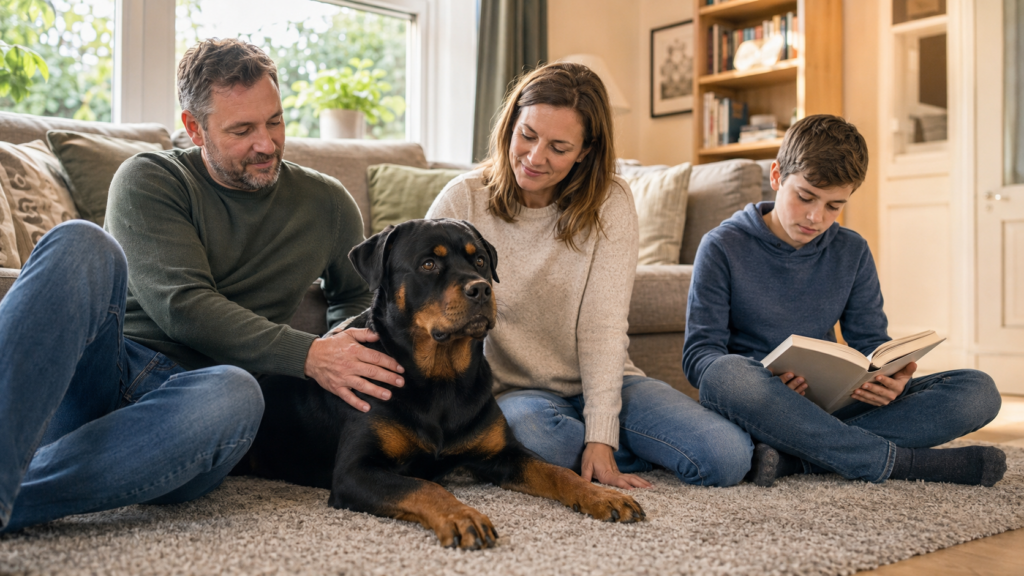
Yes—many Rottweilers are loving and devoted family companions.
A well-adjusted Rottweiler may be affectionate, playful and surprisingly sensitive with the people it trusts.
However, its size and power mean that interactions with children require sensible supervision.
Children should be taught never to:
- Climb on or ride the dog
- Pull its ears or tail
- Disturb it while sleeping
- Approach it while it is eating
- Take toys or chews away
- Corner or hug it
- Treat its bed as a play area
Dogs and young children should never be left together unsupervised, regardless of breed or previous behaviour.
A Rottweiler also needs a quiet retreat where it can rest without interruption. Baby gates and other physical barriers can make family life safer and calmer.
Are Rottweilers Dangerous?
A Rottweiler has the physical capacity to cause serious injury. It would be irresponsible to pretend otherwise.
However, physical capability does not mean malicious intent or inevitable aggression. Many large working breeds possess strength without behaving dangerously in ordinary life.
Risk is influenced by factors including:
- Individual temperament
- Breeding quality
- Owner competence
- Socialisation
- Training
- Supervision
- Confinement and exercise
- Health
- Previous warning behaviour
- Access to vulnerable people
- The dog’s living conditions
The American Veterinary Medical Association states that any dog can bite and opposes policies that assume danger solely from breed.
A responsible approach considers both sides of the truth:
Rottweilers are not automatically aggressive—but their strength means that prevention, training and management must be taken extremely seriously.
Warning Signs That Should Never Be Ignored
Owners should obtain professional help if their Rottweiler:
- Freezes or growls when approached
- Guards food, furniture or family members
- Lunges repeatedly at people or dogs
- Becomes increasingly suspicious of visitors
- Has bitten or attempted to bite
- Cannot recover after becoming frightened
- Reacts unpredictably to handling
- Displays rapidly worsening behaviour
Do not deliberately recreate a dangerous situation to “test” the dog. Avoid punishment and manage access to potential triggers while help is arranged.
Suitable support may come from:
- Your veterinary surgeon
- A qualified clinical animal behaviourist
- An accredited reward-based trainer
- A veterinary behaviour specialist
In the UK, your vet may be able to refer you to an appropriately qualified behaviour professional.
How to Raise a Stable, Well-Mannered Rottweiler
No checklist can remove every possible risk, but the following principles create a strong foundation.
Choose the source carefully
Avoid breeders who boast about aggression, extreme guarding ability or unusually intimidating dogs.
Look for stable adult dogs, appropriate health testing and puppies raised in a stimulating home environment.
Introduce new experiences gradually and positively. Do not wait until the puppy is older and physically stronger.
Train every day.
Short, enjoyable sessions are usually more effective than occasional long ones. Incorporate training into meals, walks, doorways and play.
Prevent rehearsal of unwanted behaviour.
Repeated fence running, uncontrolled barking at visitors or lunging on the lead can become well-practised habits.
Use barriers, distance and structured training before the behaviour becomes established.
Provide appropriate exercise
Rottweilers need physical activity, but exercise should be suitable for the dog’s age and health. Puppies should not be subjected to excessive forced exercise while their bodies are developing.
Include mental enrichment
Scent games, food puzzles, controlled tug, tracking activities and structured training can help satisfy the working mind.
Teach calmness
A dog that can settle is easier to live with than one kept in a permanent state of excitement. Reward resting, quiet observation and relaxation.
Protect the dog from bad experiences
Owners do not need to allow every stranger or unfamiliar dog to approach. Advocacy and thoughtful distance can prevent frightening encounters.
Seek help early
Small concerns are usually easier to address than behaviour that has been rehearsed for months or years.
What Responsible Ownership Really Looks Like
Responsible Rottweiler ownership is not about proving that the dog is harmless. It is about understanding the breed honestly and setting the individual dog up to succeed.
A responsible owner:
- Uses secure fencing and suitable equipment
- Supervises interactions carefully
- Continues training through adolescence
- Respects warning signals
- Does not encourage intimidation
- Provides sufficient exercise and enrichment
- Maintains veterinary care
- Prevents uncontrolled access to visitors
- Obtains professional help when needed
- Accepts that other people may feel nervous
Public confidence is earned through calm, considerate handling. A well-controlled Rottweiler walking politely beside its owner does more for the breed’s reputation than any online argument.
Reputation Versus Reality
The reputation says every Rottweiler is waiting for an opportunity to attack.
The reality is far more nuanced.
Rottweilers are strong, intelligent working dogs with genuine guarding heritage. They may be naturally watchful and can present a serious risk when badly bred, mistreated, poorly socialised or irresponsibly managed.
They can also be affectionate, steady, trainable and deeply devoted companions.
The important question is not simply:
“Are Rottweilers aggressive?”
A more useful set of questions would be:
- What is this individual dog’s temperament?
- How was it bred and raised?
- What experiences has it had?
- Is it healthy or in pain?
- How does it respond to pressure?
- Is the owner capable of meeting its needs?
- Are warning signs being recognised and respected?
A breed label provides part of the background. It does not provide the full story.
Frequently Asked Questions
Are Rottweiler puppies born aggressive?
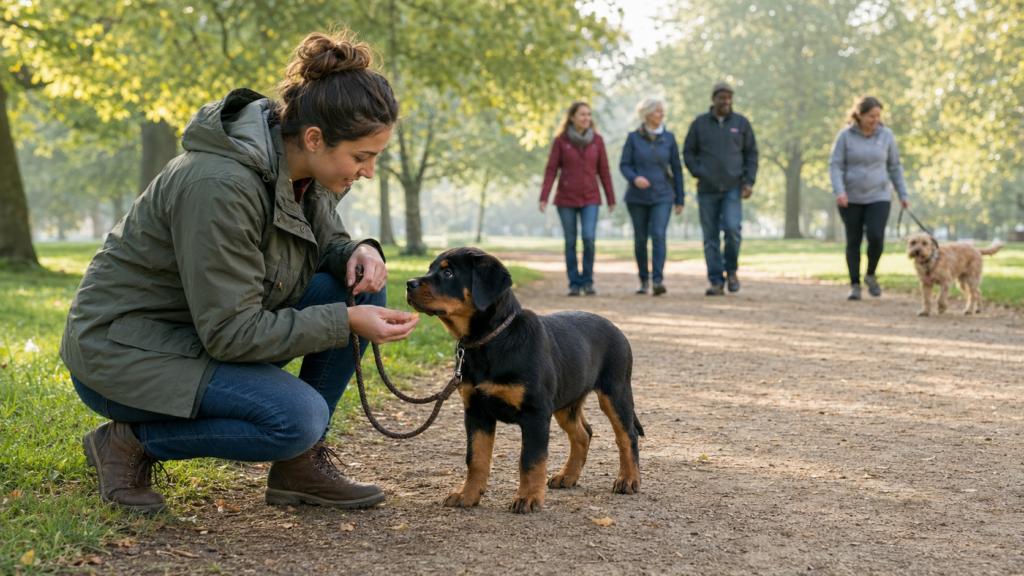
No. Puppies can inherit temperamental tendencies, but aggression develops through a combination of genetics, physical health, learning and environmental experiences.
Early behaviour should still be taken seriously, especially intense fear, persistent resource guarding or unusually severe reactions.
Can a Rottweiler be friendly with strangers?
Yes, although many adult Rottweilers are naturally reserved rather than immediately sociable. A well-adjusted dog should be capable of remaining calm and manageable around unfamiliar people without being forced to greet them.
Can poor training make a Rottweiler aggressive?
Harsh punishment, inconsistent boundaries, deliberate encouragement of guarding and inadequate socialisation can all contribute to behavioural problems. Training is only one part of the picture, but it is an important one.
No aspect of dog raising comes with a complete guarantee. Good socialisation can substantially improve resilience and confidence, but genetics, health and later experiences also influence behaviour.
Should you punish a Rottweiler for growling?
No. A growl is an important warning that the dog is uncomfortable. Punishment may stop the warning without changing the emotion behind it. Create distance, identify the trigger and seek qualified professional guidance when necessary.
Are Rottweilers suitable for first-time owners?
They are not generally the easiest choice for an inexperienced owner. Their strength, intelligence, guarding instincts and training requirements demand considerable commitment. A highly prepared first-time owner with excellent professional support may succeed, but should research the responsibility very carefully.
Can a rescued Rottweiler become a safe family companion?
Many can, but each dog must be assessed as an individual. Its history, current behaviour, health and suitability for the household should all be considered. Adopters should work with a reputable rescue and follow its behavioural and management advice.
Final Thoughts
Rottweilers are not born as villains, and aggression should never be treated as an unavoidable breed characteristic.
They are powerful dogs shaped by genetics, working history, early development and lifelong experience. A stable Rottweiler does not need to love everyone it meets, but it should be manageable, responsive and able to navigate ordinary life without uncontrolled aggression.
Defending the breed responsibly does not require denying its strength or potential risks. It requires replacing myths with evidence, careless ownership with thoughtful management, and fear-based training with patient, consistent education.
When bred thoughtfully, raised carefully and treated with respect, the Rottweiler’s defining qualities are not hostility and unpredictability but courage, loyalty, intelligence and devotion.
Want to know more? Check out our Rottweiler Blueprint page HERE
Important: Aggression can be influenced by pain, illness and serious behavioural distress. Seek veterinary advice and qualified behavioural support if a dog displays threatening, escalating or unpredictable behaviour.