
Reasons Explained
Australian Shepherds often follow their people because they’re intelligent, social working dog breeds with strong bonds.
This natural social behaviour may reflect affection, routine, herding motivation, or a need for interaction and purpose. For a dog owner, close following usually isn’t a problem.
Some Aussies become known as “Velcro dogs,” but that label doesn’t automatically mean they have separation anxiety.
Following can also come from herding instinct, boredom, or a need for more daily exercise for Australian Shepherds and canine enrichment activities.
However, sudden clinginess, panic when left alone, pacing, drooling, or signs of illness deserve closer attention. These changes may point to anxiety or a medical issue that needs veterinary attention.
We’ll explore the difference between a close companion, a busy herder, an under-stimulated dog, and an Aussie who needs professional help, with more background on Australian Shepherd behavior.
This post may contain affiliate links. If you make a purchase through these links, I may earn a small commission at no extra cost to you.
For a helpful visual guide, watch Why Does My Dog Follow Me Everywhere?. You can also Check out our great guides on Payhip or Check out our ebook guides on Etsy.
Key Takeaways
- An Aussie may become your shadow because of affection, curiosity, herding instincts, or a desire for activity.
- Following you doesn’t automatically mean separation anxiety. Focus on how your dog behaves when you leave.
- Boredom can increase clingy behavior, so provide regular exercise, training, and enrichment.
- Sudden clinginess, pain, vomiting, trembling, or appetite changes warrant a veterinary check.
- Destruction, barking, house-soiling, and panic when alone may signal separation-related distress. Research on canine separation anxiety offers useful background.
Why Does My Australian Shepherd Follow Me Everywhere?
Australian Shepherds often follow their people because they form strong family bonds and were developed to work closely with humans.
This dog breed belongs to the herding group, so staying aware of people can feel natural. As pack animals, dogs usually seek social connection without following any dominance-based “alpha” idea.
Following is only concerning when it comes with panic, destructive behavior, or an inability to settle.
Look at your dog’s whole behavior, not just the fact that they move whenever you do.
Your Aussie May Be Showing Love, Loyalty, and Herding Instinct
A healthy attachment usually looks relaxed. An affectionate dog may change rooms with you, rest nearby while you work, check in during walks, or respond happily to a familiar cue.
Your Aussie may act like your shadow, which is why people often call especially clingy dogs “Velcro dogs.” This is often natural social behaviour, not automatically a problem.
An Australian Shepherd is a dog breed in the herding group with a strong instinct to monitor movement.
Staring, circling, blocking your path, chasing your feet, or giving a gentle nip can reflect that instinct. These behaviors aren’t automatically aggressive, but they still need calm training and clear boundaries.
The American Kennel Club’s Australian Shepherd breed information describes the breed’s impulse to herd people, children, animals, and even moving objects.
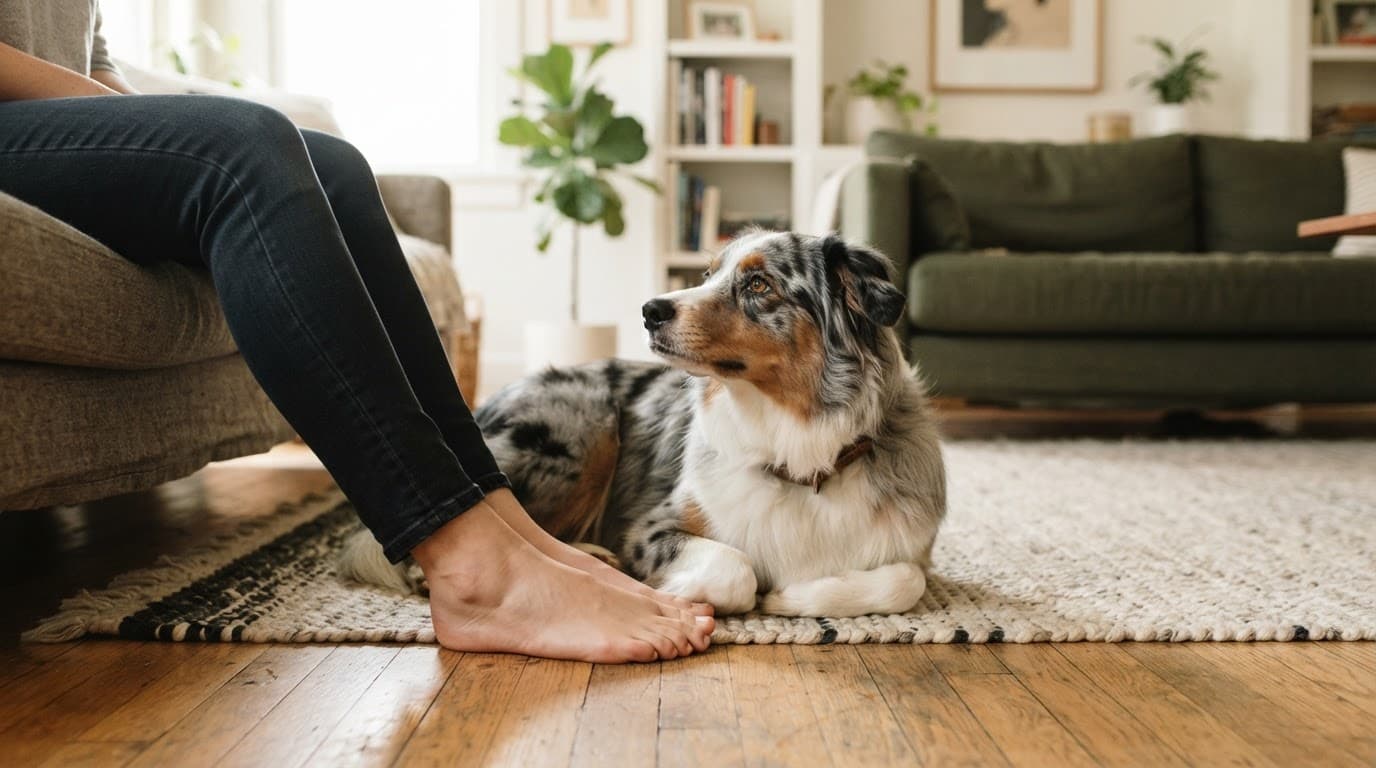
Age, temperament, training history, and your household routine all affect how closely an Aussie follows. Puppy imprinting can shape a young dog’s expectations of people, but it isn’t the only cause of lifelong attachment.
A rescue dog may follow closely while adjusting to a new home, without having attachment problems. A puppy may shadow you for reassurance, while an older dog may simply prefer company or need extra support as they age.
If your dog can relax alone, settle nearby, and listen when redirected, their furry-shadow routine is usually normal.
Boredom Can Turn a Shadowing Habit Into a Full-Time Job
Your Aussie may also follow because they expect something exciting. Walks, training, play, meals, car rides, and garden time can all become part of the pattern.
If you give attention every time your dog appears, they quickly learn that following you reliably starts an interaction.
Even plenty of physical exercise may not satisfy an intelligent, high-drive Australian Shepherd. Their brain needs work too, such as short training sessions, scent games, a food puzzle, enrichment toys, or tug toys.
Try rewarding your dog for settling on a mat, then offer activities at planned times instead of responding to every request. This gives your Aussie a job without making you their full-time entertainment manager.
When Following You Is Normal, and When It Signals a Problem
Following you around is often normal for an Australian Shepherd. Context matters, though. Can your dog relax when you sit down, or do they panic whenever you prepare to leave?
Is the behavior long-standing, or did your usually independent dog become clingy overnight?
Signs of Separation Anxiety Instead of Simple Affection
Separation anxiety happens when a dog panics during, or just before, alone time. It isn’t simply a preference for company or a habit of walking from room to room with you.
Following alone can’t prove a fear of abandonment or establish a diagnosis.
Watch for separation-related distress when you leave, such as:
- Frantic pacing, nonstop barking, whining, or howling.
- Destructive chewing around doors, windows, or other exits.
- Escape attempts, broken nails, scraped paws, or other self-injury.
- Heavy drooling, panting, trembling, or repeated attempts to reach you.
- House soiling in a dog that’s normally reliable indoors.
- An inability to settle after your departure, even when the home is quiet.
The timing and accompanying signs determine whether this pattern needs professional help for a possible behavioral issue. If it’s safe, record the first 30 to 60 minutes after you leave.
A phone, pet camera, or home security camera may reveal distress that isn’t obvious when you return. For more information, the ASPCA’s separation anxiety guidance explains why barking, destruction, and house soiling can be linked to alone time.
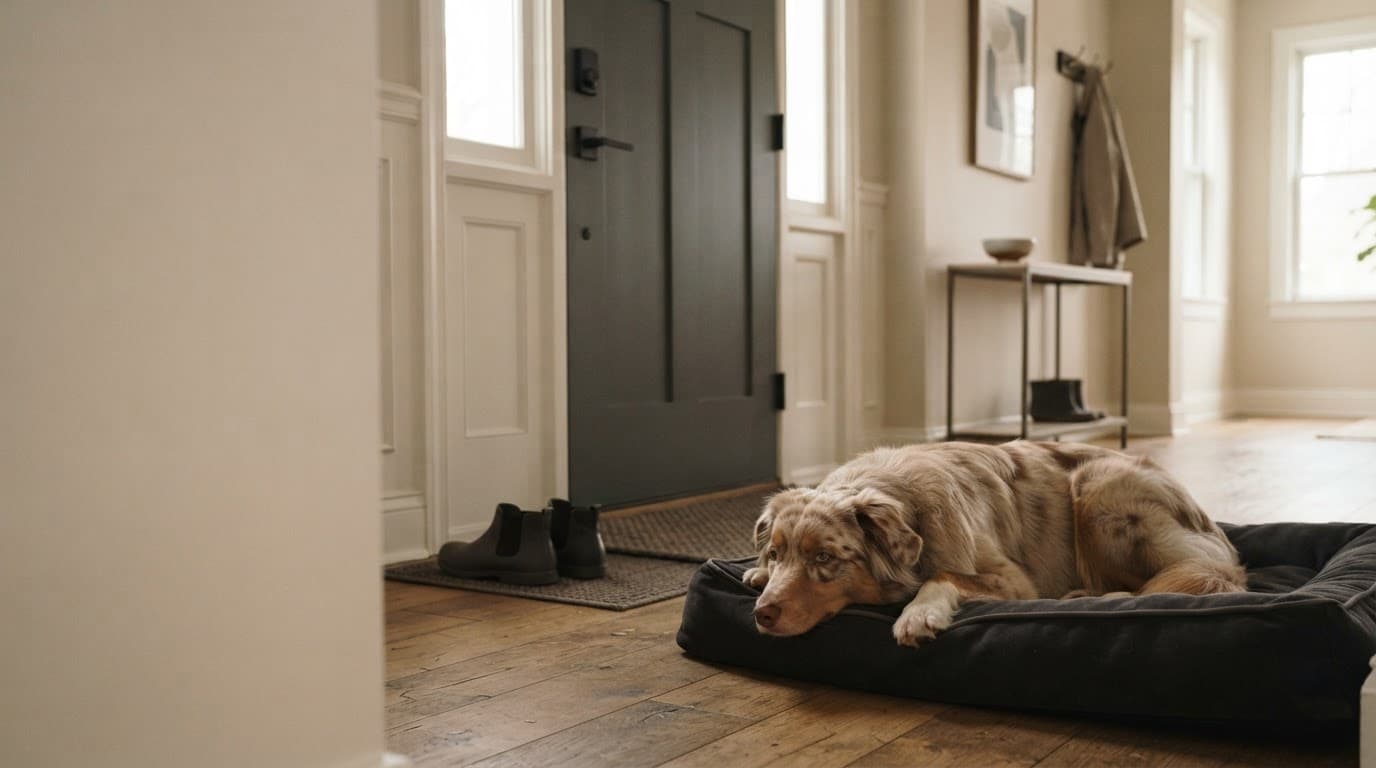
A dog who follows you but settles on a dog bed while you’re home is showing a different pattern.
Your dog may also choose a familiar bed near you while recovering or feeling insecure. You can compare these signs with boredom versus separation anxiety, since both may involve chewing or attention-seeking.
Why Sudden Clinginess Deserves a Health Check
Pain, illness, hearing or vision loss, aging changes, and neurological problems can make a previously independent dog seek constant contact.
Your Aussie may follow you because they feel uncomfortable, confused, or less secure.
In an older dog, cognitive decline is one possible concern when clinginess appears with confusion, nighttime changes, or disorientation.
It doesn’t explain every older dog who follows their person.
Schedule a veterinarian checkup if clinginess appears suddenly or comes with pain, lethargy, vomiting, appetite or drinking changes, weight loss, house accidents, trembling, or other unusual behavior.
A veterinary professional should rule out medical causes before behavior modification begins.
How Much Exercise and Mental Stimulation Does an Australian Shepherd Need?
A healthy adult Australian Shepherd commonly needs around 90 to 120 minutes of daily activity.
The right amount of mental and physical stimulation varies with age, health, fitness, weather, and individual drive.
Puppies, seniors, and dogs recovering from illness need a gentler plan.
Exercise should include purposeful walking, sniffing, training, play, and problem-solving. Repetitive ball throwing may tire your Aussie physically, but it doesn’t always satisfy their busy mind.
Breed guidance also recommends varied activities, such as Australian Shepherd exercise and enrichment, instead of one endless high-speed game.
Build a Predictable Schedule That Gives Your Aussie a Job
A predictable daily routine can help your Australian Shepherd stop monitoring your every movement.
When walks, training, food, rest, and play have their own times, your dog doesn’t need to follow you in case something exciting happens.
A simple schedule might look like this:
- Start with a 30 to 45-minute walk that allows plenty of sniffing and exploring.
- Add a five-minute training session for recall, stays, hand touches, or simple tricks.
- Serve breakfast through scatter feeding, a food puzzle, or a snuffle mat.
- Schedule quiet rest on a comfortable mat while you work or relax.
- Offer supervised play later, using fetch, hide-and-seek, or a structured tug game.
- Finish with another walk, a few recall exercises, and a safe chew.
Give your Aussie useful jobs throughout the day. They can carry a safe, lightweight item, find hidden treats, settle on a mat, or practice coming back when called.
These small tasks turn everyday life into purposeful work without making you the permanent entertainment committee.
Use Calm Activities, Not Just More High-Speed Exercise
More intense exercise isn’t always the answer. If your Aussie only practices sprinting, chasing, and bouncing, you may create a fitter, more demanding dog who expects the next big event.
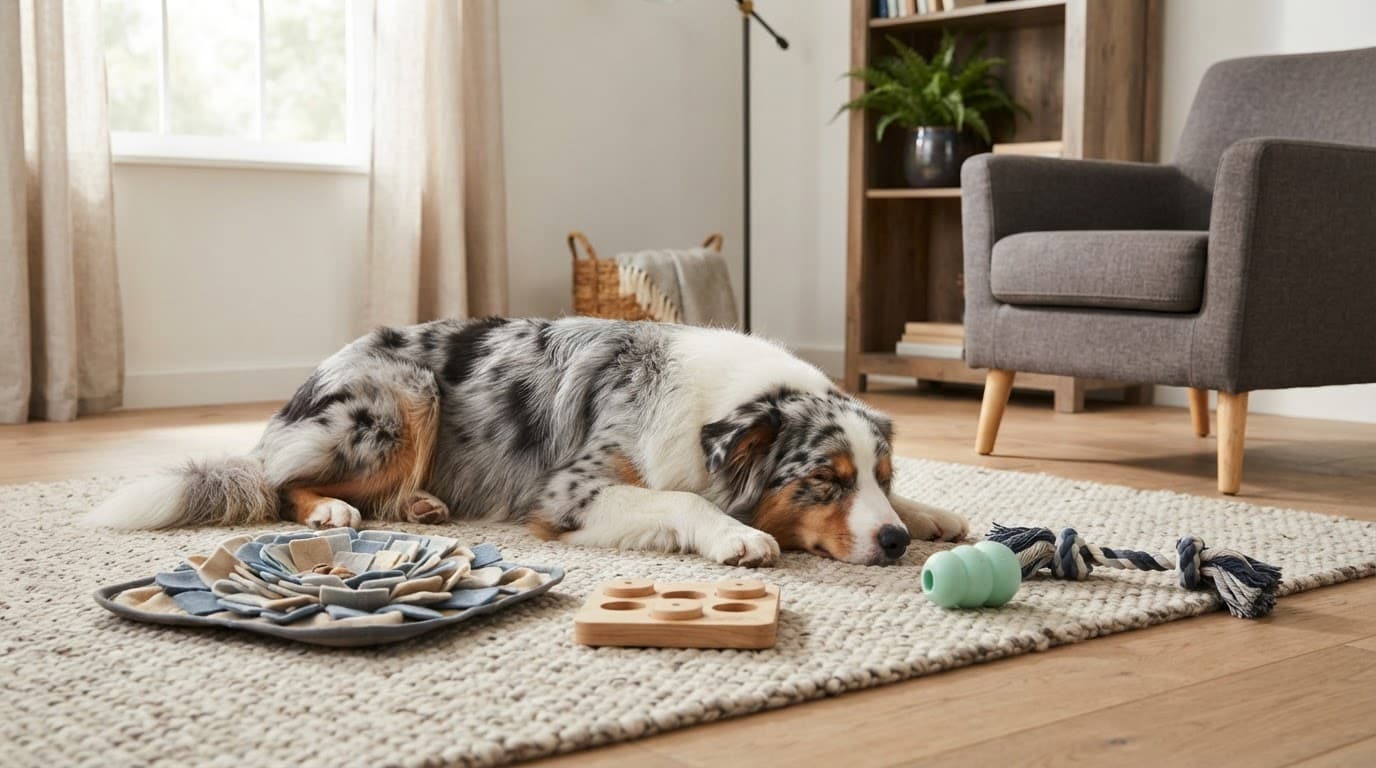
Balance active periods with sniffing, chewing, licking, shaping games, settle training, and relaxed mat time.
Nose work, hide-and-seek, scatter feeding, trick training, and a toy rotation system keep enrichment interesting. You can find more mental stimulation ideas for barking and restlessness when your Aussie struggles to switch off.
Watch for over-arousal, including panting that doesn’t settle, frantic chasing, wild grabbing, or repetitive behaviors. Tug toys can be useful, but keep the game structured with clear “start” and “stop” cues.
For more calm behavior ideas, see this training guidance for respectful boundaries and calm behavior.
You can also Check out our great guides on Payhip or Check out our ebook guides on Etsy for practical dog-care resources.
How to Teach Your Australian Shepherd to Be More Independent
Teaching independence doesn’t mean pushing your Australian Shepherd away. It means showing them that good things happen when they aren’t touching your ankle.
Use positive reinforcement, tiny progressions, and calm routines instead of punishment or forced isolation.
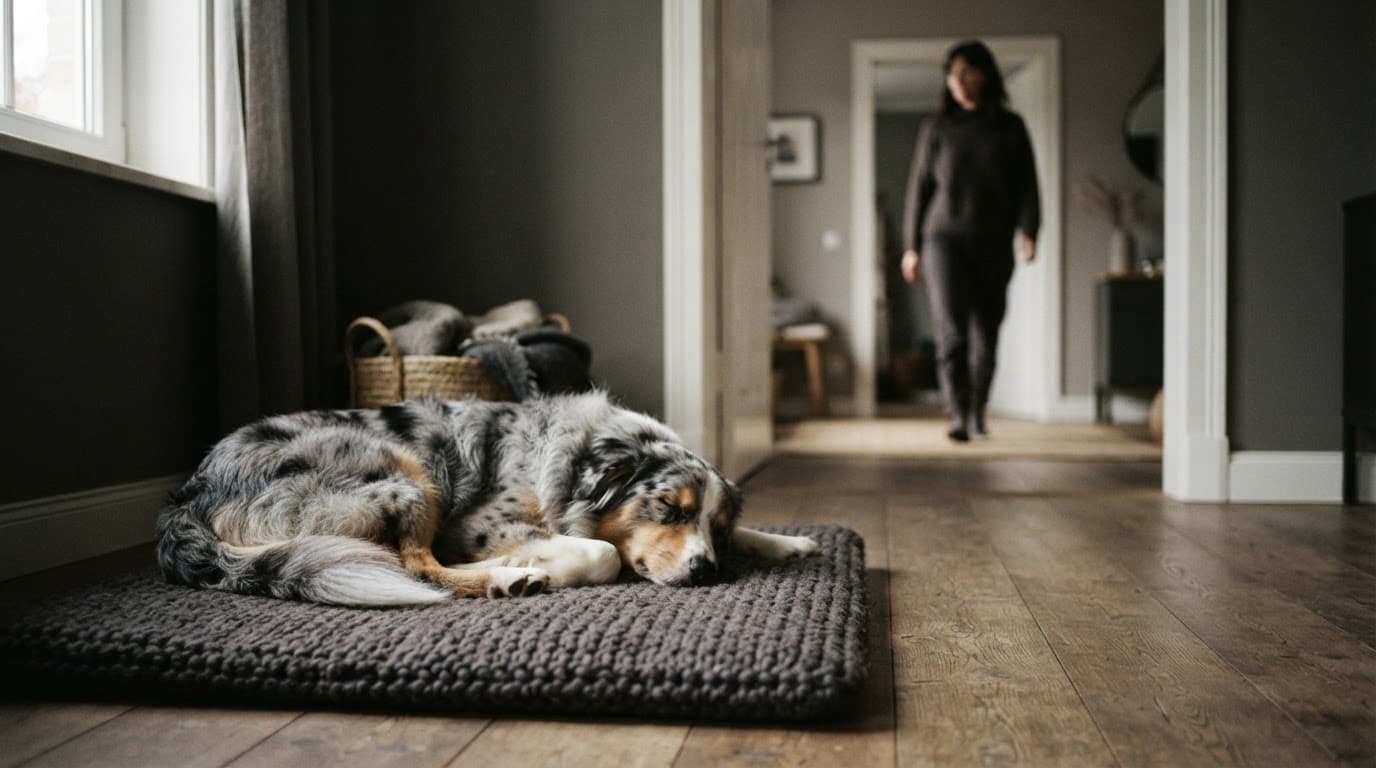
Reward Calm Choices Instead of Constant Shadowing
Pay attention to what your Aussie is doing when you offer rewards. If treats and affection only arrive after pawing, staring, nudging, or following you, those behaviors can become your dog’s personal customer-service system.
Instead, place a treat on their mat when they choose to rest. Praise relaxed body language, such as a soft face, loose muscles, a lowered head, or a gentle sigh.
You can also offer a chew or a few pieces of kibble when your dog settles nearby without demanding attention.
This dog training approach rewards calm choices, not constant requests. Offer affection and play at planned times, too.
You are teaching a clearer lesson: resting independently also earns good things.
Practice Alone Time in Seconds Before Building to Minutes
Start with an easy exercise while your Australian Shepherd is relaxed:
- Ask your dog to settle on their bed, then step behind a door for two seconds.
- Return calmly and reward them if they stayed relaxed.
- Repeat the exercise, building to five seconds, then ten seconds.
- Increase the time only when your dog remains comfortable.
Return before worry begins. If your dog gets up, whines, scratches, or rushes after you, the last step was too difficult.
Go back to a shorter absence and build more slowly. The research on systematic desensitization for canine separation anxiety supports this gradual approach.
Practice picking up your keys, putting on shoes, handling your coat, and opening the door without leaving.
These cues should not always predict a long absence. When your Aussie stays calm, reward them with a safe enrichment item during a brief departure.
Don’t jump from two seconds to several hours. Alone-time training is more like adding small stepping stones than crossing a river in one leap.
Know When to Involve a Trainer or Veterinary Behaviorist
Professional help is important if your dog panics, destroys doors, tries to escape, or injures themselves while alone.
Severe separation distress isn’t stubbornness, and punishment can make the fear worse.
A qualified dog behaviorist or veterinary behaviorist can create a safer training plan for these cases.
A rescue dog may also need especially small steps while learning that departures are safe, without assuming every rescue dog will respond the same way.
Speak with your veterinarian first. A health check can rule out pain or illness, and your vet can recommend a qualified reward-based trainer or veterinary behaviorist.
Some dogs benefit from medication alongside behavior training, but only a veterinarian can decide whether medication is suitable.
You can also review these gradual separation anxiety training principles. The linked article discusses a different breed, but the small-step training ideas can still help your Australian Shepherd.
Simple Ways to Strengthen Your Bond Without Encouraging Neediness
A close bond and healthy boundaries can exist together. Your Australian Shepherd can enjoy affection, training, exercise, and rest without following you every second.
Invite your Aussie to interact instead of responding to every stare, paw, whine, or nudge.
This protects your personal space and teaches your dog that attention is something you share, not something they demand.
Give your Australian Shepherd predictable one-on-one activities each day. A short training session, a sniffing walk, grooming, or gentle play can provide focused attention without creating an all-day shadowing habit.
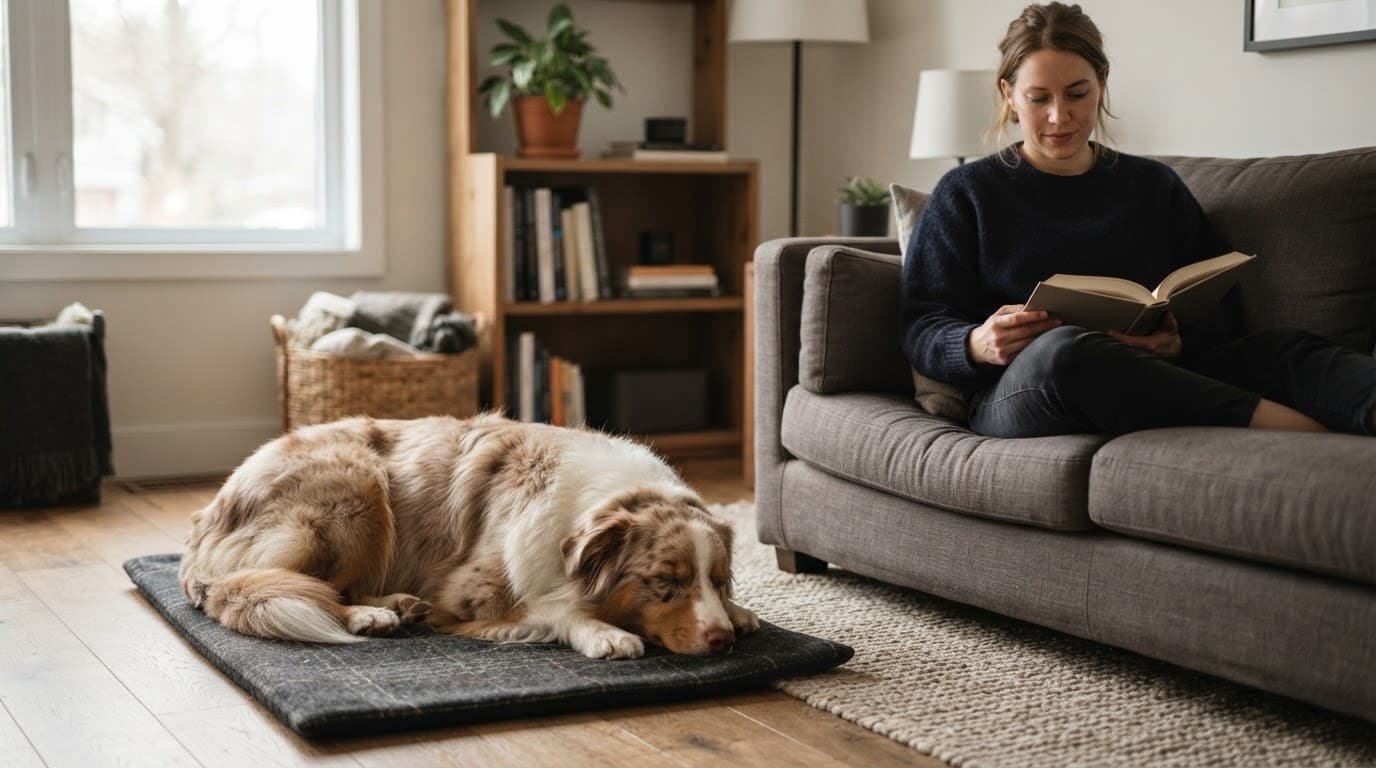
Teach a reliable place cue, such as “mat” or “dog bed.” Reward your dog for going there, relaxing, and staying settled while you move around the room.
Positive reinforcement should focus on calm behavior, not repeated demands for attention.
Start with short periods, then slowly build the time. Calm praise, a safe chew, or an enrichment item can make the space feel rewarding.
Share quiet time, too. Your Aussie doesn’t always need a walk, game, or training challenge. Sometimes the best lesson is resting near you while you read, work, or watch television.
Build Engagement With Recall and Attention Games
Recall and attention games help your dog focus on you without constantly trailing behind you indoors. Call your Aussie from a short distance, reward them generously, then release them to explore again.
This keeps coming to you from feeling like the end of all fun.
Practice hand touches, name responses, short stays, and cheerful recalls around your home or yard.
For more structured ideas, try these recall training methods. The AKC’s reliable recall guidance also recommends high-value rewards during training.
Your goal isn’t a distant dog. You want a confident Australian Shepherd that can be a constant companion at appropriate times, responds when called, and settles independently when nothing is happening.
Helpful Aussie Resources for Daily Training and Care
For a structured breed guide, explore the Australian Shepherd Blueprint or purchase the Australian Shepherd Blueprint directly.
It offers practical support with exercise, enrichment, training, and everyday Aussie care.
Paw-Tastic Guides also offers affordable ebook resources. Check out our great guides on Payhip and Check out our ebook guides on Etsy for practical ideas to use at home.
Frequently Asked Questions
Your Australian Shepherd’s shadowing habit can feel confusing, especially when it changes or becomes difficult to manage. These answers address a few common questions.
Why does my Australian Shepherd follow me to the bathroom?
Your Aussie may follow you to monitor where you go. Herding dogs often track movement, and a closed bathroom door can feel like an unnecessary barrier.
Calm waiting outside is usually harmless. Practice closing the door briefly, then reward your dog for staying relaxed instead of scratching or whining.
Why does my Australian Shepherd follow me at night?
Your dog may feel safer sleeping near you after a routine change, move, or stressful event. An older dog may also seek reassurance after changes in hearing, vision, confidence, or orientation.
Provide a comfortable sleeping area and a predictable bedtime routine. If nighttime following begins suddenly or includes pacing, confusion, pain, or repeated waking, schedule a veterinary exam.
Does my Australian Shepherd follow me because they are protective?
Possibly, but following alone doesn’t prove protective behavior. Your dog may simply be curious, affectionate, or waiting for something interesting.
Protective behavior may include staring at visitors, blocking access, barking, stiff posture, or trouble settling.
Calmly redirect your Aussie to a mat, and seek reward-based help if they become tense or controlling around people.
Will my Australian Shepherd ever stop following me everywhere?
Most Aussies can learn to stay nearby without following every step. The goal isn’t to make your dog distant.
You’re teaching them that relaxing independently is safe and rewarding.
Reward your dog for choosing their mat, staying in another room, or relaxing while you move around. Practice in small steps, and avoid calling them after every movement, since that can reinforce shadowing.
Should I ignore my Australian Shepherd when they follow me?
You don’t need to ignore your dog completely. Instead, avoid giving instant attention whenever they stare, paw, nudge, or trail behind you.
Invite interaction at planned times, then reward calm behavior afterward. If your Aussie panics when you move away or becomes destructive alone, review these separation anxiety training ideas and contact your veterinarian.
Sudden or concerning behavior always deserves professional evaluation.
Check out our fabulous Blueprint guide to find out more about this wonderful breed